
Blog
What Is a Ton of Refrigeration? Tons, BTU and kW of Cooling Made Simple
A ton of refrigeration is 12,000 BTU/h, or 3.517 kW of cooling. Learn what tons, BTU and kW really mean — and why the word kW trips up almost everyone.
 Tan Kok XinCooling Fundamentals
Part 5 of 20 in Cobler's Cooling Fundamentals course. New here? See the course page.
Part 4 finished the list of what a cooling system has to remove: heat, moisture, and the heat and moisture carried in with fresh air. That led to the question this part answers: how do engineers measure an amount of cooling, and why are large machines rated in "tons"?
Look at the label on a wall-mounted air conditioner and you will usually find a number such as 12,000 BTU/h. Ask a contractor about a large chiller and you may hear "that's a 300-ton machine". Nothing about the chiller weighs 300 tons, and it is not lifting anything. A ton of refrigeration is a rate of cooling: 12,000 BTU/h, which is 3.517 kW of heat removed. This part explains where that number comes from, how tons, BTU and kilowatts (kW) fit together, and how to keep the cooling a machine delivers separate from the electricity it uses. You only need the idea from Power vs Energy: The Difference Between kW and kWh that a kilowatt is a rate and a kilowatt-hour is an amount.
What is a ton of refrigeration? A rate of cooling, not a weight
The unit comes from the days before mechanical refrigeration, when food and rooms were cooled with blocks of ice. Engineers needed a way to describe how much cooling a new machine could do, so they compared it with something everyone understood: melting ice.
Take one ton of ice (a US "short ton" of 2,000 pounds, about 907 kg) at its melting temperature. To melt all of it over 24 hours, the ice must take in a fixed amount of heat from its surroundings. A machine that removes heat at that same steady rate is doing one ton of refrigeration, written 1 RT (refrigeration ton).
The important word is rate. A ton of refrigeration is not an amount of cooling kept in storage. It is how fast a machine removes heat, for as long as it runs. A useful comparison is water: the litres stored in your roof tank are an amount, while the litres per minute coming out of a tap are a rate. A ton is like the litres per minute. It tells you how fast heat is being carried away.
BTU is an amount of heat; BTU/h is a rate
To put a number on that rate, we first need a unit for heat. In the old imperial system, the unit is the BTU (British Thermal Unit).
One BTU is the heat needed to warm one pound of water by one degree Fahrenheit. It is a small, fixed amount of heat energy, in the same family as the joule. Heating a pot of water adds BTUs to it. Cooling a room removes BTUs from it.
A BTU on its own says nothing about speed. Removing 100,000 BTU in one minute and removing the same 100,000 BTU over a whole day are very different jobs, although the total heat is the same. So cooling capacity is written as BTU/h: BTUs removed per hour. The "/h" turns an amount into a rate, and it cannot be dropped.
Putting a number on the ton: 12,000 BTU/h
Melting ice takes about 144 BTU for every pound. So for one ton of ice:
- 2,000 lb × 144 BTU/lb = 288,000 BTU to melt the whole ton.
- Spread evenly over 24 hours: 288,000 ÷ 24 = 12,000 BTU/h.
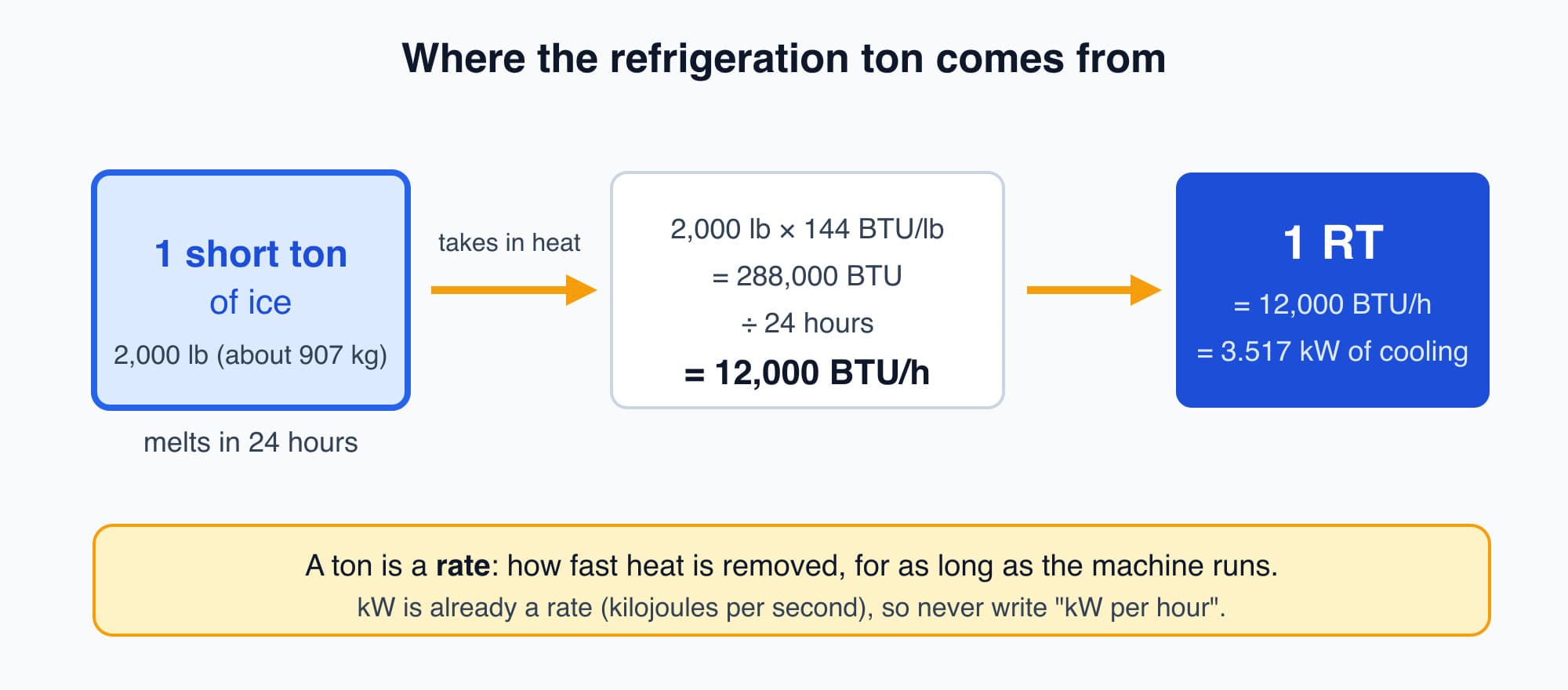
Where the ton comes from: melting one short ton of ice in a day takes heat at 12,000 BTU/h, which is 3.517 kW of cooling.
This is the definition, and you will see it everywhere:
1 ton of refrigeration (RT) = 12,000 BTU/h of cooling.
So a 300-ton chiller can remove 300 × 12,000 = 3,600,000 BTU of heat every hour. A wall unit rated at 24,000 BTU/h is a 2-ton machine (24,000 ÷ 12,000). One is quoted in tons and the other in BTU/h, but they describe the same thing.
Converting to kilowatts: 1 RT = 3.517 kW of cooling
Malaysia uses metric units, and so does your TNB (Tenaga Nasional Berhad) bill. To connect cooling to energy and cost, we convert BTU/h into kilowatts:
1 RT = 12,000 BTU/h = 3.517 kW of cooling.
A kilowatt is already a rate: one kilowatt means one kilojoule of energy every second. So 3.517 kW of cooling means heat is being removed at 3.517 kilojoules every second. There is no need to add "per hour", and adding it would be wrong.
Some everyday sizes:
- A 2-ton wall unit removes heat at about 7 kW.
- A 300-ton chiller removes heat at 300 × 3.517 = 1,055 kW of cooling.
- The office tower has three 500 RT chillers. Each can remove about 1,758 kW of heat. On a hot afternoon, the building's peak cooling load is about 900 RT, or about 3,165 kW.
These are rates of heat removal. They are the numbers you use to check whether a machine is big enough for a space, which is the subject of the next part.
Two kinds of kW: cooling out and electricity in
The 3.517 kW per ton in the previous section is kW of cooling: heat carried away from the building. But a chiller also uses electricity to do that work, and electricity is also measured in kW. These are two different quantities that share the same unit.
In Part 1 we saw that an air conditioner does not make cold. It uses electricity to move heat from indoors to outdoors. Moving heat takes much less energy than the heat itself, so the kW of cooling out is much larger than the kW of electricity in. A good water-cooled chiller might remove about 3.5 kW of heat for every 0.6 kW of electricity its compressor draws.
To keep the two apart, engineers give the input side its own unit: kW per RT (kW/RT), the electrical kilowatts used for each ton of cooling delivered. A chiller at 0.6 kW/RT draws 0.6 kW of electricity for each ton. Lower is better, because the same cooling costs less electricity. Air-cooled machines and small split units usually need more electricity for each ton, often around 1.0 kW/RT.
Two cautions. First, always say which kW you mean: "the chiller is 350 kW" could be either. Second, a figure such as 0.6 kW/RT for one chiller is not the same as a figure for the whole plant, which also includes pumps and cooling tower fans. The office tower measures about 0.95 kW/RT for its whole plant. COP, EER and kW per Ton (Part 13) explains kW/RT, the related coefficient of performance (COP) and the Malaysian star labels properly.
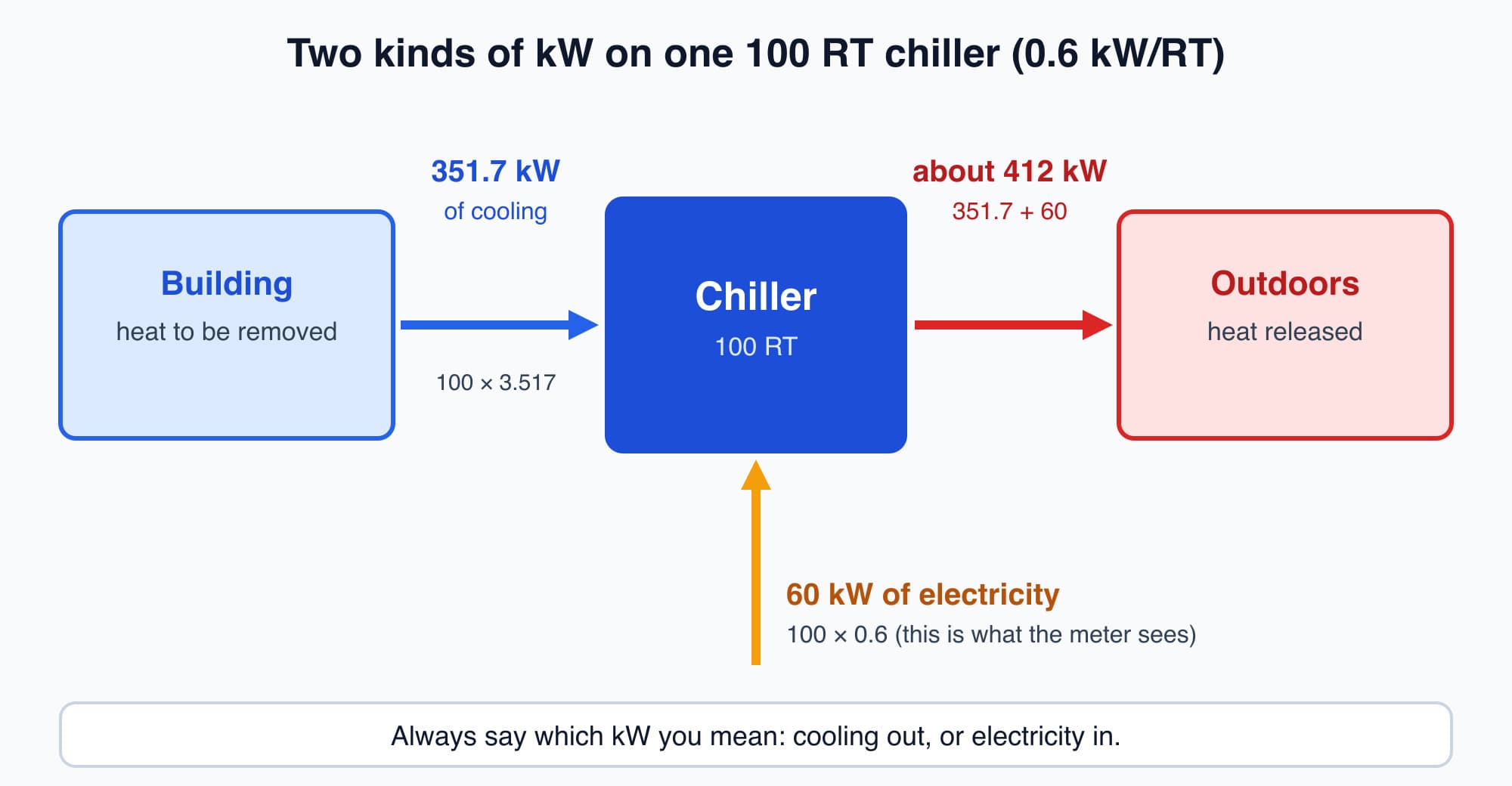
The two kinds of kW for a 100 RT chiller: 351.7 kW of cooling and 60 kW of electricity. Both end up as heat released outdoors.
A worked example from tons to the bill
Suppose a building runs a 100 RT water-cooled chiller measured at 0.6 kW/RT, working at full output.
- Cooling delivered: 100 × 3.517 = 351.7 kW of cooling. This must match the heat the building needs removed.
- Electricity drawn: 100 × 0.6 = 60 kW of electrical power.
- Energy used in one hour at that output: 60 kW × 1 h = 60 kWh. This is what appears on the bill as energy.
- Heat released outdoors: 351.7 + 60 = about 412 kW, because the electricity also ends up as heat (Part 1).
The two kW numbers are on opposite sides of the machine: 351.7 kW of cooling out, 60 kW of electricity in. If someone reports that "a 100-ton chiller uses 351 kW", they have mixed up cooling and electricity, and their figure is almost six times too high. That mistake can carry straight into a budget.
The 60 kW of electrical power can also count on the bill a second time. A large building on a Medium Voltage (MV) supply also pays for its maximum demand, the highest 30-minute average power in kW during the month, so a chiller running in that half-hour adds to it. A small shop on a Low Voltage (LV) supply pays only through its kWh. Part 14 shows what both charges mean in ringgit.
Which unit is used where
In Malaysian building work, each unit has its own job:
- Sizing equipment: tons (RT). Chillers and packaged units are specified and bought in tons, such as a "500 RT plant" or a "5 RT split system".
- Labels on small units: BTU/h. Wall and cassette units are sold as 9,000, 12,000, 18,000 or 24,000 BTU/h. Divide by 12,000 to get tons.
- Cooling in metric: kW of cooling. Engineers use it to compare equipment with a building's heat gain.
- Electricity used: kW (power) and kWh (energy). This is what the meter records and what TNB bills.
Worth knowing: Split units in Malaysian shops and homes are often sold by "horsepower" class, such as 1 HP or 1.5 HP. This is a rough trade label, not the power the unit draws. Read the cooling capacity in BTU/h or kW on the label instead.
Optional detail: For comparison with the bill, 1 kWh is 3.6 MJ (megajoules) of energy: one kilowatt kept up for one hour. Heat and electricity follow the same energy bookkeeping, which is why cooling in kW and electricity in kW can sit side by side in one calculation.
What comes next: how much cooling a building needs
We now have the units: tons, BTU/h and kW of cooling. The next part, How to Calculate a Building's Cooling Load, adds up the heat entering one floor of the office tower and turns the total into tons, to answer the question: how much cooling does a space actually need?
Check your understanding
- A wall unit is labelled 18,000 BTU/h. How many tons is that, and how many kW of cooling? 18,000 ÷ 12,000 = 1.5 RT. In kilowatts, 1.5 × 3.517 is about 5.3 kW of cooling. This is the heat it can remove, not the electricity it draws.
- A 200 RT chiller runs at 0.6 kW/RT. How much electricity does it draw at full output, and how much energy does it use in two hours? 200 × 0.6 = 120 kW of electricity. Over two hours it uses 120 × 2 = 240 kWh. Its cooling output is much larger: 200 × 3.517, about 703 kW of cooling.
Recap: A ton of refrigeration is a rate of cooling, based on melting one short ton of ice in 24 hours. 1 RT = 12,000 BTU/h = 3.517 kW of cooling. A kilowatt is already a rate, so never write "kW per hour". A machine has two different kW figures: the cooling it delivers and the electricity it draws. The electricity figure is much smaller, and kW/RT compares the two. On a Medium Voltage bill, a chiller's electrical kW can add to the maximum demand charge as well as the energy charge.
This is Part 5 of 20 in Cobler's Cooling Fundamentals course. Previous: Indoor Air Quality in Offices: Fresh Air, Filters and What CO2 Really Tells You. Next: How to Calculate a Building's Cooling Load: Where Heat Sneaks In.
Cobler builds CobiNeural, a platform that shows a facility team its building's energy, water and indoor air data as live numbers across the whole site. To see how your building performs, talk to us.
FAQ
Frequently asked questions
Ask us about this topic
Something in this article you want to dig into — or a situation in your own building it doesn't quite cover? Send us your question. We don't run public comments; the team replies to you directly by email.