
Blog
Why Air Conditioning Is the Biggest Line on a Malaysian Building's Electricity Bill
In a Malaysian building, cooling is often over half the electricity bill. Follow the ringgit to see why the chiller wins over lights, lifts and plug loads.
 Tan Kok XinCooling Fundamentals
Part 14 of 20 in Cobler's Cooling Fundamentals course. New here? See the course page.
Part 13 gave us a way to grade a cooling plant. The next question is what that electricity costs: how large is cooling's share of a Malaysian building's electricity bill? In an air-conditioned Malaysian office, the answer is most of it. As a typical range, air conditioning takes roughly 40 to 60% of the building's electricity, and lighting, lifts, computers, signage and everything else share the rest.
The exact share depends on how the building is used, how many hours it runs and how much IT or process load it carries. In this part we look at why cooling takes such a large share, how it shows up on the two main parts of a TNB (Tenaga Nasional Berhad) bill, and which changes are worth trying first.
Cooling is the biggest load in the building
In the office tower, the chiller plant alone (chillers, pumps and cooling towers) uses about 35% of the building's electricity. The air handling unit fans and lobby fan coil units that move the cooled air add about another 10%, so air conditioning as a whole is about 45%. In the shoplot, with split units and cassettes and a café on the ground floor, air conditioning is about 45% of its electricity.
Why is cooling so large? In this climate it is the one load you cannot switch off and still use the building. You can dim lights, put computers to sleep and take the stairs. But if you stop removing heat and moisture from an occupied room, the room becomes unusable within an hour or so. Cooling runs whenever the building is open, and often a little before and after.
Humidity adds a second job
As Part 3 explained, cooling has two jobs: lowering the air temperature (sensible load) and removing moisture (latent load). In a dry climate the air arrives with little moisture, so the latent load is small. In Malaysia it is large and continuous, and it is a big reason cooling's share of the bill is higher here than it would be for the same building in a temperate city.
No cool season means no rest
Malaysia has no heating season and no mild months when the cooling plant can coast. Chillers and aircon units run year-round, with no seasonal shutdown. A building in a four-season country can leave much of its cooling plant idle for months. Here, the compressors work every operating day of the year. When a building is empty, the usual energy-saving step is to let the cooling setpoint drift up so the plant works less hard.
Put the three facts so far together: a large load, with a heavy humidity component, running all twelve months. That is why cooling takes the biggest share of the annual bill.
A small gain on cooling beats a big gain elsewhere
Because cooling is such a large share, a modest percentage improvement in cooling saves more energy than a large improvement on a smaller load.
Suppose cooling is 55% of your bill and lighting is 12%:
- Improve cooling by 10%: you cut 10% of 55% = 5.5 percentage points off the total bill.
- Improve lighting by 30%: you cut 30% of 12% = 3.6 percentage points off the total bill.
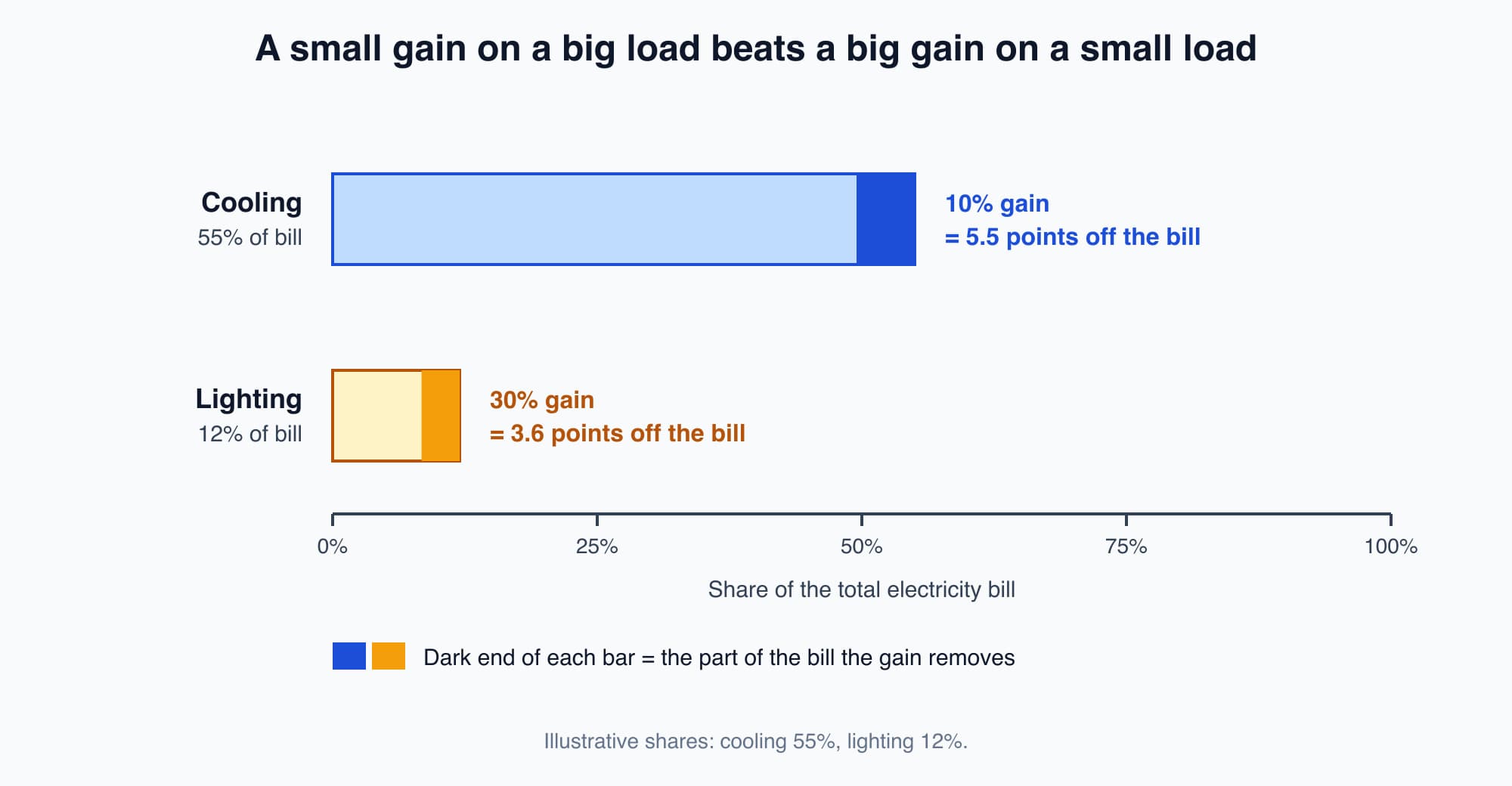
A 10% gain on a 55% share saves more than a 30% gain on a 12% share, because the percentage acts on a bigger base.
The much larger gain on lighting still saves less, because it acts on a smaller base. This is not an argument against efficient lighting, which is usually cheap and easy. It is an argument about order. When time and budget are limited, look at the largest load first.
Part 13's kW per ton puts a number on a cooling gain. The office tower's plant runs at a measured 0.95 kW/RT against a design target of 0.85 kW/RT. The plant uses about 35% of 500,000 kWh a month, which is 175,000 kWh. Reaching the target would cut plant electricity by (0.95 − 0.85) ÷ 0.95, about 10.5%, or roughly 18,400 kWh a month for the same cooling.
The next section uses both kilowatts (kW, the rate at which you use energy) and kilowatt-hours (kWh, the total energy used). If the difference is unclear, read power vs energy: kW and kWh explained first.
The bill has an energy part and a demand part
A non-domestic TNB bill has several lines. Two of them depend on how you use electricity, and cooling affects both. The full bill is explained in Your TNB Bill, Line by Line, part of our Understanding Your Electricity Bill course. This section keeps to the figures you need for cooling.
- Energy (kWh): the total electricity used in the month. Under RP4 (the TNB tariff structure in force since July 2025), this is charged per kWh on every non-domestic tariff.
- Maximum demand (kW): the highest metered 30-minute average power drawn in the month. For how the meter records it, see how electricity meters work.
Whether maximum demand costs you money depends on your tariff:
- Medium-voltage (MV) tariffs charge a capacity charge and a network charge for each kW of maximum demand. On MV non-domestic General, these are RM29.43/kW and RM59.84/kW, RM89.27/kW together, and the highest half hour counts at any hour of any day. On MV non-domestic ToU (time of use), they are RM30.19/kW and RM66.87/kW, RM97.06/kW together, but only demand inside the 2pm to 10pm, Monday to Friday peak window is charged.
- Low-voltage (LV) tariffs have no per-kW demand charge. They charge capacity and network per kWh instead (8.83 sen/kWh and 14.82 sen/kWh on LV non-domestic General). A small shop or shoplot on LV pays for cooling through its kWh only.
The office tower is on MV General. In September 2026 its maximum demand was 1,600 kW, so its capacity and network charges were 1,600 × RM89.27 = RM142,832. Each kilowatt of avoidable peak costs RM89.27 a month on this tariff.
When cooling sets the peak
Cooling often sets the month's maximum demand, because the chillers are the largest load and they work hardest at the same times of day as everything else.
The office tower's maximum demand is usually set on a hot weekday afternoon, between 2:30pm and 3:00pm, when the chillers are close to full load. If the plant reached its 0.85 kW/RT target, it would draw up to about 90 kW less at its roughly 900 RT afternoon peak (900 × 0.95 = 855 kW, against 900 × 0.85 = 765 kW). On MV General that could be worth up to about 90 × RM89.27, roughly RM8,000 a month, but only if the peak half hour falls by the same amount.
Another common peak is the morning start. After a warm weekend, the building has soaked up heat. On Monday morning several chillers, pumps and air handlers start together to bring the space down to setpoint, and the plant draws hard for a short time. How much this matters depends on the tariff:
- On MV General, a Monday-morning spike can set the month's maximum demand, because demand counts at any hour. Staggering equipment starts is worth checking.
- On MV ToU, a spike at, say, 8am is outside the 2pm to 10pm window and is not charged as demand. The peak that matters is in the afternoon and evening.
- On an LV tariff, there is no demand charge, so the spike does not change the bill directly. Only the kWh used counts.
To estimate what your own peak costs, the maximum demand calculator gives a rough figure. Treat it as a first estimate, not a diagnosis.
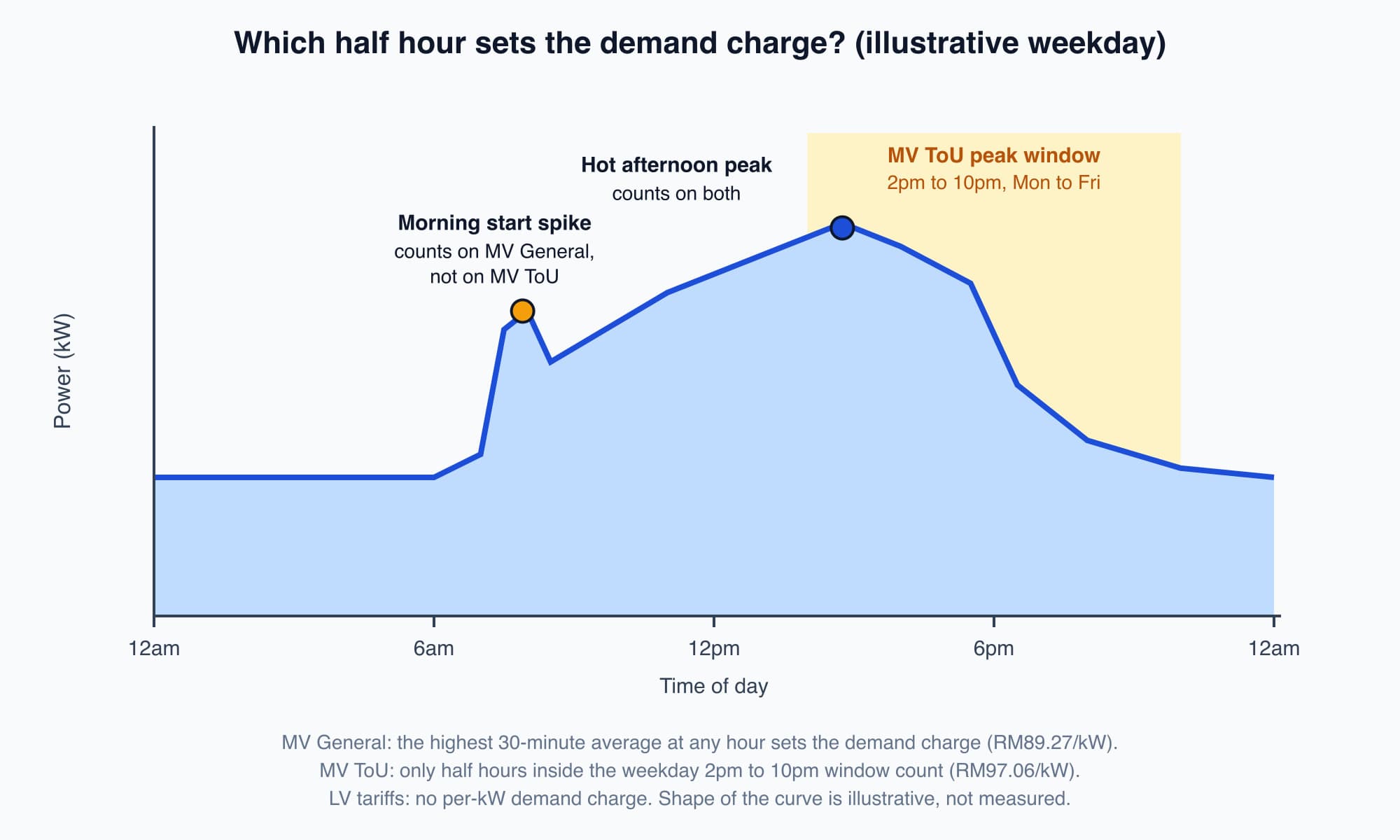
Which half hour sets the demand charge depends on the tariff: any half hour on MV General, only the weekday 2pm to 10pm window on MV ToU.
The free experiment, the setpoint
The cheapest change in the building is the number on the thermostat.
As a rule of thumb, each 1 °C you raise the cooling setpoint saves a few percent of cooling energy. A warmer target means the plant removes less heat, and the temperature difference it works against is smaller, so the compressors run less.
That is why the usual guidance is to aim for about 24 °C in occupied spaces, not 20 °C. At 20 °C people reach for jackets indoors while the plant uses extra electricity to keep them cold. At 24 °C most people are comfortable in normal office clothes. The change costs nothing, takes seconds and can be reversed if people complain.
For the shoplot, this is also the main lever. Its air conditioning uses about 45% of 8,000 kWh, or 3,600 kWh a month. On LV General every kWh costs 27.03 sen (energy) + 8.83 sen (capacity) + 14.82 sen (network) + 3.67 sen (AFA, the Automatic Fuel Adjustment for September 2026) = 54.35 sen. So its air conditioning costs about 3,600 × 54.35 sen, roughly RM1,960 a month, and each percent saved is worth about RM20 a month.
Worth knowing: The water dripping from a fan coil drain pan, or from a split unit's drain pipe, is moisture the system has removed from the air, and condensing it took electricity. In Malaysia that moisture load never stops, which is part of why cooling takes such a large share of the bill.
Optional detail: Some plants use thermal energy storage, sometimes called peak shaving. They make chilled water or ice overnight, store it in an insulated tank and use it during the day, so fewer chillers run in the expensive hours. On MV ToU this lowers demand in the peak window and moves kWh to the cheaper off-peak energy rate (27.23 sen/kWh against 31.32 sen/kWh peak). On MV General, where the energy rate is the same at any hour, the benefit comes mainly from a lower maximum demand. Storage needs space and careful design, and this course does not cover it further.
What comes next
Cooling is the largest line on the bill, and kW per ton is how we grade the plant that causes it. But a chiller's nameplate kW per ton is measured at full load, and a chiller rarely runs at full load. Part 15 explains part-load efficiency and IPLV, the figure that reflects how chillers really run. It answers the question: if full load is rare, what is a chiller's efficiency the rest of the time?
Check your understanding
- Cooling is 50% of a bill and lighting is 10%. Which saves more: a 10% gain on cooling or a 40% gain on lighting? The cooling gain: 10% of 50% is 5 percentage points of the bill. The lighting gain is 40% of 10%, which is 4 percentage points.
- Your chillers start together at 7:30am every Monday and set a high spike. Does it raise your demand charge? It depends on the tariff. On MV General, yes, if it is the highest half hour of the month, because demand counts at any hour. On MV ToU, no, because only demand between 2pm and 10pm on weekdays is charged. On an LV tariff there is no per-kW demand charge at all.
Recap: In an air-conditioned Malaysian building, cooling typically takes roughly 40 to 60% of the electricity, driven by a humidity load and a climate with no cool season. Because it is the largest load, a modest cooling gain beats a large gain on a small load. Cooling affects both the kWh on the bill and, on MV tariffs, the capacity and network charges set by the highest 30-minute demand (RM89.27/kW on MV General at any hour; RM97.06/kW on MV ToU in the weekday 2pm to 10pm window). LV tariffs charge these per kWh instead. Raising the setpoint towards 24 °C is the cheapest first step.
Go deeper on video (optional)
This video shows how a building's chillers, air handling units and rooftop units work together, which is why central cooling is the largest electrical load. It does not cover TNB tariffs. You do not need it for the next part.
The Engineering Mindset walks through how a building's chiller, air handling units and rooftop units work together to cool the whole building, showing why central cooling is the largest electrical load.
This is Part 14 of 20 in Cobler's Cooling Fundamentals course. Previous: COP, EER and kW per Ton: How to Read Chiller and Aircon Efficiency Numbers. Next: Why Chiller Efficiency Is Measured at Part Load: Understanding IPLV.
Cobler builds CobiNeural, a platform that shows a facility team its building's energy, water and indoor air data as live numbers across the whole site. To see how your building performs, talk to us.
FAQ
Frequently asked questions
Ask us about this topic
Something in this article you want to dig into — or a situation in your own building it doesn't quite cover? Send us your question. We don't run public comments; the team replies to you directly by email.