
Blog
COP, EER and kW per Ton: How to Read Chiller and Aircon Efficiency Numbers
COP, EER, CSPF and kW/ton all grade one thing: cooling delivered per unit of electricity. Learn to read each one and honestly grade your own chiller plant.
 Tan Kok XinCooling Fundamentals
Part 13 of 20 in Cobler's Cooling Fundamentals course. New here? See the course page.
Part 12 finished following the heat from the rooms to the roof, and every stage on the way used electricity. That raises the question this part answers: how much electricity does a plant use for each unit of cooling it delivers, and how do you judge whether that is good?
Picture two identical offices side by side, both held at 24 °C on a hot afternoon. They feel exactly the same, but one building's cooling may use far more electricity than the other's to deliver that comfort. You cannot feel the difference and the thermostat will not show it. The only fair way to compare two cooling machines is a number that divides the cooling delivered by the electricity used. This part explains the four versions of that number you will meet: COP, EER, CSPF and kW per ton. By the end you will be able to convert between them and grade a split unit or a chiller plant.
Cooling out divided by electricity in
Every efficiency number in this part answers one question: how much cooling does this machine deliver for each unit of electricity it uses?
A good chiller delivers five or six units of cooling for every unit of electricity. That can look impossible if you think of efficiency as "output can never be more than input". An electric heater, for example, turns 1 kW of electricity into 1 kW of heat and can go no higher.
A cooling machine is different because it does not turn electricity into cold. As Part 1 explained, it moves heat out of the building. The electricity runs the compressor, fans and pumps that do the moving. The heat that is moved is not made from the electricity, so there is no rule that says it must be smaller. Moving heat out of the building takes less energy than the amount of heat moved, which is why a ratio of 5 or 6 is normal and breaks no law of physics.
COP, the plain ratio (higher is better)
The simplest measure is the coefficient of performance (COP):
$$\text{COP} = \frac{\text{cooling output}}{\text{electrical input}}$$
Both quantities are in the same unit, kilowatts of cooling over kilowatts of electricity, so COP is a plain number with no unit. It means the same thing in every country.
- A COP of 3 means 3 kW of heat moved for every 1 kW of electricity.
- Higher is better.
- A small split air conditioner typically sits around COP 2.3 to 3.5.
- A large, well-run water-cooled chiller reaches COP 5 to 6 or better.
Chillers do better than small units mainly because they reject heat through water and a cooling tower, which can cool the condenser closer to the outdoor wet-bulb temperature. A small outdoor unit has to reject its heat into the hotter outdoor air. Part 8 compared air-cooled and water-cooled plant, and Part 12 explained how the tower does it.
EER, the same idea in mixed units
The energy efficiency ratio (EER) measures the same thing, cooling out over electricity in, but in mixed units. It divides cooling in BTU per hour (British thermal units per hour, an imperial unit of heat flow) by electrical input in watts.
Because of the mixed units, EER gives numbers such as 10 or 12, and you cannot read it as a plain multiple the way you can read COP. One watt equals about 3.412 BTU per hour, so the two convert like this:
$$\text{COP} \approx \frac{\text{EER}}{3.412}$$
An EER of 12 is therefore about COP 3.5. EER is also a snapshot: it is measured at one fixed test condition, with one outdoor temperature and one load. Real weather changes all day, which is why seasonal ratings exist.
CSPF and the star label, for buying a split unit
A single snapshot can flatter a machine, because efficiency changes with the outdoor temperature and with how hard the unit is working. A seasonal rating averages efficiency across a realistic spread of conditions, so it better reflects a full cooling season.
In other countries you will see SEER (seasonal energy efficiency ratio) for this. On the energy label of a split unit sold in Malaysia you will not see SEER. Suruhanjaya Tenaga (the Energy Commission) runs the Minimum Energy Performance Standards (MEPS) scheme, and its label shows:
- a star rating, up to 5 stars (more stars means more efficient), and
- a CSPF figure, the cooling seasonal performance factor: cooling delivered across a season divided by the electricity used, based on a warm, cooling-only climate like ours.
When you compare split units for a shop, office or home, use the 5-star MEPS label and its CSPF, not a SEER figure from an imported catalogue. COP and EER help you understand the physics; stars and CSPF are what to compare when buying the unit.
kW per ton, the chiller engineer's number (lower is better)
In a plant room, engineers rarely say "COP". They say kW per ton (kilowatts per refrigeration ton), written kW/RT in this course. You will also see it written kW/ton, as in the formula below. It turns the ratio upside down:
$$\text{kW/ton} = \frac{\text{electrical kilowatts drawn}}{\text{tons of cooling delivered}}$$
Electricity used is on top and cooling delivered is on the bottom, the opposite of COP. So:
- For kW/RT, lower is better. Fewer kilowatts of electricity for each ton of cooling is the goal.
- A useful comparison is a car's fuel use in litres per 100 km: a smaller number means you use less fuel for the same distance. In the same way, a smaller kW/RT means less electricity for the same cooling.
Part 5 defined the refrigeration ton: 1 RT = 3.517 kW of cooling. That one fact links kW/RT and COP exactly:
$$\text{COP} = \frac{3.517}{\text{kW per ton}}$$
Here is what that gives for some common values:
kW per ton (kW/RT) | COP |
|---|---|
0.50 | about 7.0 |
0.59 | about 6.0 |
0.80 | about 4.4 |
0.95 | about 3.7 |
1.00 | about 3.5 |
A higher COP and a lower kW/RT both mean the same thing: better.
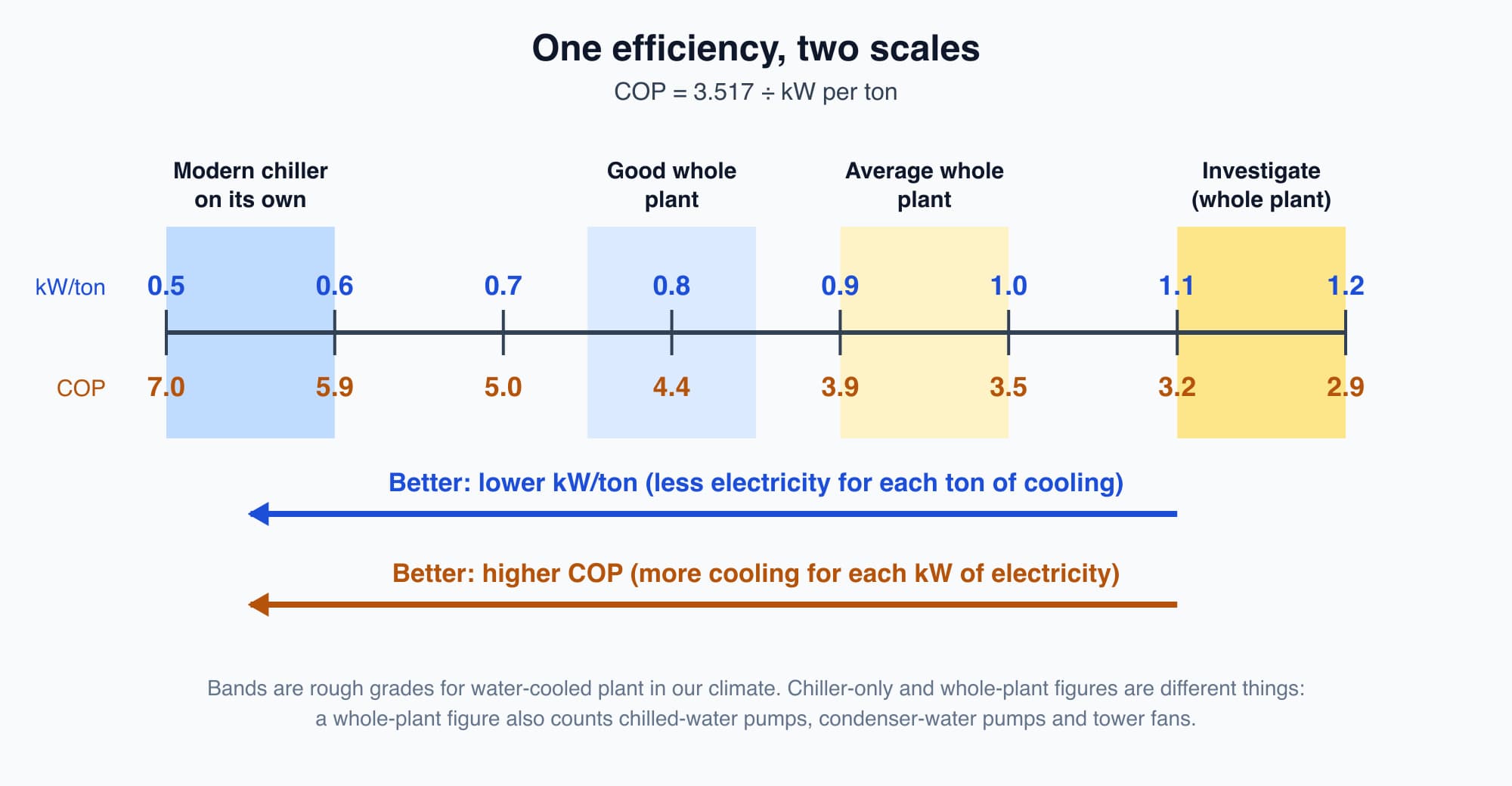
The same efficiency on two scales: kW per ton falls as COP rises, using COP = 3.517 ÷ kW per ton.
What the "kW" counts, and what power factor does not change
The kW in kW/RT is real power, the same kW that the meter records and TNB (Tenaga Nasional Berhad) bills. Power vs energy: kW and kWh explains the difference between that rate and the kWh you use over time.
Chiller compressors, pumps and fans are driven by motors. A motor's current is not perfectly in step with the voltage, so its power factor is below 1. A low power factor raises the current and the kVA the supply must carry, but it does not raise the real kW the motor uses to do its work. The kW, kVA and kVAR power triangle explains why.
So a low power factor does not make your kW/RT worse, and correcting power factor does not make it better in any noticeable way. To improve kW/RT, the plant has to move the same heat with less real power: cleaner heat exchangers, better water temperatures, better control. (A low power factor can still cost money through a separate TNB surcharge. That is an electrical supply issue, not a cooling efficiency one.)
Chiller alone or the whole plant?
The most common mistake with these numbers is mixing up the chiller with the plant.
A chiller's nameplate might say 0.55 kW/RT. That counts only the electricity used by the chiller itself, mostly its compressor. But a complete water-cooled plant also runs:
- chilled-water pumps, which push cold water to the air handlers,
- condenser-water pumps, which push warm water to the cooling towers,
- cooling-tower fans, and
- other smaller auxiliaries.
Add those in, and a plant whose chiller alone reads 0.55 kW/RT might run at 0.75 to 0.85 kW/RT as a whole plant. The whole-plant figure is the one that matters for the electricity bill, because you pay for every one of those motors, not just the compressor. When you quote or compare a figure, always say which one it is.
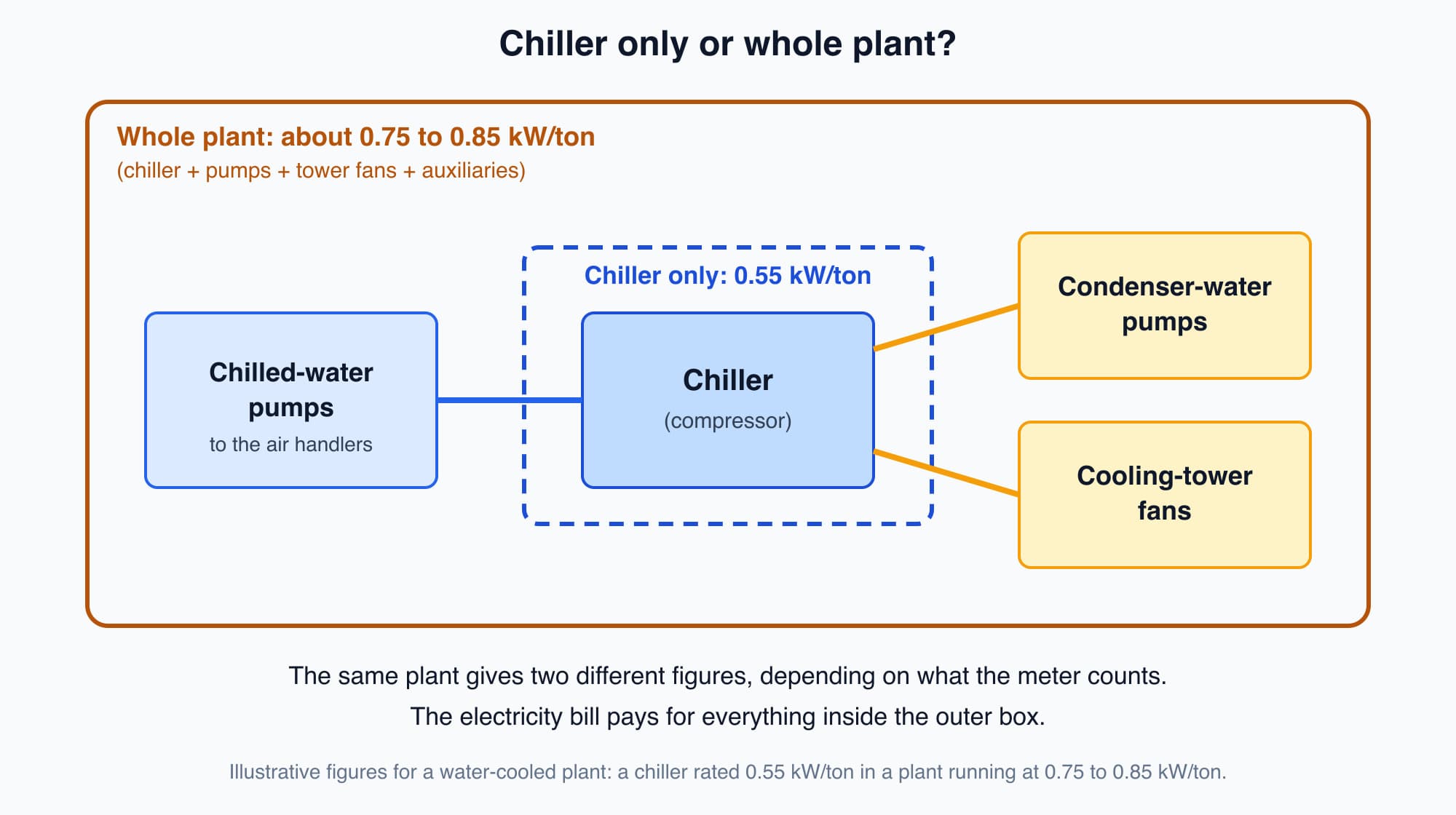
A chiller-only figure counts one machine; a whole-plant figure also counts the pumps and tower fans that the bill pays for.
Grading a plant, with the office tower
Here are rough grades for a water-cooled chiller plant in our climate. Keep the two kinds of figure apart:
- A modern chiller on its own can run near 0.5 to 0.6 kW/RT (COP about 5.9 to 7.0) at its rated conditions.
- A good whole plant built around such a chiller typically lands around 0.75 to 0.85 kW/RT (COP about 4.1 to 4.7).
- An average whole plant, typical of older or loosely tuned systems, sits around 0.9 to 1.0 kW/RT (COP about 3.5 to 3.9).
- A whole plant above about 1.1 kW/RT (COP below about 3.2) is using a lot more electricity than it should. Investigate it.
The office tower has a design target of 0.85 kW/RT for the whole plant. Its measured figure is 0.95 kW/RT, which is COP 3.517 ÷ 0.95, about 3.7. That puts it in the "average" band, with room to improve. At its peak cooling load of about 900 RT, 0.95 kW/RT means the plant draws about 900 × 0.95 = 855 kW. At the design target it would draw about 765 kW for the same cooling.
Air-cooled plant and small split units sit higher on the kW/RT scale because they lack the cooling tower. For the shoplot, with its split units and cassettes, a unit around COP 3 to 3.5 is respectable for its type. If you look after a building like the shoplot, the star label and CSPF described earlier are the numbers to use. The whole-plant grades in this section apply to chilled-water buildings.
The nameplate is a best case
Every efficiency figure printed for a machine, whether COP, EER, CSPF stars or kW/RT, is measured in a test lab under set conditions: a stated load, clean coils, set water or air temperatures and new components. Your plant on a humid afternoon, with fouled tubes, chillers running at part load and pumps running at full speed whatever the demand, will usually do worse.
So the nameplate tells you what the machine achieved in the test, not what it achieves every day in your building. The only way to know your plant's real kW/RT is to measure the electricity going in and the cooling coming out, and to follow that figure over months. Part 16 shows how to measure both.
Worth knowing: If a table calls 0.5 kW/RT "excellent" and then praises COP 4.4 as top-tier, the two scales have been mixed up. 0.5 kW/RT is COP 7, while COP 4.4 is 0.80 kW/RT. Converting with COP = 3.517 ÷ kW per ton catches this kind of error.
Optional detail: For a sense of how far chillers have come, 1970s-era equipment sat closer to 0.9 kW/RT for the chiller alone, where a modern chiller runs near 0.5 to 0.6 kW/RT at its rated conditions.
What comes next
You can now read any efficiency figure and say whether it is good. The next question is what those figures cost. Part 14 looks at how cooling affects both the energy (kWh) and the demand (kW) lines on the bill, and starts with the question: how large is cooling's share of a Malaysian building's electricity bill?
Check your understanding
- A chiller is rated at 0.70 kW/RT. What is its COP, and is a higher or lower kW/RT better? COP = 3.517 ÷ 0.70, which is about 5.0. For kW/RT, lower is better, because electricity used is on top of the ratio. For COP, higher is better.
- A contractor says your chiller is "0.55 kW/RT", but the plant sub-meter shows the plant using about 0.85 kW for every ton of cooling. Who is wrong? Possibly neither. The 0.55 is probably a chiller-only figure at test conditions. The 0.85 is a whole-plant figure that includes the chilled-water pumps, condenser-water pumps and tower fans. The whole-plant figure is the one your bill follows.
Recap: COP, EER, CSPF and kW/RT all measure cooling delivered per unit of electricity. COP is a plain ratio (higher is better). EER is the same idea in mixed units at one test condition (COP ≈ EER ÷ 3.412). CSPF and the Suruhanjaya Tenaga star rating are the seasonal figures to use when buying a split unit in Malaysia. kW/RT puts electricity on top (lower is better) and converts with COP = 3.517 ÷ kW per ton. The kW is real power, so power factor does not change it. Always say whether a figure is chiller-only or whole-plant, and remember that nameplate figures are best cases.
Go deeper on video (optional)
This video goes through COP, kW/RT and EER side by side for a chiller plant. It may use US units in places; the conversions in the EER and kW-per-ton sections still apply. You do not need it for the next part.
The Engineering Mindset walks through COP, kW/Ton and EER side by side, showing how each number grades a chiller plant's cooling-per-kilowatt.
This is Part 13 of 20 in Cobler's Cooling Fundamentals course. Previous: How Does a Cooling Tower Work? Throwing a Building's Heat at the Sky. Next: Why Air Conditioning Is the Biggest Line on a Malaysian Building's Electricity Bill.
Cobler builds CobiNeural, a platform that shows a facility team its building's energy, water and indoor air data as live numbers across the whole site. To see how your building performs, talk to us.
FAQ
Frequently asked questions
Ask us about this topic
Something in this article you want to dig into — or a situation in your own building it doesn't quite cover? Send us your question. We don't run public comments; the team replies to you directly by email.