
Blog
AHU vs FCU: The Difference Between an Air Handling Unit and a Fan Coil Unit
AHU vs FCU difference, explained in plain terms: one big unit ventilates a whole zone with fresh outdoor air, one small unit trims cooling in a single room.
 Tan Kok XinCooling Fundamentals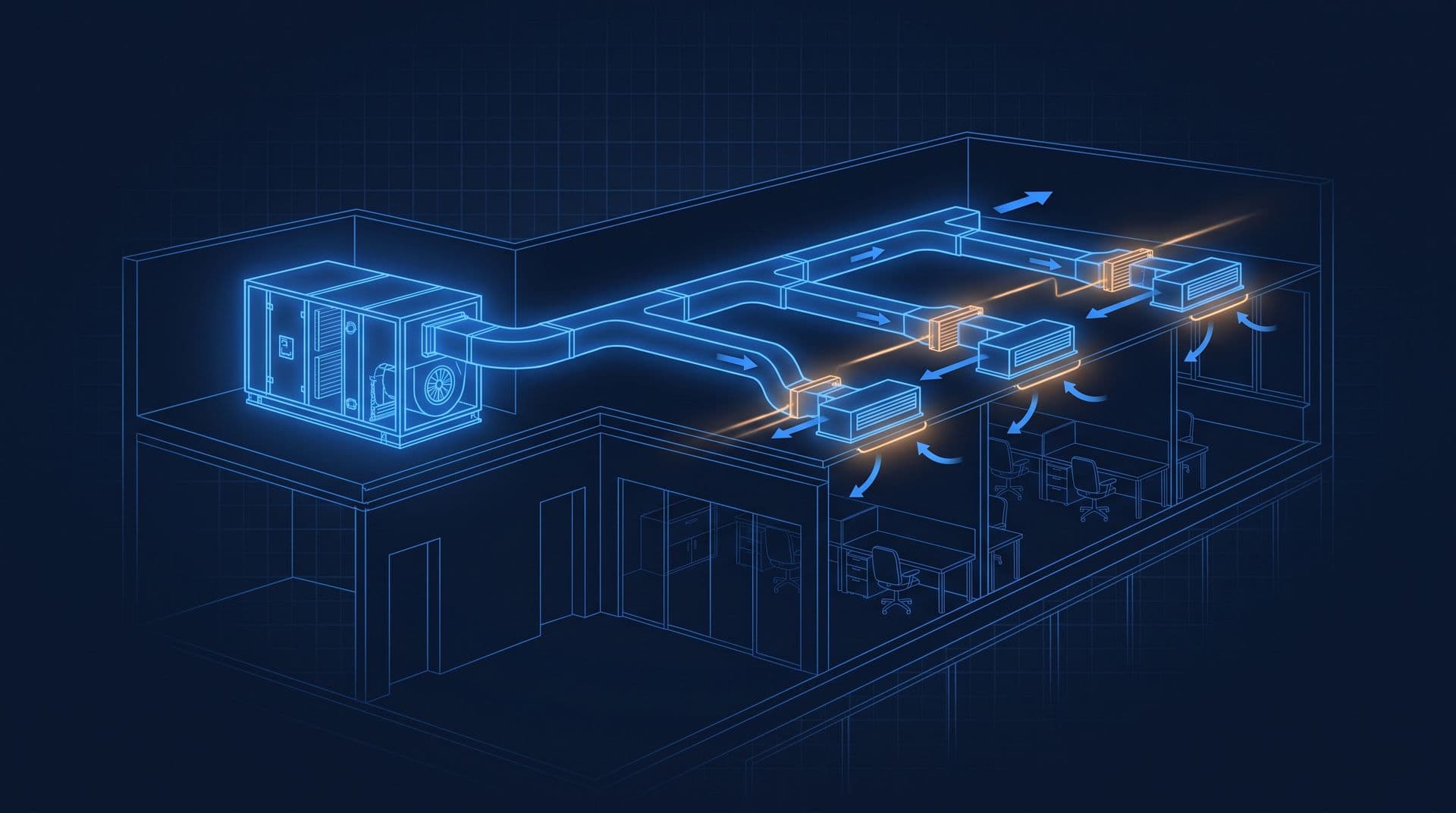
Part 10 of 20 in Cobler's Cooling Fundamentals course. New here? See the course page.
Part 9 got the chilled water to the cooling coils, in the amount each one asks for. Those coils sit inside the machines that actually push cool air towards you: a fan blowing air across a cold coil, which in a chilled-water building comes in two common versions, the air handling unit (AHU) and the fan coil unit (FCU). So what is the difference between an AHU and an FCU?
The AHU vs FCU difference comes down to size and job. An AHU serves a whole zone, such as an office floor, and brings in, filters and dries fresh outdoor air. An FCU serves a single room and mostly recirculates that room's own air. This part explains both, and shows how knowing which is which helps you find the cause of a comfort complaint.
If your building uses split units or cassettes, like the shoplot, each indoor unit is also a fan and a coil, but its coil is cooled by refrigerant rather than chilled water. You can read this part quickly; the fresh-air point in the sections on the AHU and on complaints applies to you too, because split units and cassettes recirculate room air in the same way an FCU does.
Both units are a fan and a chilled-water coil
The chilled water arrives at each coil at about 6 °C in the office tower. A coil is a heat exchanger: copper tubes carrying the chilled water, with thin aluminium fins packed around them, much like a car radiator.
A coil on its own does very little. Cold water sitting in a pipe will not cool a room, because the air has to pass over the fins to give up its heat. So a fan is placed next to the coil. The fan pulls warm air across the cold fins, the air gives its heat to the water, and cooler air comes out the other side. The water, now a few degrees warmer, flows back to the chiller.
That pair, a fan and a coil, is the heart of both the AHU and the FCU. The fan is driven by an electric motor, the same kind explained in our Electricity Fundamentals course (how electric motors work). In a large unit, that motor is a sizeable electrical load in its own right.
If both units are a fan and a coil fed from the same chilled-water loop, what makes them different? Size, and the job each one is given.
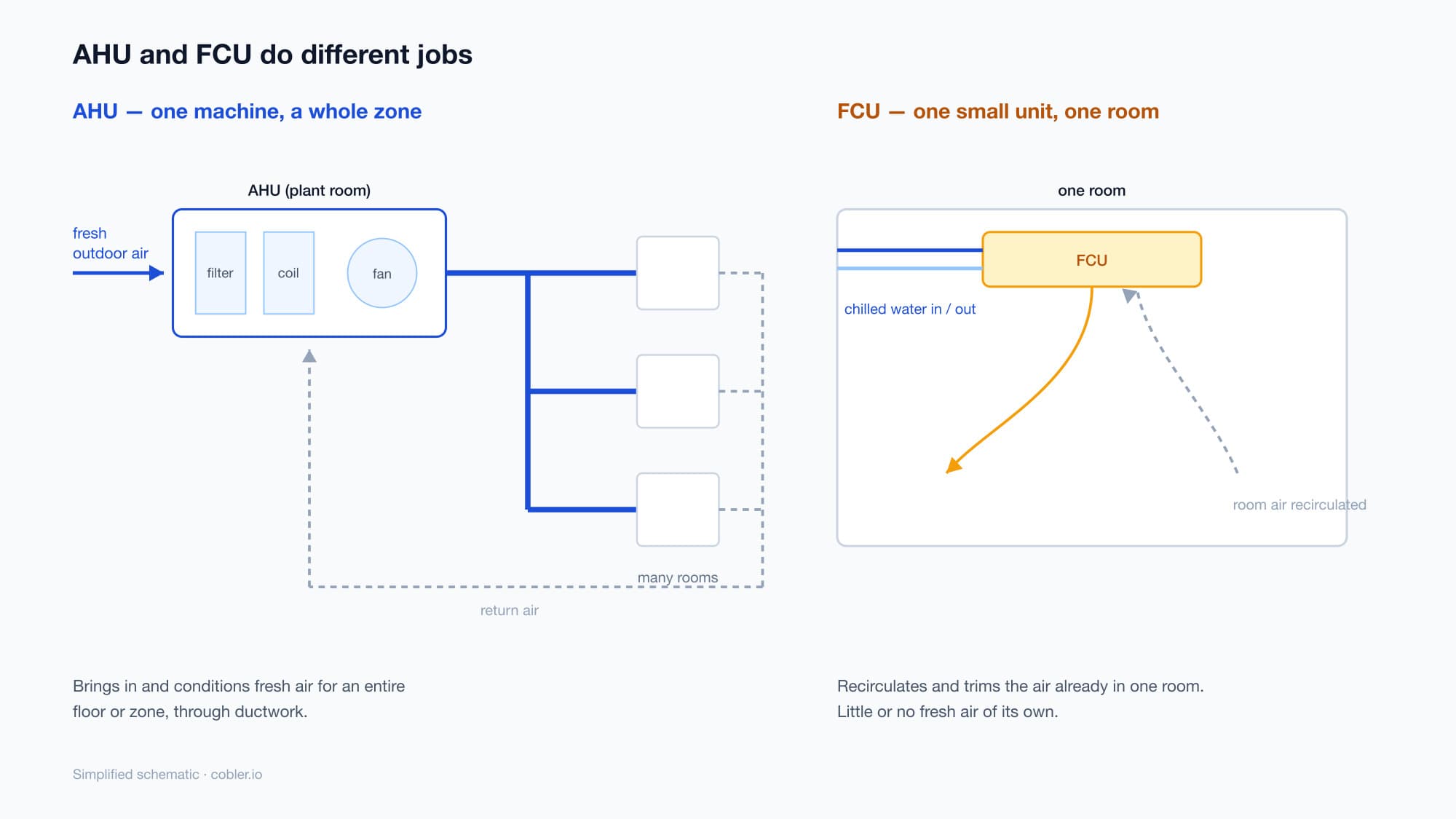
The split in one picture: the AHU feeds a whole zone with conditioned fresh air; the FCU trims one room by recirculating it.
The FCU is a small unit that cools one room
FCU stands for fan coil unit, and the name describes it: a fan and a coil in a small box, with little else.
An FCU serves a single room or small area: a hotel guestroom, a meeting room, a corner office or a small shop. It is usually hidden above the ceiling or in a bulkhead, and sometimes mounted on a wall. It is roughly the size of a large suitcase.
An FCU mostly recirculates the air already in the room. It draws in the room's warm air, blows it across its coil and returns the cooled air to the same room. The same air goes round again and again until the room reaches its setpoint, the temperature someone has asked for.
Because an FCU handles only one room's air, it is small and inexpensive, and a building can have one per room, each with its own thermostat. Hotels use them for this reason: each guest can set their own room temperature.
What an FCU typically does not do:
- It brings in little or no fresh outdoor air. On its own, it keeps cooling the same room air.
- Its filter is basic. Usually a thin, coarse filter that keeps dust and lint off the coil, not one that cleans the air to a high standard.
- It does not treat the humid outdoor air. Some moisture from the room air condenses on its cold coil and drains away, but an FCU does not deal with the moisture that fresh outdoor air brings in.
In short, an FCU controls the temperature of one room. Ventilation, meaning the supply of fresh outdoor air, has to come from somewhere else.
The AHU is a large unit that treats fresh air for a whole zone
AHU stands for air handling unit. Where an FCU is the size of a suitcase, an AHU is the size of a small room: a walk-in metal cabinet, usually in its own plant room (often called the AHU room) on each floor, or on the roof.
An AHU serves a whole zone, such as an office floor, a mall concourse or a large open-plan area. It moves a large volume of air and connects to the space through ductwork: sheet-metal channels above the ceiling that carry cool air out to grilles across the floor and bring return air back. In the office tower, each floor has two AHUs, one for each half of the floor. The one on level 12, east side, is called AHU-12A, and we will meet it again in later parts.
The most important difference is that the AHU is where fresh outdoor air enters the building. Inside a typical AHU, the air passes through four stages in order:
- A mixing section. The AHU draws in warm, humid fresh air from outside and mixes it with return air coming back from the floor. The fresh-air share is what stops carbon dioxide (CO2) and other indoor pollutants from building up in a sealed building. Part 4 explains why.
- Filters. Because it handles outdoor air carrying dust and fine particles, an AHU has proper filtration, often in several stages from coarse pre-filters to fine filters. This is well beyond the thin screen in an FCU.
- The chilled-water coil. The same idea as the FCU's coil, but much larger. The mixed air is cooled and dried. Malaysia's outdoor air carries a lot of moisture, and as it passes over the cold coil, water vapour condenses on the fins and drains away. Part 3 explains why a coil below the dew point removes moisture.
- A large fan, which pushes the conditioned air through the ducts to the whole zone.
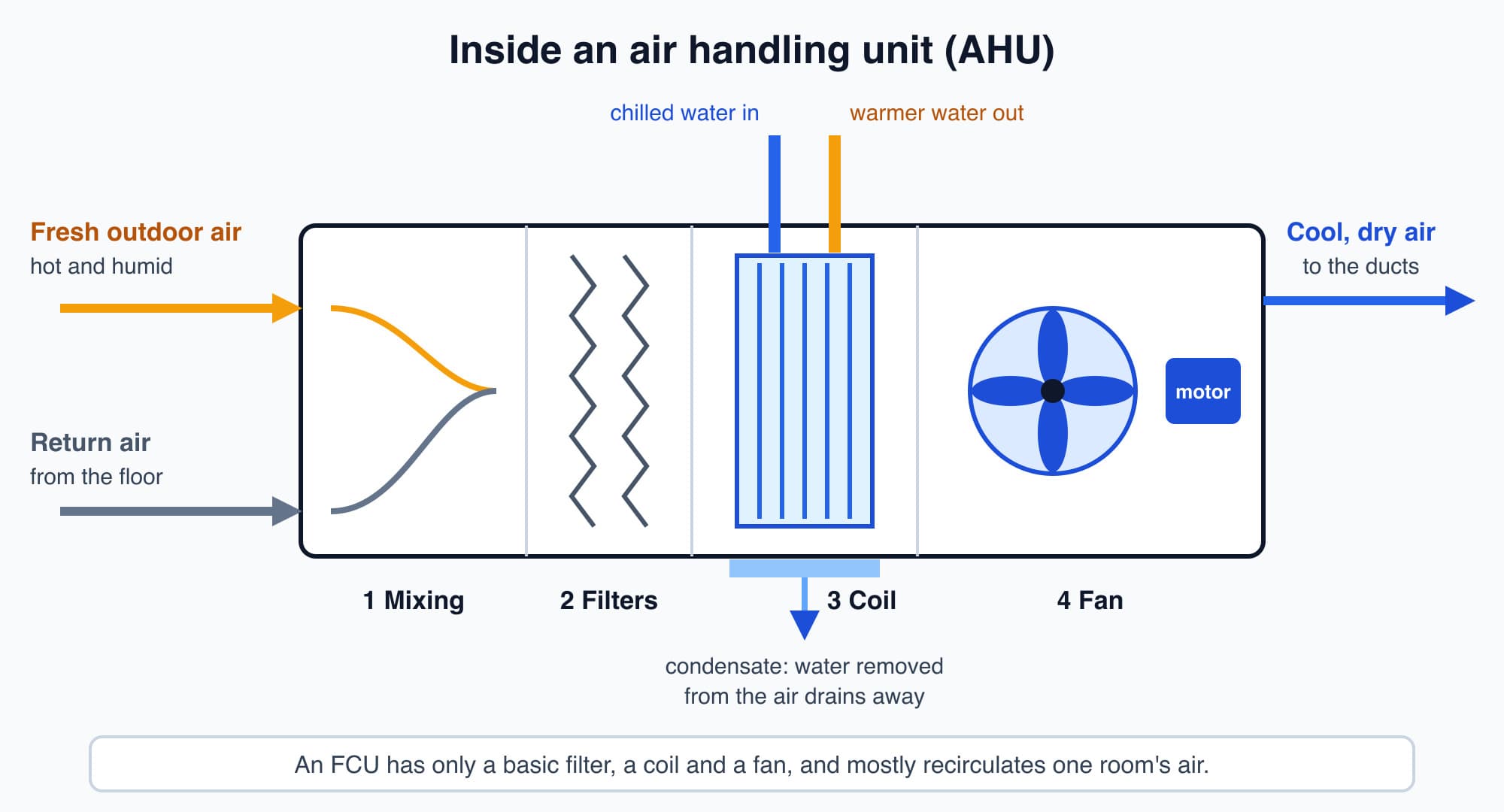
Inside an AHU, fresh and return air mix, then pass through filters, the chilled-water coil and the fan before going out through the ducts.
So an AHU does more than cool. It ventilates, filters and dries the air for a whole zone. An FCU cannot do these jobs because it was not designed for them.
What is an AHU room?
An AHU room is the plant room that holds an air handling unit. In many office towers there is one on each floor, often near the building core, close to the risers that carry the chilled-water pipes up the building. In the office tower, AHU-12A sits in the AHU room on the east side of level 12.
Besides the AHU itself, an AHU room usually holds:
- The fresh-air connection. A louvre or duct through which outdoor air reaches the mixing section.
- The chilled-water pipes. Supply and return pipes to the coil, with the control valve that sets how much water flows through it.
- A floor drain. The water that condenses on the cold coil runs out through a drain pan and pipe to this drain.
- The fan's electrical panel. It powers the fan motor, often through a variable speed drive (VSD) that sets the fan speed.
In some buildings, the AHU room is also part of the return-air path: air from the floor flows back through the ceiling space or through the room itself into the AHU. That is why an AHU room should never be used as a store. Dust, cartons and cleaning chemicals kept there can end up in the air supplied to the whole floor, and stacked items can block the return air the unit needs.
Keep the door shut, the drain clear and the access panels free, because filters and coils need regular cleaning. A wet floor in an AHU room usually means a blocked condensate drain, and is worth fixing before it leaks into the ceiling below.
Many buildings use both, each for its own job
Many buildings do not choose between AHUs and FCUs. They use both on purpose, and each does the job it is best at:
- An AHU handles ventilation for the zone. It delivers a steady supply of fresh, filtered, dried air. When a unit's only job is treating fresh air, it is often called a primary air unit (PAU). This is the air that keeps CO2 down and humidity under control across the floor.
- FCUs handle temperature, room by room. Each room's FCU does the final "trim" cooling, so a corner office in the afternoon sun and a shaded meeting room can each reach their own setpoint.
The split makes sense because the two needs are different. Everyone on a floor needs fresh air, so it is efficient to treat it once, centrally, in one well-filtered unit. Heat load, on the other hand, varies from room to room with sun, occupancy and equipment, so small units in each room can adjust to it.
Which unit to check when someone complains
Knowing which unit does which job tells you where to look first when a complaint comes in.
Complaint | Where to look first | Why |
|---|---|---|
"The office is cold but stuffy, and people feel drowsy after lunch." | The AHU or PAU | The room is cold enough, so cooling is working. Stuffiness points to too little fresh air: the fresh-air damper may be stuck closed, the intake may have been reduced to save energy, or the unit may be off. |
"One room is always too warm, but the rest of the floor is fine." | That room's FCU | It is a local problem. Check for a clogged filter, a failed fan, a stuck chilled-water valve or a coil getting too little water. In a floor served by an AHU with VAV boxes, check that room's VAV box instead (Part 11). |
"The whole floor is warm and humid." | The AHU serving that floor | One unit serves everyone. If humidity is rising across a whole zone, the AHU's coil is not keeping up with drying the air, or the chilled water reaching it is too warm. |
The pattern is: one room, think FCU. A whole zone, or anything about fresh air, filtration or humidity, think AHU.
This also shows where the main lever on indoor air quality sits. If people complain of stuffiness or headaches, adding FCUs or setting them colder will not help, because they only cool the same room air harder. The fresh-air supply, the filtration and the drying of outdoor air are all controlled at the AHU. FCUs make a room colder; the AHU decides how fresh the air is.
Worth knowing: Hotels show the AHU and FCU split clearly. A central AHU or PAU supplies treated fresh air to the corridors and rooms, while each guestroom's FCU lets the guest choose their own temperature.
What comes next: sharing one AHU's air between many rooms
An AHU like AHU-12A sends one stream of cool air into its ducts, but the rooms on that half-floor need different amounts at different times. The next part, What Is a VAV System?, explains how variable air volume (VAV) boxes share that air out and let the AHU's fan slow down when less is needed. It answers the question: how does one AHU send each room the right amount of cool air?
Check your understanding
- A whole floor feels cold enough but stuffy, and people are drowsy by mid-afternoon. Which unit would you check first, and why? The AHU (or PAU) serving that floor. The room temperature is fine, so the cooling is working. Stuffiness points to too little fresh air, and fresh air enters the building through the AHU. Check the fresh-air damper, the intake setting and whether the unit is running.
- Why would setting all the FCUs on a floor colder not fix a stuffiness complaint? FCUs mostly recirculate the air already in each room and bring in little or no fresh air. Making them colder only cools the same stale air further. The fix is more fresh, filtered air from the AHU.
Recap: An AHU and an FCU are both a fan blowing air across a chilled-water coil fed from the same plant. An FCU is small, serves one room, mostly recirculates that room's air, has basic filtration and little or no fresh air. An AHU is large, serves a whole zone through ducts, and brings in, filters and dries fresh outdoor air. Many buildings use AHUs (or PAUs) for fresh air and FCUs for room-by-room temperature. For complaints: one room, check the FCU; a whole zone or anything about fresh air or humidity, check the AHU.
Go deeper on video (optional)
The section on the AHU described the four stages inside one. This video walks through a large air handling unit, following the air from the fresh-air intake to the ducts. It is optional: you do not need it for the next part.
The Engineering Mindset walks through how a big air handling unit pulls in fresh outdoor air, filters it, and conditions a whole zone before pushing it through ductwork.
This is Part 10 of 20 in Cobler's Cooling Fundamentals course. Previous: Pumps, Valves and Flow: How Chilled Water Reaches Every Coil. Next: What Is a VAV System? How Ducts, Dampers and Static Pressure Deliver Cool Air.
Cobler builds CobiNeural, a platform that shows a facility team its building's energy, water and indoor air data as live numbers across the whole site. To see how your building performs, talk to us.
FAQ
Frequently asked questions
Ask us about this topic
Something in this article you want to dig into — or a situation in your own building it doesn't quite cover? Send us your question. We don't run public comments; the team replies to you directly by email.