Blog
How Does a Cooling Tower Work? Throwing a Building's Heat at the Sky
How a cooling tower rejects a building's heat by evaporating water, why range and approach grade it, and how Malaysia's humid wet-bulb sets a cold-water floor.
 Tan Kok XinCooling Fundamentals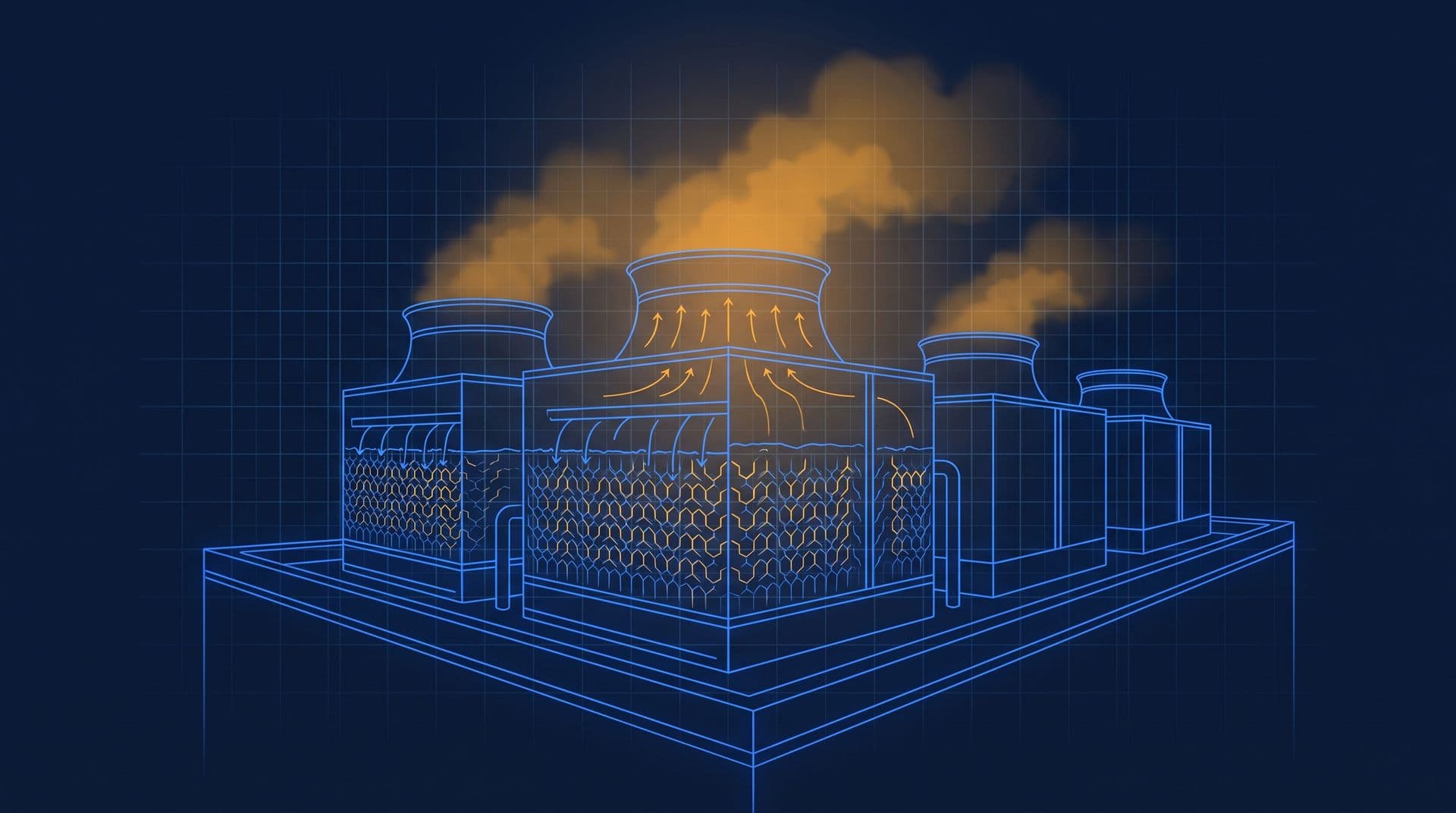
Part 12 of 20 in Cobler's Cooling Fundamentals course. New here? See the course page.
Part 11 finished following the cooling from the plant to the air in each room. The heat collected on that journey still has to leave the building, and in a water-cooled plant it leaves through large boxes on the roof, with fans on top, water splashing inside and a faint warm mist rising from them. Many people assume these are "the air conditioning", but no cold air comes out of them and there is no refrigerant inside.
So how does a cooling tower work? It takes the warm water coming from the chillers, lets a small part of that water evaporate into the outdoor air, and sends the rest back cooler. The heat that evaporation carries away is the heat the building collected from its rooms, plus the heat added by the chillers' own electricity. The tower is where that heat finally leaves the building.
The office tower has three cooling towers on its roof, serving three 500 RT water-cooled chillers. If your building uses split units or cassettes, like the shoplot, or air-cooled chillers, there is no cooling tower: the outdoor units give their heat straight to the air with fans, and you can skip this part.
The tower sits at the end of the condenser-water loop
In Part 8 we followed the loops of a water-cooled chiller plant. The chilled-water loop carries cold water into the building to collect room heat. The condenser-water loop carries that heat away from the chiller to be released outside, and the cooling tower sits at the far end of it.
The heat travels like this:
- The rooms give their heat to the chilled water, at the coils in the AHUs and FCUs.
- The chiller takes that heat, plus the heat from its own compressor's electricity, and passes it to the condenser water. Part 1 explained why the heat released outdoors is always more than the heat taken from the rooms.
- The condenser water, now warm, is pumped up to the cooling tower.
- The cooling tower evaporates a small part of that water. The heat leaves with the vapour, and the cooled water flows back to the chiller to collect more.
The water going up to the tower is warm and the water coming back is cooler. The difference is heat that has left the building and gone into the outdoor air.
Inside the tower, evaporation does the cooling
Inside the tower, the warm condenser water is sprayed over stacks of plastic sheets called fill. The fill spreads the water into thin films and slow drips, so as much water surface as possible meets the air. A large fan draws outdoor air through the wet fill. As the air passes the water, a small part of the water evaporates. The energy needed to turn that water into vapour comes from the water left behind, so the remaining water gets cooler.
A useful comparison is sweat. When sweat evaporates from your skin, it takes heat with it and you feel cooler. A cooling tower uses the same effect on the building's condenser water.
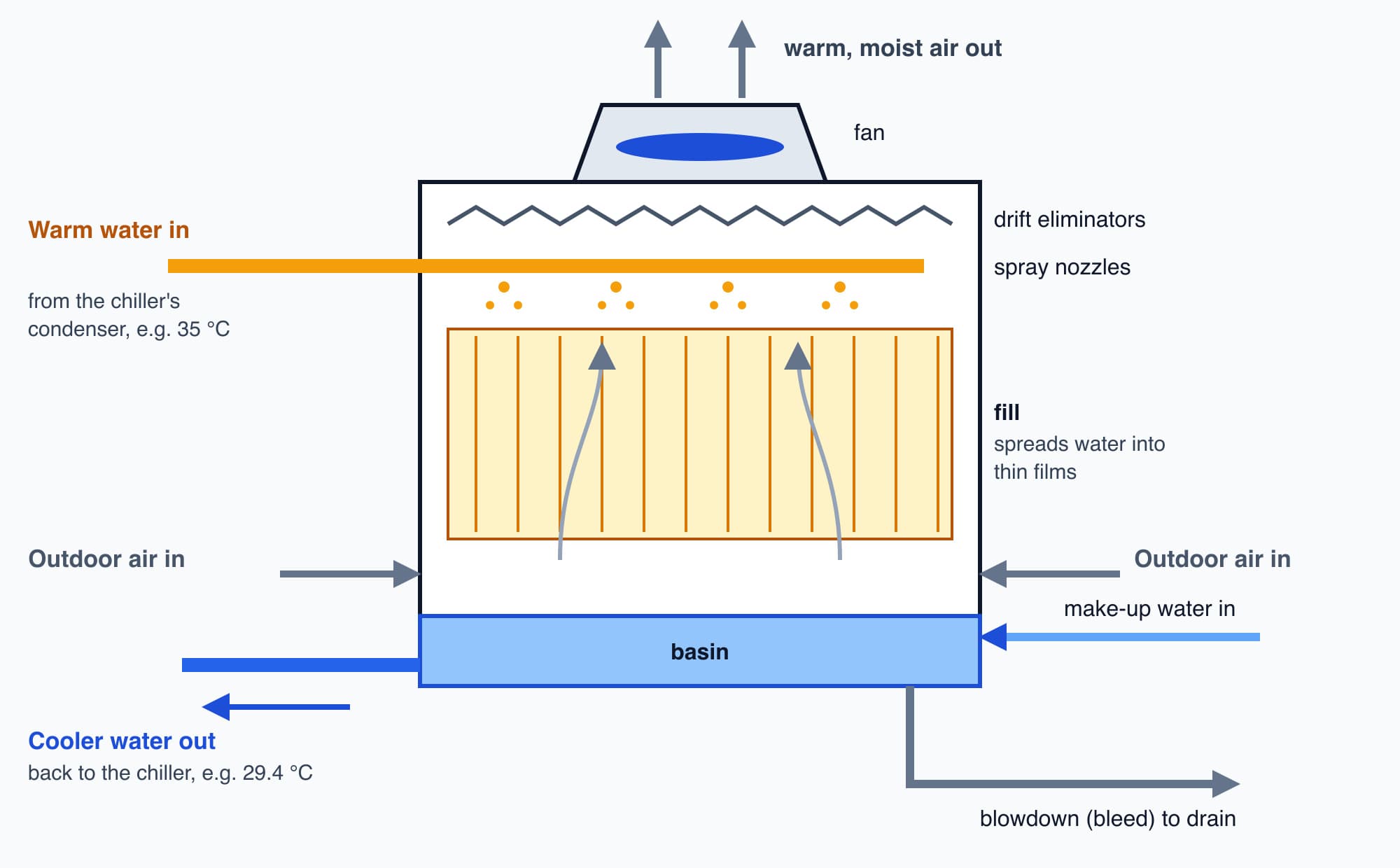
Warm water is sprayed over the fill while the fan draws outdoor air through it; a small part evaporates and the rest falls, cooler, into the basin.
The tower only needs to evaporate a small fraction of the water to cool the rest noticeably. The arithmetic shows why, using two properties of water:
- Evaporating 1 kg of water (about 1 litre) takes roughly 2,400 kJ of heat.
- Cooling 1 kg of water by 1 °C releases about 4.19 kJ, the same figure we used in Part 9.
- Take 100 kg of warm water and evaporate 1 kg of it. The 2,400 kJ needed comes from the other 99 kg.
- The 99 kg cools by 2,400 ÷ (99 × 4.19) ≈ 5.8 °C.
So evaporating about 1% of the water cools the remaining 99% by around 5 to 6 °C.
The "steam" you see above a tower is the warm, damp air the fan pushes out, with some of its moisture condensing into mist as it meets cooler air. It is not smoke. It is the building's heat leaving.
Range tells you how much heat the tower is removing
Engineers judge a cooling tower with two numbers. The first is range: how much the water cools as it passes through the tower.
$$\text{Range} = T_{\text{water in}} - T_{\text{water out}}$$
For example, if water arrives at the tower at 35 °C and leaves at 29.4 °C, the range is about 5.6 °C. Range goes up and down with how hard the building is working. A packed mall on a hot afternoon gives its towers a bigger range than the same mall at dawn.
The wet-bulb temperature sets a floor
How cold can a tower make the water? The limit is set by the outdoor air, through a number called the wet-bulb temperature. Part 3 introduced it: the wet-bulb temperature is the lowest temperature you can reach by evaporating water into the air as it is. Dry air takes up water readily, so evaporation cools well and the wet-bulb is low. In humid air, water evaporates slowly, so evaporation cools less and the wet-bulb is close to the ordinary air temperature.
Malaysia's air is warm and very humid, so our wet-bulb temperature is high, often around 26 to 27 °C. A cooling tower can never cool its water below the wet-bulb temperature. That is the physical floor. This is a limit set by the climate, not a defect in the tower. An identical tower in a dry highland town would produce colder water because the air there is drier.
Approach tells you how good the tower is
The second number, approach, compares the water leaving the tower with that floor:
$$\text{Approach} = T_{\text{water out}} - T_{\text{wet-bulb}}$$
If the water leaves at 29.4 °C and the outdoor wet-bulb is 26 °C, the approach is about 3.4 °C. A small approach means the tower is getting the water close to the coldest temperature the air allows. That is a sign of a clean, correctly sized tower with good airflow. A typical good approach is roughly 3 to 4 °C. Adding that to our wet-bulb of 26 to 27 °C, the coldest condenser water a real tower delivers in Malaysia is usually around 30 °C.
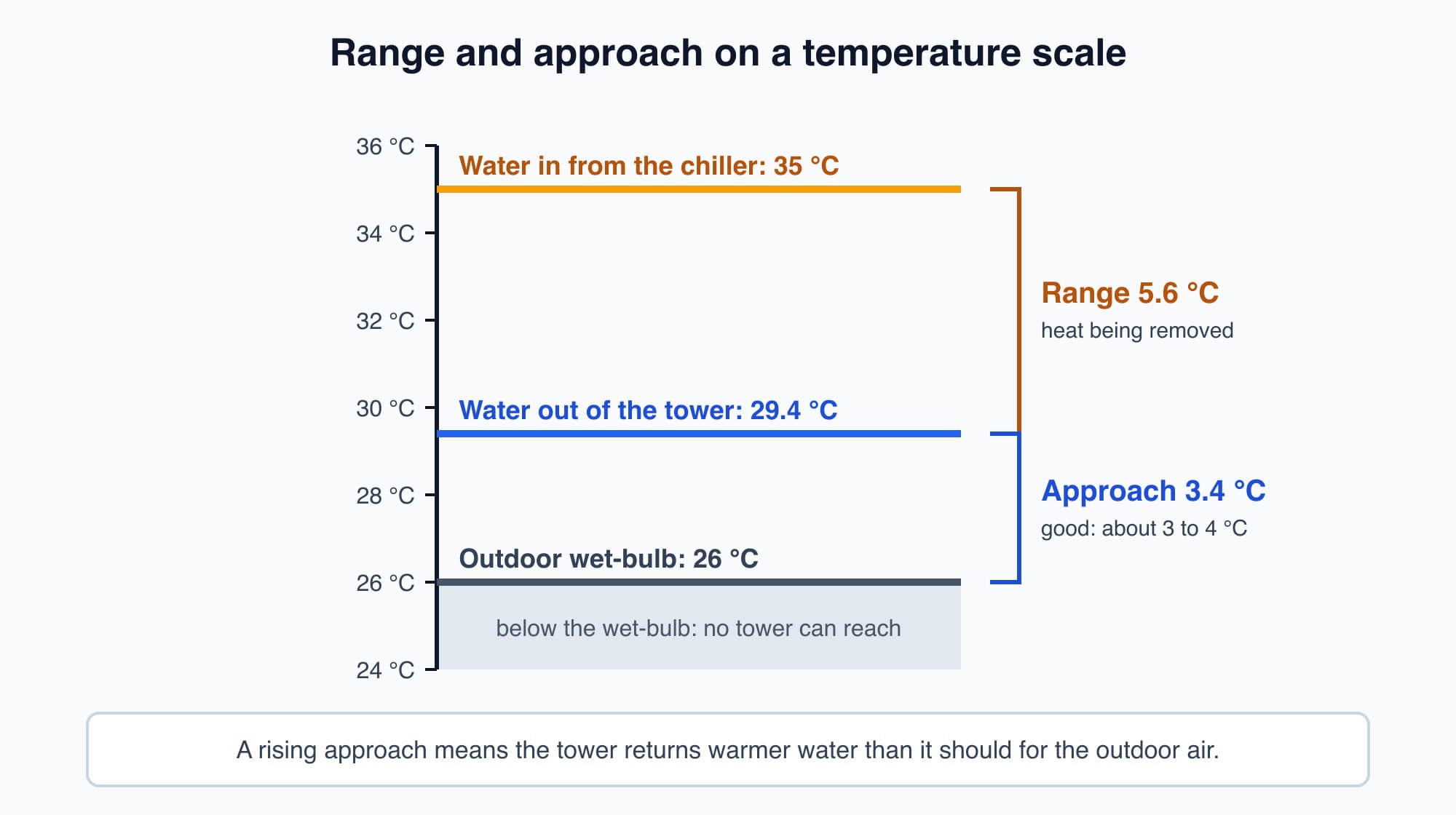
Range is the drop from water in to water out; approach is the gap between water out and the outdoor wet-bulb, which no tower can go below.
A large or slowly rising approach is the warning sign. A tower with scale or slime on its fill, a weak fan or a blocked air path can no longer get close to the wet-bulb, so it returns water warmer than it should. Nothing alarms and the building still cools, but the chiller has to work harder, as the next section explains. So in Malaysia, the sensible target is not very cold water, which the climate does not allow. It is a small approach, held steady.
Warmer water from the tower makes the chiller use more electricity
The temperature of the water the tower sends back affects how hard the chiller works. The chiller releases its heat into the condenser water. The cooler that water is, the lower the pressure at which the chiller's refrigerant can condense, and the less work its compressor has to do. Warmer condenser water forces the compressor to push against a higher pressure, which uses more electricity for the same cooling.
A rule of thumb:
Every ~0.5 °C rise in the condenser-water temperature the tower delivers costs the chiller roughly 1–2% more power for the same cooling output.
Chillers vary, so check your own machine's manufacturer curve before relying on a number. The effect adds up: a tower that has drifted about 2.8 °C warmer than it should be can add roughly 5 to 10% to the electricity used by the chillers, usually the largest load in the building. It shows up as a higher bill, not as a fault alarm, which is why a slowly rising approach is worth watching. The reverse also holds: keep the tower clean and its approach small, and the chiller gets the coldest water the climate allows.
A tower uses electricity and a lot of water
A tower uses electricity for its fan. The fan is driven by a large electric motor, which is a significant load in its own right. Many plants put that motor on a variable speed drive (VSD), so the fan can slow down when the day is cooler or the load is light. The Electricity Fundamentals course explains how electric motors work and how a drive varies their speed in Power Electronics: Rectifiers and Inverters.
A tower also uses water, because evaporation is how it works. The lost water is replaced continuously by make-up water, and it leaves the tower in three ways:
- Evaporation: the intended loss, the water that carried the heat away.
- Drift: fine droplets carried out of the tower by the fan, kept small by baffles called drift eliminators.
- Blowdown: water deliberately drained off and replaced. Evaporation leaves minerals behind, so the remaining water becomes more concentrated. Blowdown removes some of that concentrated water so scale does not build up on the fill and pipes.
How much water does evaporation use? We can estimate it from the heat the tower has to remove. Take the office tower at its peak cooling load of about 900 RT:
- Cooling delivered: 900 × 3.517 ≈ 3,165 kW.
- The tower also has to remove the heat from the chillers' electricity. A common round figure is to add about a quarter, so the heat rejected is about 1.25 × 3,165 ≈ 3,960 kW, meaning 3,960 kJ every second.
- Each kilogram (about a litre) of water evaporated carries roughly 2,400 kJ, so evaporation is about 3,960 ÷ 2,400 ≈ 1.65 litres every second.
- Over an hour: 1.65 × 3,600 ≈ 5,900 litres.
- Over a 10-hour office day at that load: about 59,000 litres.
A small part of the heat warms the air directly instead of evaporating water, so real evaporation is a little lower than this, but the size is right. A large plant evaporates tens of thousands of litres on a busy day.
The office tower's sub-meter backs this up. Its towers use about 1,350 m³ (1,350,000 litres) of make-up water a month, about 61,000 litres per working day over 22 days. That figure includes blowdown and drift, and the plant is below its peak for most hours, so it sits in the same range as the estimate. That makes the cooling towers the largest water user in the building. The optional side reading on cooling tower water consumption explains how blowdown is controlled and how to meter it.
Hygiene: who looks after the tower water? >The warm water in a cooling tower basin, typically between about 25 and 45 °C, is the range in which Legionella bacteria multiply fastest. The tower's drift can carry these bacteria in fine droplets, and people catch legionellosis by breathing in contaminated droplets, not by drinking water. >Under the Occupational Safety and Health Act 1994, employers have a general duty to protect the safety and health of their employees and of other people affected by their work, which includes visitors, tenants and neighbours downwind of the roof. In practice, the building owner or operator should have a written risk assessment and water management plan, a competent water treatment contractor, regular cleaning and inspection, and records showing the controls were checked. Towers left standing idle, such as a standby cell, need their own procedure. See Legionella in cooling towers for what that plan should cover.
Worth knowing: Because make-up water runs continuously and out of sight, a stuck float valve or a slow leak can add a lot of water before anyone notices on the bill. Trending the make-up water meter, and checking that the flow falls close to zero at night when the chillers are off, turns that hidden loss into an early warning.
Optional detail: For a 1,000 RT plant, the same steps as the office tower estimate give about 6,600 litres of evaporation an hour, or roughly 160,000 litres a day if it ran at full load around the clock. So a large plant that runs hard for long hours evaporates well over 100,000 litres a day.
What comes next: how efficient is the plant?
We have now followed the heat from the rooms to the roof: through the coils, the chilled water, the chiller and the cooling tower. Every stage uses electricity. The next part, COP, EER and kW per Ton, explains the numbers that answer the question: how much electricity does a plant use for each unit of cooling it delivers?
Check your understanding
- Water enters a tower at 34 °C and leaves at 29.5 °C. The outdoor wet-bulb is 26.5 °C. What are the range and approach, and is the tower doing well? Range = 34 − 29.5 = 4.5 °C. Approach = 29.5 − 26.5 = 3 °C. An approach of about 3 °C is within the typical good range of 3 to 4 °C, so the tower is getting the water close to the coldest temperature the air allows.
- A new facility manager asks for the towers to deliver 24 °C condenser water on a typical Malaysian afternoon. Why is that not possible? A cooling tower cannot cool water below the outdoor wet-bulb temperature, which in Malaysia is often around 26 to 27 °C. Adding a good approach of 3 to 4 °C, the coldest water a real tower delivers is usually around 30 °C. The realistic target is a small, steady approach.
Recap: A cooling tower is not an air conditioner. It removes the building's heat, plus the chillers' own heat, by evaporating a small part of the condenser water; evaporating about 1% cools the rest by around 5 to 6 °C. Range is how much the water cools in the tower. Approach is how close the leaving water gets to the outdoor wet-bulb, which no tower can go below; 3 to 4 °C is a good approach. Every 0.5 °C of warmer condenser water costs the chiller roughly 1 to 2% more power. A tower uses fan electricity and a lot of water: at peak, the office tower's plant evaporates close to 6,000 litres an hour. Tower water also needs a written hygiene plan to control Legionella.
Go deeper on video (optional)
The sections above described how a tower cools water by evaporation and how range and approach measure it. This video shows the inside of a wet cooling tower with 3D models. It is optional: you do not need it for the next part.
The Engineering Mindset walks through how a wet cooling tower rejects a building's heat by evaporating water, using 3D models and real-world examples.
This is Part 12 of 20 in Cobler's Cooling Fundamentals course. Previous: What Is a VAV System? How Ducts, Dampers and Static Pressure Deliver Cool Air. Next: COP, EER and kW per Ton: How to Read Chiller and Aircon Efficiency Numbers.
Cobler builds CobiNeural, a platform that shows a facility team its building's energy, water and indoor air data as live numbers across the whole site. To see how your building performs, talk to us.
FAQ
Frequently asked questions
Ask us about this topic
Something in this article you want to dig into — or a situation in your own building it doesn't quite cover? Send us your question. We don't run public comments; the team replies to you directly by email.