Blog
What Is a VAV System? How Ducts, Dampers and Static Pressure Deliver Cool Air
What is a VAV system? Learn how ducts, motorised dampers and static pressure deliver just the right amount of cool air to each zone — and save fan energy.
 Tan Kok XinCooling Fundamentals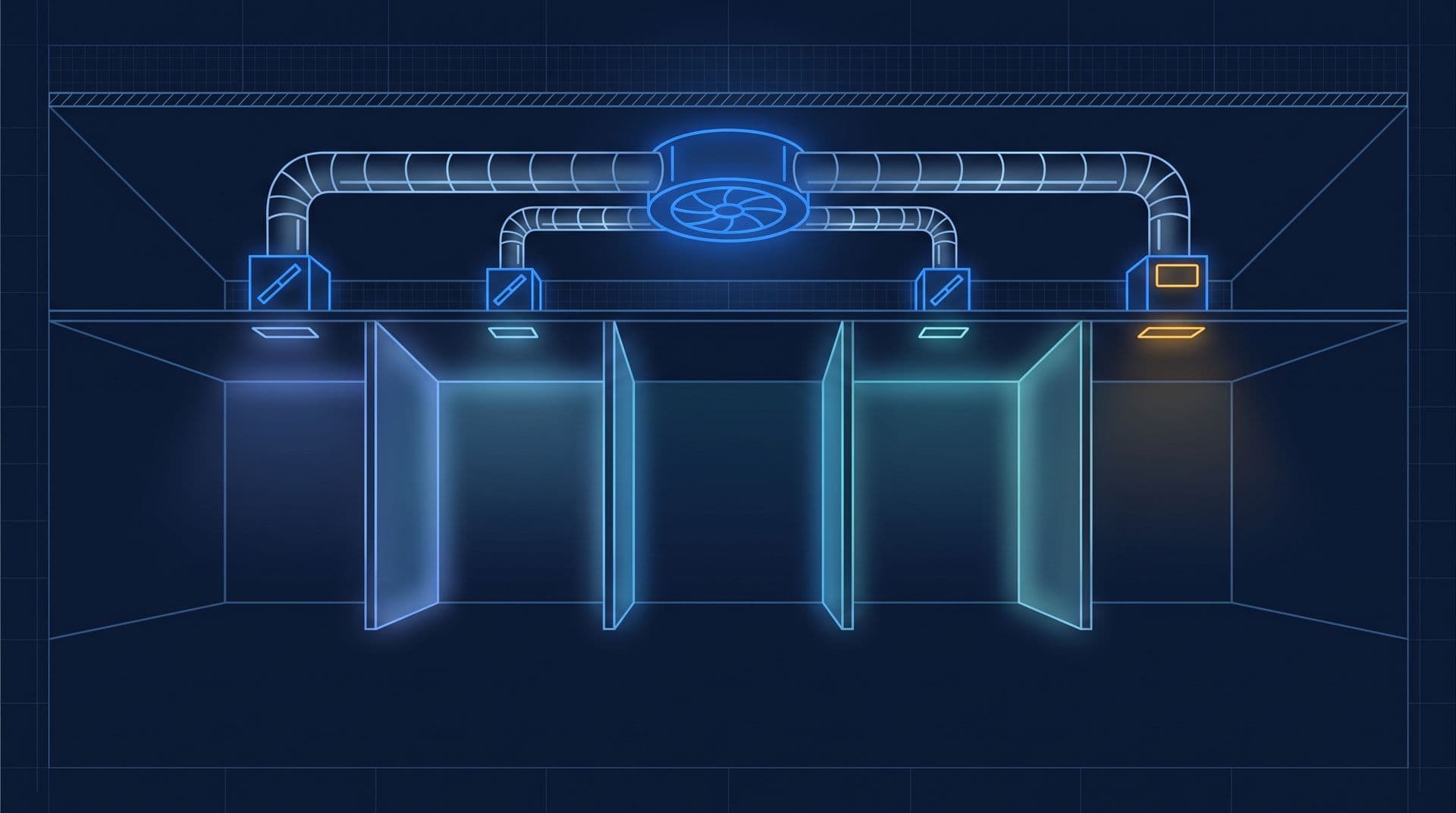
Part 11 of 20 in Cobler's Cooling Fundamentals course. New here? See the course page.
Part 10 ended with AHU-12A sending one stream of cool air into its ducts for rooms that need different amounts. On a typical office floor, the meeting room packed with people needs a lot of cooling, while the empty storeroom down the corridor needs very little. So how does one AHU send each room the right amount of cool air?
In most large offices the answer is a VAV system. VAV stands for variable air volume: the AHU supplies air at a steady cool temperature, and a small box in the ceiling for each zone varies how much of that air the zone receives. This part explains what a VAV system is, how the pressure in the ducts keeps it working, and why it lets the AHU's fan use far less electricity.
We use AHU-12A in the office tower as the running example. It serves the east half of level 12 through ducts and VAV boxes. If your building uses split units or cassettes, like the shoplot, there are no ducts or VAV boxes, and you can skip this part.
What is a VAV system?
An AHU cools and dries air and pushes it into a network of ducts. The next job is delivery: getting the right amount of that cool air to each room. There are two ways to do it.
- Constant air volume (CAV): the fan pushes the same amount of air to every zone all the time. To stop a room getting too cold, the system has to change the air's temperature, for example by mixing in warmer air. The airflow is fixed and the temperature changes.
- Variable air volume (VAV): the air stays at one cool temperature, often around 13 °C (AHU-12A holds 14 °C), and each zone gets more or less of it. The temperature is fixed and the airflow changes.
A short way to remember it: VAV varies volume; CAV varies temperature.
Varying the volume saves energy because moving air takes fan power. When half the floor goes out for lunch, a VAV system can send less air and slow its fan down. A constant-volume fan keeps running at full speed regardless. In Malaysia, where the cooling runs hard every working day, that difference adds up.
The VAV box is a motorised valve for air
Each zone has a VAV terminal box above the ceiling, usually one per room or per group of similar rooms. It is a short metal box in the duct with two main parts:
- A motorised damper. A damper is a flap or blade that pivots to open or block the duct, like a valve for air instead of water. A small electric motor, called an actuator, moves it between fully open and nearly shut.
- An airflow sensor. This measures how much air is actually passing through the box, so the controller can check it is delivering the amount it intended.
The box works with a thermostat in the zone. When the room warms up because more people arrive, the afternoon sun hits the glass or equipment gives off heat, the thermostat calls for more cooling and the damper opens to let in more cool air. When the room reaches its setpoint, the damper closes down to a minimum flow. That minimum is set so the room still receives some air, including its share of the fresh air the AHU brings in (Part 4 explains why fresh air matters).
Because the air arriving at the box is already cool and at a steady temperature, the box does not need to change the air itself. It only controls how much passes. The design is simple and scales to hundreds of zones in a large office tower.
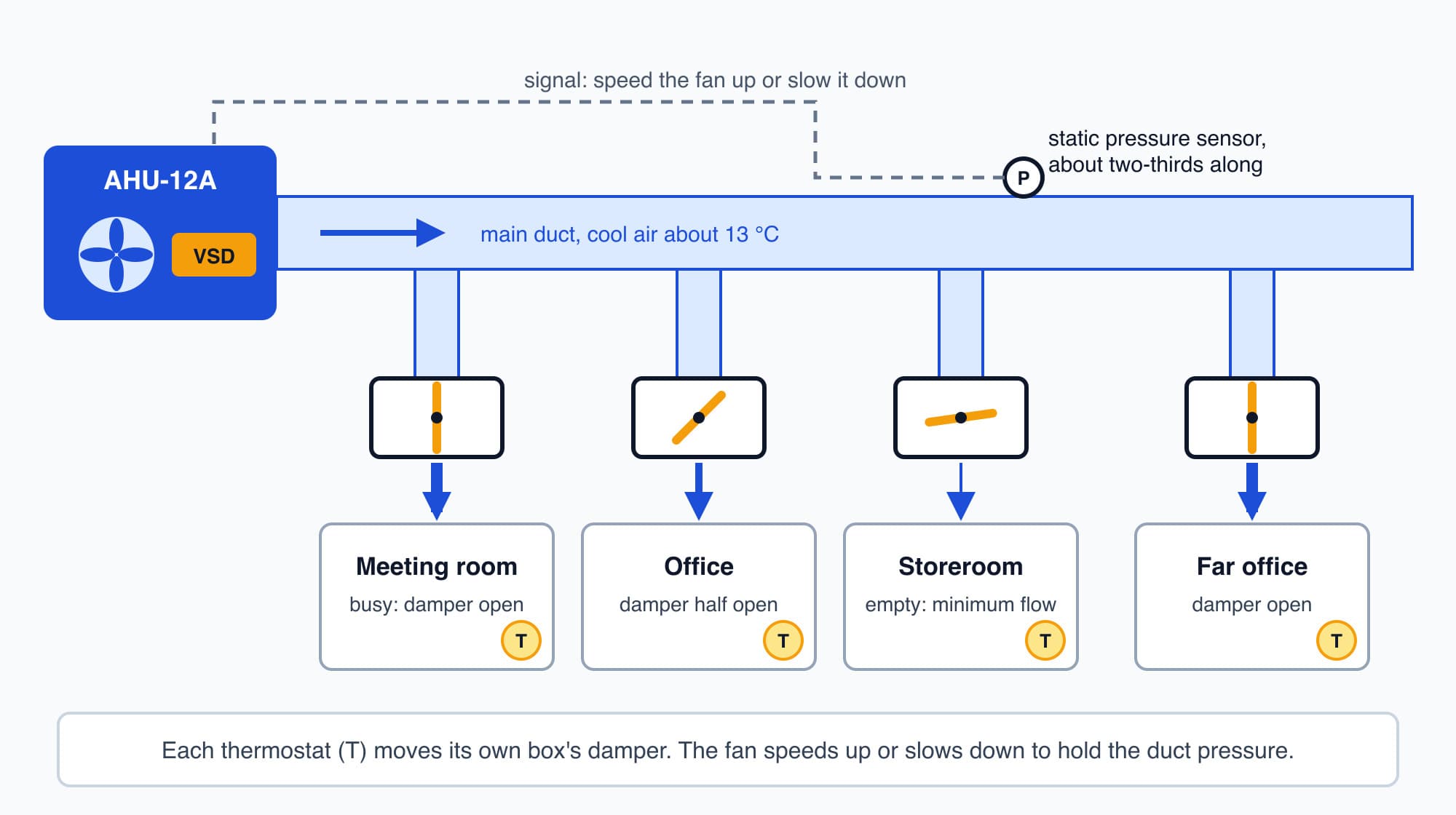
One AHU fan feeds many VAV boxes; each box opens or closes for its own zone, and a pressure sensor partway along the duct tells the fan how hard to push.
Static pressure keeps air ready at every box
If dozens of VAV boxes open and close independently, how does the fan know how hard to blow? It watches the static pressure in the duct.
Static pressure is the steady pressure the supply fan keeps inside the ductwork: the air pressing outwards on the duct walls, ready to flow through whichever boxes are open. A useful comparison is the water pressure in a building's pipes. With enough pressure in the pipes, water flows the moment any tap opens, and other taps do not run dry. The ducts work the same way: the fan keeps them pressurised so that any box that opens gets the air it asks for straight away.
A duct static pressure sensor reads the pressure inside the main duct and reports it to the fan's controller. It is typically placed about two-thirds of the way down the main duct, where the reading is a fair indication of what the boxes farthest from the fan receive.
The controller has a static pressure setpoint, the target pressure it tries to hold in the duct. It speeds the fan up when the pressure is below target and slows it down when the pressure is above.
As dampers close, the fan slows and saves energy
Follow what happens across a normal afternoon. As rooms cool down or empty out, their VAV dampers close. With fewer open outlets, the pressure in the duct rises above the setpoint. The controller sees this and slows the fan until the pressure settles back at the target.
To change speed smoothly, the fan motor is driven by a variable speed drive (VSD), the same kind of drive that runs the secondary pumps in Part 9. The Electricity Fundamentals course explains the motor in how electric motors work and the drive in rectifiers and inverters.
A slower fan uses much less electricity. The affinity laws from Part 9 apply to fans too: for a fan with no fixed pressure to hold, power falls roughly with the cube of speed, so a 20% cut in speed roughly halves it.
In a VAV system the saving is smaller than that ideal, for the same reason as the pumps in Part 9. The fan must keep the duct at its static pressure setpoint even when little air is needed, so its power does not fall all the way along the cube curve. The saving is still large compared with a constant-volume fan running at full speed all day, and it is the main reason VAV became the standard for large commercial buildings.
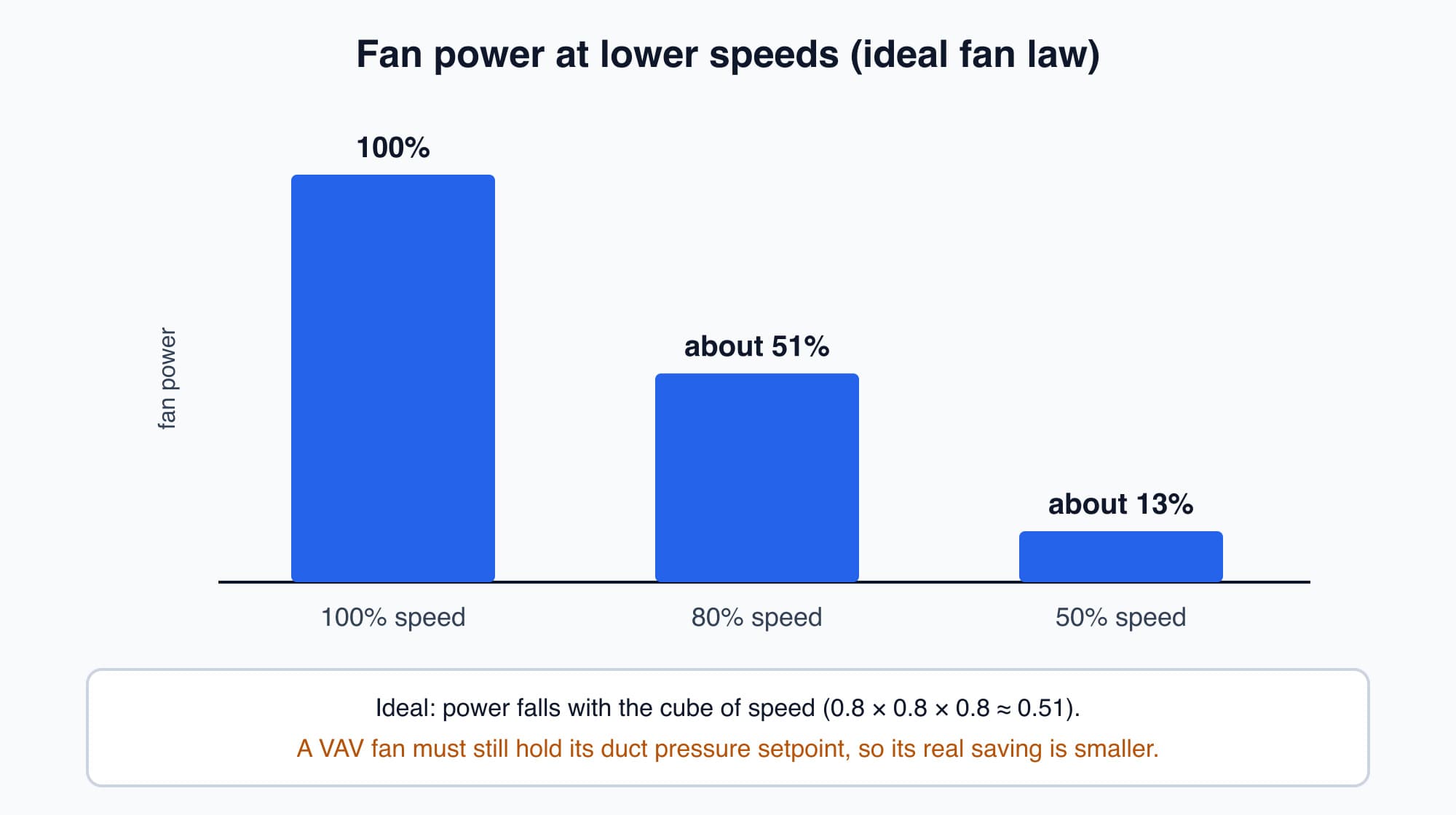
The cube law gives the ideal saving; holding a fixed duct pressure means a real VAV fan saves less, but still a lot.
The pressure setpoint has to be set with care
The static pressure setpoint is the setting that most often separates a well-run VAV system from a poorly run one.
- Set too high, the fan works harder than it needs to all day, using electricity for nothing. It often causes noise as well: a hiss or rumble as air rushes through the boxes and grilles at too much pressure.
- Set too low, there is not enough pressure to reach the far end of the ducts. Zones near the fan are fine, but far zones are starved of air. Their dampers are wide open, calling for cooling, and still not enough arrives. These are the rooms that stay warm whatever the thermostat says.
Making sure every zone, near and far, can get its share of air at a sensible fan speed is part of what engineers call balancing the system. A system balanced correctly at handover can drift over the years as filters load up and coils get dirty, which changes how the air moves. Part 18 covers dirty coils and oversized equipment, and Part 19 explains how a building management system (BMS) can reset the static pressure setpoint automatically, lowering it when most dampers are partly closed.
Why economizers rarely help in Malaysia
Articles about VAV systems written for the United States or Europe often mention an economizer, sometimes called air-side free cooling. On a mild day, instead of running the chiller, the system opens a large damper and uses cool outdoor air to cool the building.
That works well in a temperate climate. In Malaysia it rarely pays. Our outdoor air is hot and very humid for nearly the whole year. Bringing more of it indoors adds heat and also a large amount of moisture, which engineers call latent load: the energy needed to condense water vapour out of the air on the coil (Part 3 explains it). The energy an economizer might save is usually outweighed by the energy needed to dry that air. In a tropical building, the efficiency gains come from delivering already cooled and dried air more carefully, which is what a VAV system does.
Worth knowing: A duct pressure sensor fitted right beside the fan would show plenty of pressure even while the rooms at the far end of the duct were short of air. That is why it is placed well down the duct, closer to the boxes that are hardest to reach.
What comes next: where the heat finally leaves
We have now followed the cooling from the plant, through the pumps and coils, to the air in each room. The heat collected on that journey still has to leave the building, and in a water-cooled plant it leaves from the roof. The next part, How Does a Cooling Tower Work?, follows it there and answers the question: how does a cooling tower work?
Check your understanding
- Several meeting rooms on level 12 empty out at 5pm. What happens to their VAV dampers, the duct static pressure and the AHU-12A supply fan? The rooms cool down, so their thermostats close the dampers towards minimum flow. With fewer open outlets, the static pressure in the duct rises above its setpoint. The controller slows the fan through its VSD until the pressure is back at the setpoint, and the fan uses less power.
- A room at the far end of a VAV duct is always warm, and its damper is always wide open. What setting would you look at, and why? The duct static pressure setpoint, and where its sensor is. If the setpoint is too low, there is not enough pressure to push air to the far end of the duct, so far zones are starved even with their dampers fully open. It is also worth checking the box's own airflow and the balancing.
Recap: A VAV system keeps the supply air at a steady cool temperature, often around 13 to 14 °C, and varies the volume sent to each zone. Each VAV box has a motorised damper and an airflow sensor, controlled by the zone thermostat, and closes to a minimum flow rather than shutting off. A static pressure sensor about two-thirds of the way down the main duct tells a variable-speed fan how hard to push. As dampers close, the fan slows and saves energy; the cube law is the ideal, and a fixed pressure setpoint makes the real saving smaller. The setpoint must be high enough for far zones and no higher. Economizers rarely help in Malaysia's humid climate.
Go deeper on video (optional)
The sections above described how VAV boxes, static pressure and the fan work together. This video shows the same system in motion. It is optional: you do not need it for the next part.
The Engineering Mindset walks through how a VAV system supplies cool air and modulates airflow zone-by-zone to save fan energy.
This is Part 11 of 20 in Cobler's Cooling Fundamentals course. Previous: AHU vs FCU: The Difference Between an Air Handling Unit and a Fan Coil Unit. Next: How Does a Cooling Tower Work? Throwing a Building's Heat at the Sky.
Cobler builds CobiNeural, a platform that shows a facility team its building's energy, water and indoor air data as live numbers across the whole site. To see how your building performs, talk to us.
FAQ
Frequently asked questions
Ask us about this topic
Something in this article you want to dig into — or a situation in your own building it doesn't quite cover? Send us your question. We don't run public comments; the team replies to you directly by email.