
Blog
How to Run a Water Balance Audit on Your Building
A water balance audit compares the water your building buys against the water you can actually account for. The gap that shows up is almost always the cheapest saving on site.
 Tan Kok XinWater Fundamentals
Part 9 of 12 in Cobler's Water Fundamentals course. New here? See the course page.
Part 8 showed how much of the office tower's water its cooling towers take. That leaves the whole bill: where did the month's cubic metres on the bill actually go, and how much of them can nobody explain? This part answers that with a water balance audit.
The bill has one number on it for the month, about 3,000 m³ for the office tower. Ask the building team where those cubic metres went, and most will name the cooling towers and the toilets, and then stop. A water balance audit splits that one billed number into a list of uses you can check line by line. The part of the list that does not add up is usually where water, and money, is being lost. The method is bookkeeping applied to pipes, and it uses what earlier parts taught: the supply path and tanks (Parts 1 and 3), meters (Part 6), the bill (Part 7) and cooling tower make-up (Part 8).
What a water balance audit is
A water balance audit compares the water that comes into your building with the water you can account for. It has three pieces:
- Inflow: the metered supply from Air Selangor or your state operator, plus any other source you have, such as a borehole or a rainwater harvesting tank.
- Known uses: the things you can name and either measure or estimate. Examples are cooling tower make-up, toilets and washrooms, pantries, tenant premises, kitchens, a pool, irrigation and washdown.
- Unexplained remainder: what is left after you subtract the known uses from the inflow.
Water operators do the same sum for a whole city and call the gap non-revenue water: water that was treated and pumped but never billed. Inside your fence line, the remainder is water you paid for but cannot trace to a purpose. It is usually leaks, tanks overflowing, connections nobody metered, or meter error.
The remainder also reaches the sewerage bill, because IWK's excess charge follows the water supplied, even water that leaks into the ground (Part 7).
Start with the bills you already have
Before you buy a single sub-meter, collect twelve months of water bills and plot them. Two useful things show up straight away.
The first is how consumption changes with the calendar. People use less water in a month with long public holidays, because there are fewer working days. If a building's consumption barely moves between a full month and a holiday month, a large share of its water is not driven by people. That share is cooling tower make-up, irrigation or a leak, and only one of those three is optional.
The second is estimated readings. Operators do estimate when a meter is hard to reach, and an estimated month followed by a correcting month produces a spike that has nothing to do with the building. Read the incoming meter yourself and compare it with what you were billed before you conclude anything. How water meters work in buildings (Part 6) explains what the meter registers and how it can go wrong.
While you have the bills out, note what one extra cubic metre costs you. For the office tower, Part 7 worked it out as RM4.28 (RM3.83 water plus 45 sen sewerage), so value the remainder at that rate. Other states have their own operators and rates.
Read every meter at the same time
A balance only works if every number covers the same period. The operator's billing period rarely matches your own sub-meter readings.
Suppose the operator read the bulk meter on 3 August and 4 September, which is 32 days, and you read your sub-meters on 1 August and 31 August, which is 30 days. At about 100 m³ a day (3,000 m³ over 30 days), the two extra days add roughly 200 m³ to the bill. Compared with 30 days of sub-meter readings, that 200 m³ looks like a loss of about 7 percent, even though nothing is wrong.
The fix is to read the bulk meter yourself, at the same hour as the sub-meters and the tank levels, on the same date each month. Early morning, before occupants arrive, is a good time because little water is moving. If you must use the operator's reading, scale both sets to the same number of days, and accept that this is only a rough correction because weekdays and weekends use different amounts.
Correct for the water held in the tanks
In a tank-fed building, the bulk meter measures water going into storage, not water being used. As Part 1 showed, water from the bulk meter first fills the suction tank. Transfer pumps then lift it to the roof tanks, and the floors draw from there. If the tanks end the month fuller than they started, some of the water you bought is still sitting in them. If they end emptier, the building used water that was bought the month before.
So the water the building actually used is:
Water used = inflow − change in storage
Change in storage means the contents at the end of the period minus the contents at the start, added up over every tank the bulk meter feeds (the suction tank, the roof tanks and, if it is filled from the same supply, the fire tank). It is positive when the tanks got fuller.
Level transmitters (Part 3) usually show tank level as a percentage. In a tank with straight sides, each percent is the same volume. The office tower's suction tank holds 300 m³ when full, so 1 percent is 3 m³.
Here is one 30-day month in the tower, a little busier than the 3,000 m³ month that Part 7 billed, with every reading taken at 7:00am:
- The bulk meter recorded 3,140 m³.
- The suction tank went from 70 percent to 95 percent, a rise of 25 percent of 300 m³, which is 75 m³.
- The roof tanks and the fire tank read the same level at both readings.
- Water used = 3,140 − 75 = 3,065 m³.
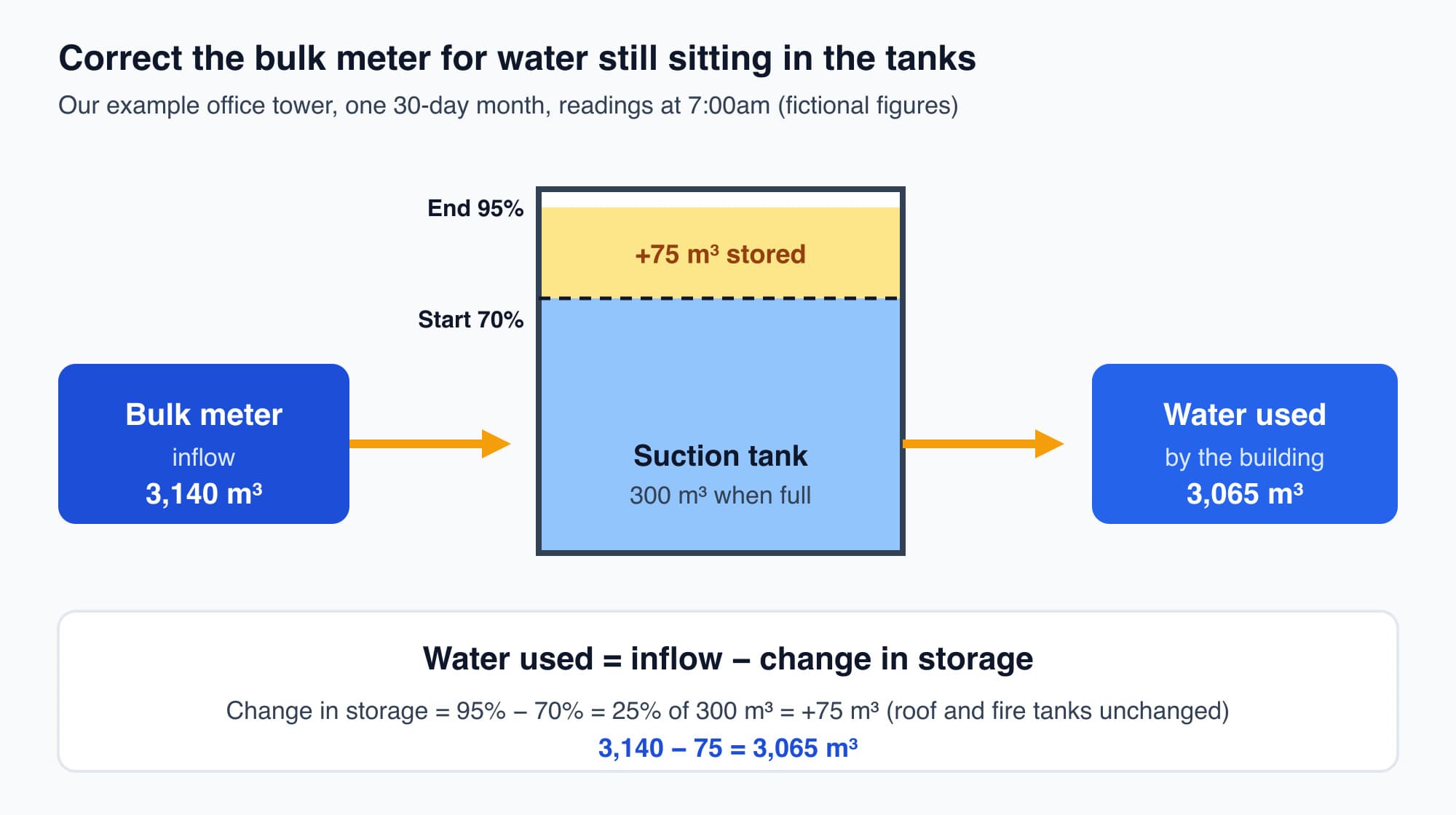
Water still sitting in the tanks at the end of the month was bought but not used, so subtract it from the bulk meter reading.
Over a month, the storage change is usually small next to the total. Over a week, a day or a single night it can be as large as the whole signal you are looking for. Part 10 comes back to this.
List the uses you can name
The first pass of the balance can use estimates rather than meters. At this stage you are finding out whether the remainder is about 3 percent or about 30 percent, and estimates are good enough for that.
Cooling tower make-up. In buildings with water-cooled chillers, this is often the largest single use, which surprises owners who assume toilets dominate. Part 8 explains how to estimate it from evaporation and cycles of concentration, and why a tower run at three cycles uses far more make-up than the same tower run at six. The best source is a sub-meter on the make-up line. The office tower has one, and it read 1,350 m³ for the month. If your building uses air-cooled or split-unit air conditioning (DX, direct expansion), it has no tower make-up and you can skip this line.
Domestic fixtures. Estimate from headcount and working days. A typical office occupant uses something like 30 to 60 litres per working day across toilets, urinals, basins and the pantry. That is an illustrative planning range, not a measured figure for your building. Hotels, hospitals and gyms use several times more per person. For the tower: 1,500 people × 50 litres × 22 working days = 1,650,000 litres, which is 1,650 m³. The small ground-floor café is on the same supply and is counted inside this estimate.
Irrigation and washdown. This covers landscape watering, car park washing and facade cleaning. With regular tropical rain, irrigation should vary from month to month. If it is flat all year, a timer has probably been left running through the monsoon. The tower has no irrigation, and the cleaning contractor's schedule gives an estimate of 15 m³ for car park washdown.
Tenants. Retail podium tenants, and food and beverage tenants in particular, can use far more water than their floor area suggests. A single busy restaurant kitchen can use as much as a whole office floor.
Known unmetered uses. Write down anything else that used water in the period, with an estimate: a fire system test, draining a tank for cleaning (Part 5), or a contractor filling a new pipe system. The tower had none this month.
Subtract to find the remainder
Now put the numbers side by side.
Line | m³ | Where the number came from |
|---|---|---|
Bulk meter inflow | 3,140 | Own reading, 7:00am |
Change in storage | +75 | Suction tank 70% to 95% |
Water used | 3,065 | 3,140 − 75 |
Cooling tower make-up | 1,350 | Sub-meter |
Domestic | 1,650 | Estimate |
Car park washdown | 15 | Estimate |
Unexplained remainder | 50 | 3,065 − 3,015 |
The known uses add up to 1,350 + 1,650 + 15 = 3,015 m³. The remainder is 3,065 − 3,015 = 50 m³, which is 1.6 percent of the water used. Without the storage correction, the remainder would have been 3,140 − 3,015 = 125 m³, or 4.0 percent: two and a half times larger, and all of the difference is water that was still sitting in the suction tank.
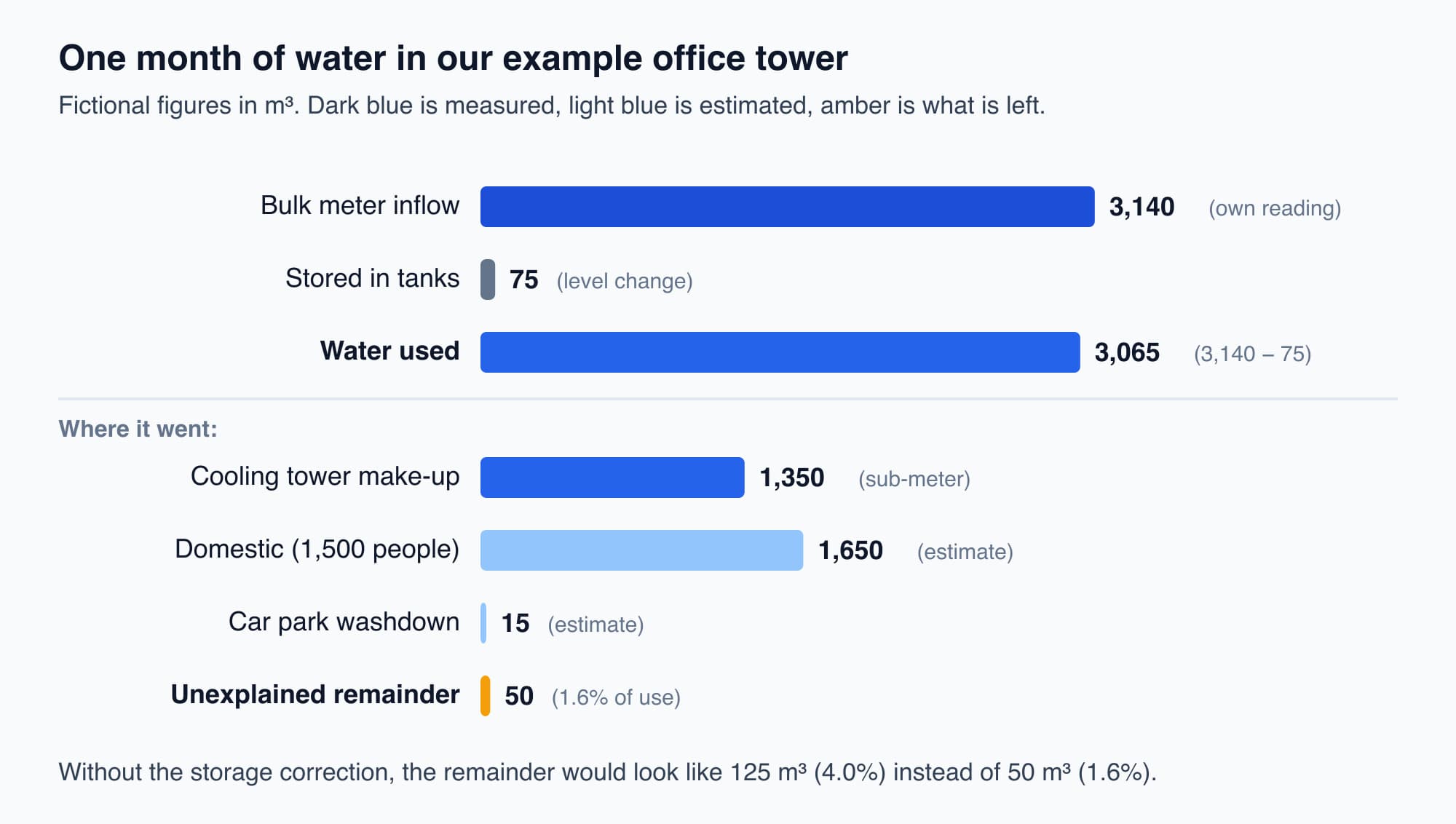
The office tower's month: measured lines in dark blue, estimates in light blue, and the 50 m³ that cannot yet be explained in amber.
Treat a small remainder with some care. The domestic line is an estimate: at 30 litres per person per day it would be 990 m³, and at 60 litres it would be 1,980 m³. That uncertainty is larger than the remainder itself. So a first-pass remainder of a few percent means "no large loss found", not "no loss at all". Replacing estimates with sub-meters, covered below, shrinks this uncertainty.
What the remainder usually turns out to be
When the remainder is large, the cause is rarely unusual. The same few culprits come up again and again:
- A buried supply pipe between the bulk meter and the suction tank, leaking into the ground where no water ever pools on the surface.
- The suction tank's inlet float valve no longer closing fully, so water keeps running out through the overflow pipe (Part 3 shows where each valve sits).
- A roof tank overflowing because its stop probe has failed, the transfer pump keeps running and the backup float valve does not shut (Parts 3 and 4). The water lost at the roof is replaced from the suction tank, which refills through the bulk meter, so it still shows up in the balance.
- Urinal flush valves timed to flush far more often than the building is occupied, or a flush valve stuck open on a floor that is rarely used.
- A hose tap left slightly open in a plant room.
- A meter that registers too little or too much (Part 6).
- A tenant connection added years ago that was never metered.
Tanks deserve special attention in Malaysian buildings, because almost every building has them and few teams watch them. An overflowing tank looks like a hidden leak on the meter: water flows constantly, nothing is visible where people work, and nobody complains, because the taps still have normal pressure.
How big a remainder is too big?
Any balance built from real meters carries some error. Meters have tolerances, readings are never taken at exactly the same moment, and estimates are estimates. So the target is never zero.
For a first audit, a working rule of thumb (not a standard) is:
- Under about 5 percent of the water used: within measurement error and not worth chasing on its own.
- About 5 to 15 percent: worth investigating at the next maintenance window.
- Above about 15 percent: almost certainly a physical loss that will keep costing money every month until someone finds it.
After the first audit, the change from month to month tells you more than the size. A remainder that stays about the same each month is your building's normal gap, made up of meter tolerances and estimate error. A remainder that grows is the signal. A pipe that starts weeping in March shows up as a 200 m³ step in the April balance. At Part 7's RM4.28 per cubic metre, that is about RM856 a month, and if you are watching, you fix it in April rather than finding it a year later.
Add a few sub-meters where they split the building
You do not need to meter every fixture. You need enough meters to split the balance into pieces small enough that a remainder points somewhere specific.
For most commercial buildings, four to six well-placed meters do the job: cooling tower make-up, the domestic riser or a group of floors, irrigation, the largest tenant or food and beverage cluster, and any kitchen or pool. That turns a single unexplained lump into a statement such as "the remainder sits below the domestic riser on levels 5 to 12", which a plumber can act on in an afternoon instead of a week. Water sub-metering and leak detection covers placement and sizing in more detail.
The office tower has a tower make-up meter and one meter on each of its two zone downfeeds, placed after the roof tanks. With those, the domestic line becomes a measurement rather than an estimate. The remainder then covers only the pipework and tanks between the bulk meter and those sub-meters. A leak further downstream, inside a zone, shows up as that zone's use going up, which is what Part 10 watches for.
Repeat the balance every month. A one-off audit describes the building on one day, and the useful event is the month the remainder grows. Manual balances tend to stop after a staff handover, so it helps if the meters send their readings to a logger automatically, through a pulse output or a digital link such as Modbus, as described in Part 6.
To run your first audit:
- Pull twelve months of bills and plot them.
- On the same date for two months in a row, read the bulk meter yourself at the same hour, and check it against the bill.
- At the same moment, record every tank level and every sub-meter.
- Estimate cooling tower make-up, domestic use and irrigation or washdown on paper.
- Work out the water used with the storage correction, and subtract the known uses.
If the remainder is small, you have shown your building is tight, which is worth knowing. If it is 20 percent, you have a number to take to management and a good reason to meter the branches that matter.
Worth knowing: Without the storage correction, the office tower's remainder this month would have looked two and a half times larger: 125 m³ instead of 50 m³. All of the difference was water still sitting in the suction tank, bought but not yet used.
What comes next
A monthly balance tells you that water is missing, but not when it started or where it is going. Most leaks keep running when the building is empty, so the next step is to look at the small hours of the night, when almost nobody uses water. Part 10, Night Flow Analysis: A Daily Leak Test, shows how to read those hours, and why the bulk meter can mislead you at night for the same reason the tank-level correction is needed. It opens with the question: if a monthly balance shows water is missing, how can you tell each morning whether something changed overnight?
Check your understanding
- In one month, the bulk meter records 3,140 m³ and the 300 m³ suction tank falls from 95 percent to 70 percent. The roof tanks end at the same level. How much water did the building use? The change in storage is 70% − 95% = −25% of 300 m³, which is −75 m³. Water used = inflow − change in storage = 3,140 − (−75) = 3,215 m³. The building used 75 m³ more than it bought that month, because it drew down water that was already in the tank.
- The operator's bill covers 32 days and your sub-meter readings cover 30 days. Why can this make a tight building look leaky? The bill includes two extra days of water that the sub-meters did not record. At about 100 m³ a day, that is roughly 200 m³, which appears in the remainder as a false loss of about 7 percent. Reading all meters yourself at the same hour removes the mismatch.
Recap: A water balance audit compares inflow with the uses you can name, and the unexplained remainder is where losses hide. Read every meter at the same time, and correct the bulk meter for the change in tank storage: water used = inflow − change in storage. Estimates are fine for a first pass, but their uncertainty can be larger than a small remainder. Watch how the remainder changes month to month, and add a few sub-meters so that a remainder points to a specific part of the building.
This is Part 9 of 12 in Cobler's Water Fundamentals course. Previous: Cooling Tower Water Consumption Explained. Next: Night Flow Analysis: A Daily Leak Test.
Cobler builds CobiNeural, a platform that shows a facility team its building's energy, water and indoor air data as live numbers across the whole site. To see how your building performs, talk to us.
FAQ
Frequently asked questions
Ask us about this topic
Something in this article you want to dig into — or a situation in your own building it doesn't quite cover? Send us your question. We don't run public comments; the team replies to you directly by email.