How stored water in a building stays safe to drink: keeping drinking and non-drinking water apart, air gaps and backflow preventers, why water age matters, what to check in a tank, and who is responsible after the meter.
Tan Kok XinWater Fundamentals
Part 5 of 12 in Cobler's Water Fundamentals course. New here?See the course page.
Part 4 finished the equipment side of the course: the tanks that store water, the pressure that moves it and the pumps that lift it. After all that storing and pumping, is the water still as safe as when it left the treatment plant, and whose job is it to keep it that way? This part answers both.
Think of a glass filled from a tap on level 15 of the office tower. That water left the treatment plant clean and safe to drink. On its way it passed through the bulk meter, sat in the suction tank, was pumped up to a roof tank and waited there before running down to the floor. This part explains how stored water can become unsafe on that journey, how the plumbing is designed to stop that, and who is responsible for each part of the system.
Drinking water and non-drinking water must stay apart
Potable water is water that is safe to drink. In most Malaysian buildings it is the treated water from the public supply, which Air Selangor provides in Selangor, Kuala Lumpur and Putrajaya. Non-potable water is any water that is not meant for drinking. A building can hold several kinds:
Water in the fire-fighting system, which can sit in the pipes for months.
Water circulating in cooling towers, which is warm and full of treatment chemicals (Part 8 covers towers).
Rainwater collected from the roof for flushing toilets or watering plants.
Water in air-conditioning pipework, heating systems or industrial processes.
The basic rule is that these systems must never be joined to the drinking-water pipes. The national technical guidelines from SPAN (Suruhanjaya Perkhidmatan Air Negara, the National Water Services Commission) say that piping for domestic water, air conditioning, fire fighting and non-potable water "shall be separated from each other" with no interconnections (). We call this document "the SPAN guidelines" below.
FAQ
Frequently asked questions
Ask us about this topic
Something in this article you want to dig into — or a situation in your own building it doesn't quite cover? Send us your question. We don't run public comments; the team replies to you directly by email.
For rainwater and other non-potable supplies, the same guidelines add practical safeguards:
Potable and non-potable water are stored in separate tanks that are not connected to each other.
Pipes carrying non-potable water are painted green along their whole length.
Taps and outlets for non-potable water are labelled "Not for Drinking Purposes".
A joint between a drinking-water pipe and any other system is called a cross-connection. Cross-connections are often added later, during a renovation or a quick repair, so a walk-round to look for them is a useful first check in any building.
Backflow can pull dirty water back into clean pipes
Water normally flows one way: from the supply, through the building and out of the taps. But if the pressure in a supply pipe drops, water can flow backwards. This is called backflow. It can happen when a main bursts, when a large pump starts and draws hard on a pipe, or when a supply is shut off for repairs. If the end of a hose is lying in a bucket of cleaning chemicals at that moment, the falling pressure can siphon the chemicals back into the pipe.
The plumbing uses two defences against backflow.
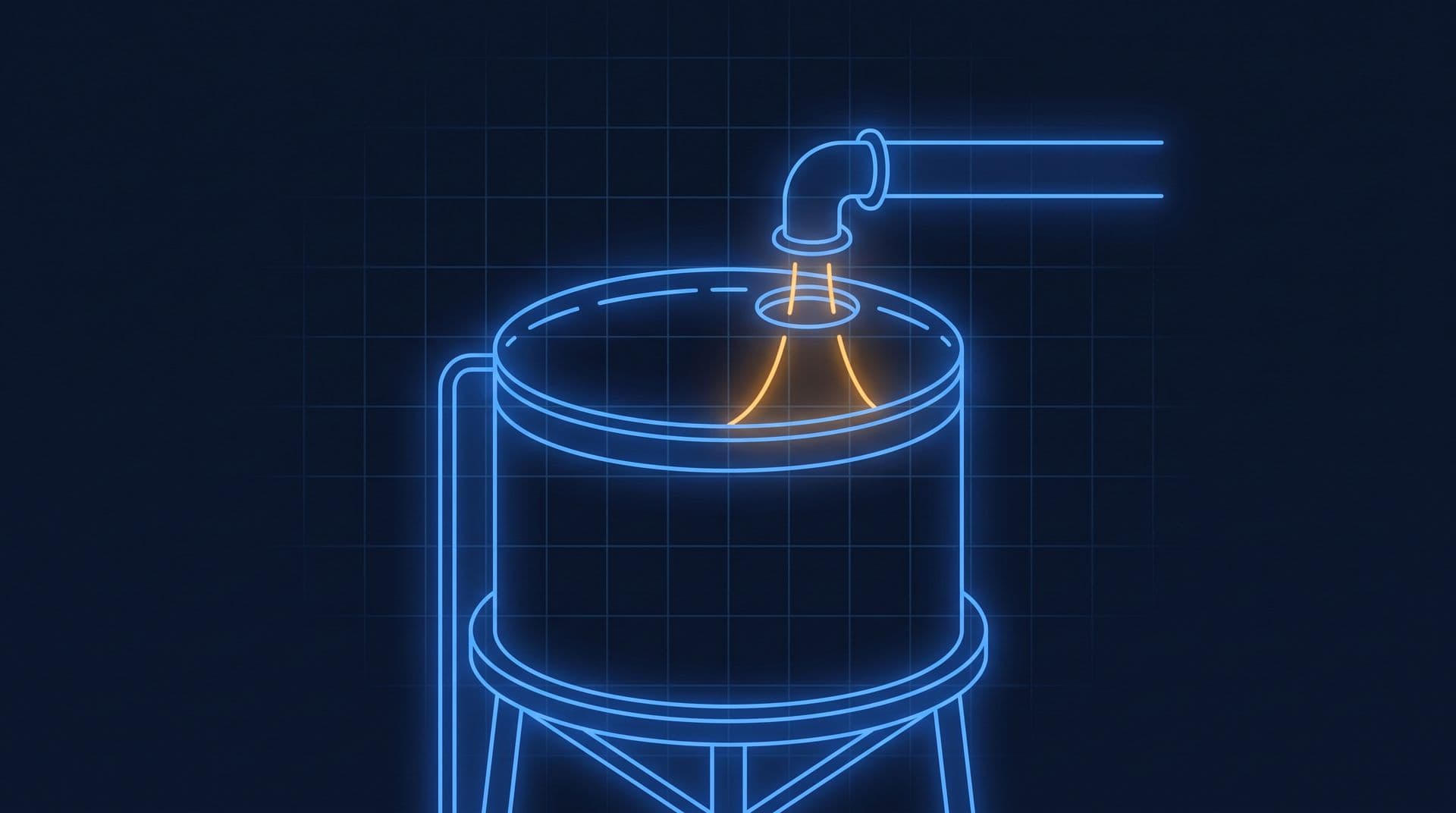
An air gap is a clear vertical space between the end of the pipe that delivers water and the highest level the water in the tank, sink or basin can reach. Water cannot jump upwards across open air, so however low the supply pressure falls, nothing can be drawn back into the pipe. The SPAN guidelines set minimum gaps:
At least 75 mm between the delivery point and the water line of roof tanks, suction tanks, baths, sinks and basins.
At least 150 mm between a kitchen tap fed directly from the supply pipe and the top edge of the sink.
At least 225 mm above the overflow level where drinking water tops up a rainwater tank, or feeds the balancing tank of a swimming pool.
A backflow preventer is a valve that lets water pass one way only. The SPAN guidelines require a dual check valve (two one-way valves in series) after the meter for premises with a higher risk, such as hospitals, mortuaries, veterinary clinics, automated car washes and factories using toxic chemicals, and a single check valve before a garden tap fed from the supply pipe. Valves can wear or jam, so they need testing and maintenance. An air gap has no moving parts.
{{media:499}}
A mains-fed roof tank, like the shoplot's, protects drinking water in several ways: the air gap at the inlet, a covered and mosquito-proof opening, visible overflow and warning pipes, and a scour pipe for draining and cleaning.
The building's storage tank is itself a large air gap. Because the float valve discharges above the water surface, water in the tank cannot flow back into the public main. The SPAN guidelines list this protection as one of the reasons a building has a storage tank at all, and say a separate backflow preventer is not needed for equipment fed from an approved storage tank. The air gap only works if it stays open. A float valve set too high, or an inlet pipe extended down into the water during a repair, removes it.
Stored water ages, and old water loses its protection
Treated water leaves the plant with a small amount of disinfectant, usually chlorine, still in it. This leftover disinfectant is called the residual. It keeps killing bacteria in the pipes on the way to your tap. The residual fades with time. The longer water sits in a tank or pipe, the less protection is left.
The time water spends in the system is called its water age. For a tank, a rough estimate is:
water age in days ≈ volume of water stored ÷ volume used per day
The office tower uses about 3,000 m³ of water a month, mostly on its 22 working days, and all of it (including the cooling tower make-up) passes through the suction tank. That is roughly 3,000 ÷ 22, or about 136 m³ on a working day. Its 300 m³ suction tank therefore holds a little over two working days of water (300 ÷ 136 ≈ 2.2), the low end of the two to three days given in Part 1. Over a weekend, when use falls, the water sits longer. Water in the roof tanks and pipes adds more time on top.
The US Centers for Disease Control and Prevention (CDC) names four factors that control the growth of Legionella, the bacterium that causes Legionnaires' disease: sediment and biofilm (a slimy layer that grows on wet surfaces), temperature, water age and disinfectant residual (CDC, Controlling Legionella in Potable Water Systems). Stored water becomes a risk when these combine:
Water age is high. Common causes are a tank much larger than the building now needs, a vacant floor, or a pipe branch that no longer serves anything (a dead leg).
The water is warm. CDC advises keeping stored cold water below 25 °C, because Legionella grows best between 25 °C and 45 °C. In a hot country, a roof tank in the sun can sit inside that range, so measuring the temperature of stored water tells you something useful.
Sediment has built up. Sand and rust settle at the bottom of a tank and give bacteria a place to grow.
The same CDC guidance recommends flushing little-used pipe runs and dead legs at least weekly, and checking that disinfectant residual can still be detected throughout the system. You can apply both to a vacant floor: run its taps and flush its toilets regularly until tenants move in.
(For the curious: cooling towers are a separate Legionella risk because they spray warm water into the air as fine droplets. Part 8 covers tower water, and Legionella in cooling towers covers the risk and its management.)
Keep the tank in good condition and keep records
Most problems with stored water start with the tank itself. The SPAN guidelines describe how a tank should be built and fitted. You can use the same points as an inspection checklist:
Cover. The tank has a chlorine-resistant cover that keeps out dust and mosquitoes, with an access opening of at least 300 mm diameter above the float valve.
Security. A shared tank, such as the office tower's roof tanks, is kept locked. Anyone entering the tank area is registered and the reason recorded in a registration booklet kept by the management.
Overflow and warning pipes. Overflow and warning pipes discharge where people can see them, so an overflow is noticed. (Part 3 explains how level controls and these pipes work together.)
Scour pipe. A drain pipe at the lowest point of the tank lets the tank be emptied fully for cleaning.
Access. There is enough clear space around and above the tank to inspect and clean it.
Inside the tank. Look for sediment, rust, algae, damaged lining, insects or anything that has fallen in.
How often should a tank be cleaned? The SPAN guidelines do not give an interval for commercial buildings. They say owners "should take initiatives to inspect, clean and disinfect" tanks at regular intervals on a voluntary basis. For shared tanks in high-rise residential buildings and gated communities, they refer to separate rules on tank maintenance that were still proposed when the guidelines were published. Check with SPAN whether those rules are now in force before relying on them. For your own building, agree an inspection interval with a tank-cleaning specialist and shorten it if inspections keep finding sediment.
Keep a simple record for every tank. Each entry should say:
The date, and who inspected or cleaned the tank.
What they found (sediment, damage, the condition of the cover and the float valve).
What was done, including how the tank was disinfected and flushed afterwards.
Any water test results, and when the tank went back into service.
After any plumbing change there is one more requirement. In buildings with shared water distribution, new or altered pipes and fittings must be disinfected by a permit holder before they are used.
The water operator's job ends at the meter
Responsibility for the water changes at the meter.
The water operator (Air Selangor in our examples) supplies treated water up to and including the meter. Air Selangor states that the property owner is responsible for leaks within the property, including supply pipes, internal pipes, fittings and appliances (Air Selangor, Leakages FAQ).
The building owner or manager is responsible for everything after the meter: tanks, pumps, pipes and taps. In a strata building, Air Selangor says the management corporation (MC) or joint management body (JMB) is responsible for the internal plumbing, pumps and water tanks.
SPAN regulates the water services industry in Peninsular Malaysia and the Federal Territories of Kuala Lumpur, Putrajaya and Labuan. It publishes the technical guidelines, registers the pipes, valves and tanks that may be used, and issues permits to plumbers. Only a holder of a SPAN Type A permit may carry out plumbing works.
{{media:500}}
The water operator is responsible up to the meter. After the meter, the building owner or management is responsible, following SPAN's rules.
For the office tower, this means the facilities team owns the water quality risk from the bulk meter to every tap. For the shoplot, the owner owns the pipe from its meter to the roof tank and every fitting inside.
Know when to call a specialist
A facilities team can check covers, locks, overflows, temperatures and records itself. Some situations need a specialist:
Discoloured, cloudy or smelly water, or complaints of illness. Stop using the affected supply for drinking and call a tank-cleaning and water-testing specialist. If the water is already bad at the meter, report it to your water operator.
Anything found inside a tank, such as a dead animal, heavy sediment or a broken cover.
After a long shutdown or a flood, before the system goes back into use.
Any plumbing change, which must be done by a SPAN-permitted plumber, followed by disinfection of the new work.
Suspected cross-connections or failed backflow valves, which a registered plumber should test and correct.
Worth knowing: The building's storage tank is itself the main backflow protection for the public main. Because the float valve discharges above the water surface, tank water cannot flow back into the street supply, which is why the SPAN guidelines say equipment fed from an approved storage tank needs no separate backflow preventer. A repair that extends the inlet pipe down into the water quietly removes that protection.
Optional detail: The SPAN clauses behind this part, all in the Uniform Technical Guidelines for Water Reticulation and Plumbing (2018): separate piping systems with no interconnections, C.3.1(g); rainwater and non-potable safeguards, C.5.2; air gaps of 75 mm at tanks, baths, sinks and basins, C.4.1(a); 150 mm at a directly fed kitchen tap, C.3.1(e); 225 mm at rainwater tanks, C.5.2(f), and pool balancing tanks, C.3.7(c); dual and single check valves, C.4.1; no separate backflow preventer after an approved storage tank, C.3.3 and C.4.1(d); tank construction and fittings, C.3.3; voluntary inspection and cleaning, C.4.2(b); disinfection of new work, C.4.3; SPAN Type A permit for plumbing works, C.3.1(a) and (c).
What comes next: measuring the water
So far this course has followed where water goes and how to keep it safe. The next module asks how much of it the building uses and what it costs, starting with the instrument at the boundary we have just drawn. The next part, How Water Meters Work in Buildings, opens with the question: how does a meter turn moving water into the one number that decides your bill, and why can a slow leak pass through it without being recorded?
Check your understanding
A contractor replaces the float valve in the shoplot's roof tank and fits the new valve so that its outlet sits below the water surface. What protection has been lost? The air gap. With the outlet under water, a drop in supply pressure could siphon water from the tank back into the supply pipe. The SPAN guidelines require at least 75 mm between the delivery point and the water line of a roof tank. The valve should be refitted so it discharges above the water.
Level 8 of the office tower is vacant between tenants and may stay empty for three months. What happens to the water in that floor's pipes, and what should the facilities team do? The water stops moving, so its age rises, its disinfectant residual fades and it warms up to room temperature. Those are the conditions that let bacteria grow. The team should flush the floor's taps and toilets regularly (CDC suggests at least weekly for little-used pipe runs) and record it, then flush thoroughly before the new tenant moves in.
Recap: Drinking water and non-drinking water must be kept in separate pipes and tanks, with no cross-connections. Backflow can pull dirty water into clean pipes when pressure drops; air gaps (at least 75 mm at tanks and basins) and backflow preventers stop it. Stored water ages and loses its disinfectant residual, so large tanks, vacant floors, dead legs, warm water and sediment all raise the risk. Inspect tanks against a checklist and keep records. The water operator is responsible up to the meter; the building owner or management is responsible after it; SPAN sets the rules and permits plumbers.
Cobler builds CobiNeural, a platform that shows a facility team its building's energy, water and indoor air data as live numbers across the whole site. To see how your building performs, talk to us.

 Tan Kok XinWater Fundamentals