
Blog
Night Flow Analysis: A Daily Leak Test
Between 2am and 4am, an empty building should use almost no water, so whatever the meter still records is mostly leakage. Night flow analysis turns continuous metering into an automatic leak test that runs every single night.
 Tan Kok XinWater Fundamentals
Part 10 of 12 in Cobler's Water Fundamentals course. New here? See the course page.
In Part 9, the monthly water balance told us whether water was missing. If a monthly balance shows water is missing, how can you tell each morning whether something changed overnight? Night flow analysis answers that. It is how you find out that a leak started on Tuesday, rather than at the end of the month.
At 3am, the office tower should be one of the quietest water systems in the city. Nobody is flushing or washing hands, the pantry taps are shut, and the cleaners went home hours ago. Yet in many buildings, water is still flowing at that hour. Night flow analysis is built on that observation: water used when almost nobody is using water is mostly water being lost. It needs a meter with a pulse output or a digital link such as Modbus (Part 6), and a logger that records it every few minutes, every night.
What night flow analysis measures
Take the flow rate through a meter and find the lowest steady value during the deep night. Do not use the lowest single reading, because single readings are noisy. Use the lowest average over a block of time: the smallest 15-minute or 30-minute average between about 2am and 4am works well for most commercial buildings. That one number, one per night, is the building's minimum night flow.
A quick note on units, because night flows are small:
- Flow is usually shown in cubic metres per hour (m³/h). One m³/h is 1,000 litres an hour.
- Small flows are sometimes given in litres per second (L/s). One L/s is 3.6 m³/h.
Plot the minimum night flow as a daily chart and you have a health check for the building's whole pipe system. A building with no legitimate night uses and no leaks should sit close to zero. A building sitting at 1.5 m³/h at 3am is losing about 1.5 × 24 hours × 30 days = 1,080 m³ a month through pipework that nobody is using, and it will keep doing that until somebody notices.
The method works because it removes people from the picture. Daytime use swings with occupancy, weather, tenant mix, events and school holidays, so comparing one month's bill with another is a weak test. At night most of that variation disappears. What remains mainly reflects the physical condition of the pipes, valves and tanks.
Why 2am to 4am is the window
You want the hours when people use the least water but the pipes are still full and under pressure. In Malaysian commercial buildings, that is usually the middle of the night: after the last cleaning shift, and before deliveries, security rounds and early gym users. Midnight is often too early, because late tenants and cleaners are still working. In a hotel or hospital, 5am is too late, because the first shift has started.
This course uses 2am to 4am. Pick a window for your building, keep it fixed, and let the trend do the work. Consistency matters more than finding the perfect hour, because you are comparing tonight with the last ninety nights.
In a tank-fed building, the bulk meter at night often shows the tanks refilling
Here is the trap. In a building like the office tower, the bulk meter does not measure water being used. It measures water going into the suction tank (Parts 1 and 3). During the day the building draws the tanks down. At night, the inlet float valve keeps refilling the suction tank, so the bulk meter can show a steady flow at 3am even when every tap is shut.
It can also mislead the other way. Some suction tanks have a delayed-action float valve, which stays shut until the level has fallen by a set amount and then opens fully. With that valve, the bulk meter can read zero at 3am while a leak is draining the tank, followed by a burst of refilling later.
There is a third problem. A large bulk meter measures low flows poorly. The office tower's 100 mm bulk meter has an illustrative label with a minimum flow (Q1) of 1 m³/h. Below that flow, the meter's accuracy is not guaranteed, and night flows are often well below it (Part 6).
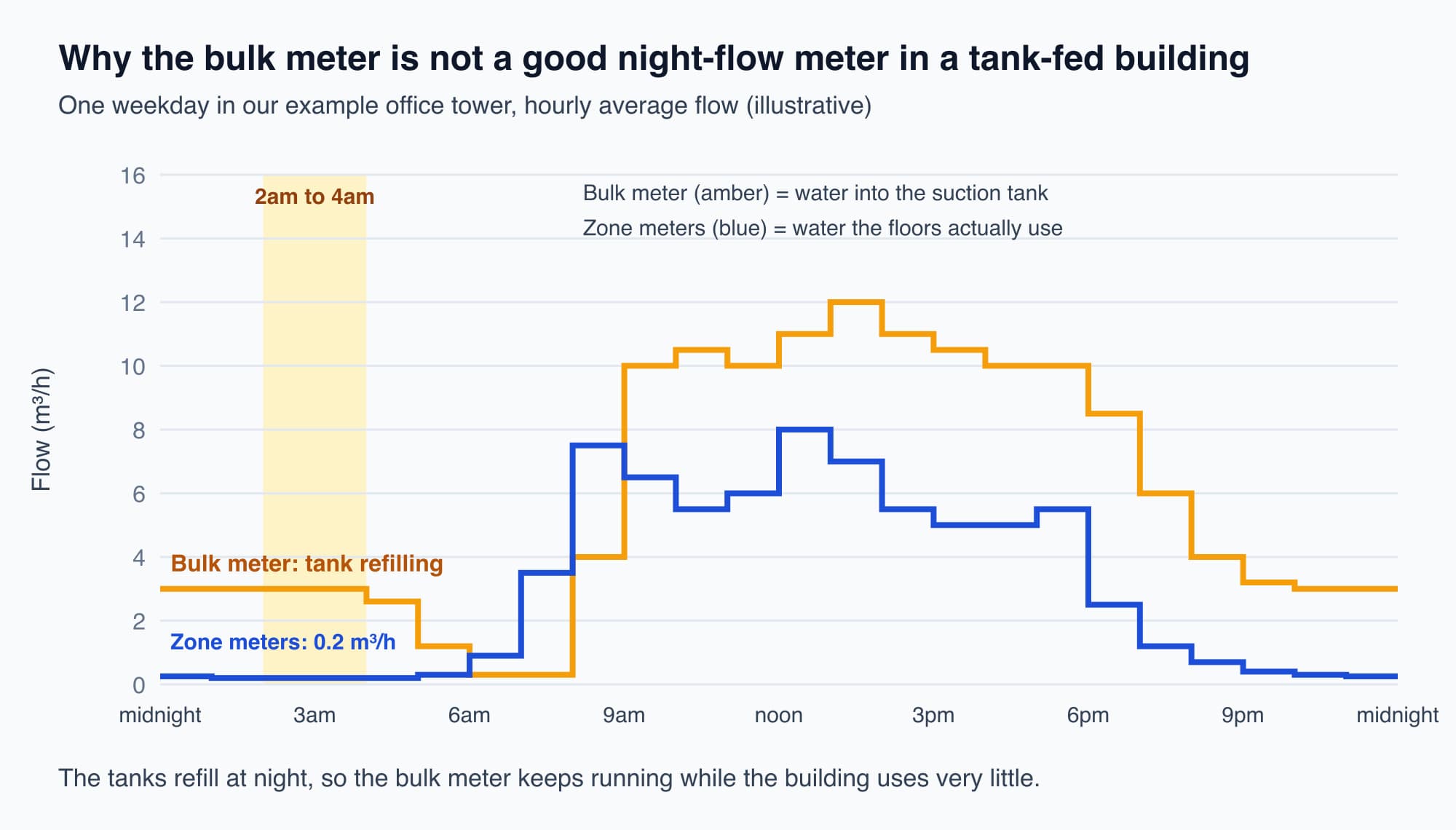
At night, the bulk meter mainly records the suction tank refilling. The meters after the tanks show what the floors actually use.
There are two ways around the trap.
- Use meters after the tanks. Meters on the pipes leaving the roof tanks (the zone downfeeds) measure what the floors draw, and refilling cannot affect them. They are also smaller, so they measure low flows better. This is the better option.
- Correct the bulk meter for tank levels. Use the same rule as the monthly balance in Part 9: night use = bulk meter volume − change in stored volume, over the whole 2am to 4am window.
Here is the correction for one normal Tuesday night in the office tower, 2am to 4am:
- The bulk meter recorded 6.0 m³, which looks like 3.0 m³/h.
- The suction tank rose from 94 to 96 percent. At 3 m³ per percent, that is +6.0 m³.
- The transfer pumps did not run, and the roof tanks fell from 45.0 to 44.6 m³, which is −0.4 m³. The fire tank did not change.
- Change in storage = 6.0 − 0.4 = +5.6 m³.
- Night use = 6.0 − 5.6 = 0.4 m³ in 2 hours, which is 0.2 m³/h.
The zone meters recorded 0.08 m³/h (upper zone) and 0.12 m³/h (lower zone) over the same window, 0.2 m³/h in total, so the two methods agree. The bulk meter on its own would have suggested 3.0 m³/h.
The correction is only as good as the level readings. In a 300 m³ tank, an error of half a percent in the level is 1.5 m³, which is almost four times this night's real use. That is why meters after the tanks are the better tool.
There is one catch in the other direction. A meter after the tanks cannot see a loss that happens at the tanks themselves, such as a suction tank overflowing because its float valve no longer closes, or a buried pipe leaking between the bulk meter and the tank. Watch both: the zone meters for use in the building, and the tank-corrected bulk figure for losses before the zone meters.
Write down the legitimate night uses first
Almost every building has some honest night-time water use. Before you raise any alarms, list it. Common examples in Malaysia:
- Cooling tower make-up, if chillers run overnight for data rooms, trading floors, hospitals or hotel back-of-house areas.
- Automatic urinal flush timers and landscape irrigation timers, which often run in the small hours by design.
- Water features, ice machines, laundries and kitchen preparation in hotels.
- Water treatment backwash cycles, which show up as short, large, repeating pulses.
- Fire tank top-up after a fire system test.
- Genuine occupant use in homes, serviced apartments, hospitals and hotels.
That last item is why night flow analysis reads differently by building type. An office tower, school, mosque or shopping mall should approach zero at 3am, which makes the method very sensitive. A 400-unit condominium never approaches zero, because people do get up at night. But its night baseline is still steady from night to night, so you watch the change rather than the absolute value.
In the office tower, the chillers are off at night, so the tower make-up meter reads zero. The normal minimum night flow is 0.20 m³/h across the two zone meters, from the ground-floor security post, the lobby washrooms and the urinal flush timers.
One item looks legitimate but is not. Fire systems have a jockey pump: a small pump that keeps the fire main at pressure and starts briefly whenever the pressure drops a little. If the jockey pump starts again and again through the night, it is not a normal load. It means water is escaping from the fire system, and the pump is replacing it. In the tower, the fire tank is filled from the incoming supply, so its top-up shows on the bulk meter but not on the zone meters.
How much night flow is too much?
No single figure suits every building. The practical approach is to compare the building with itself. Record the minimum night flow for two to four weeks, agree which part of it the legitimate uses explain, and treat the unexplained part as the leakage you are trying to reduce.
As an illustrative rule of thumb, in a building with very little genuine night use, a night flow above a few percent of the average hourly flow across the day deserves a walk-through. Many buildings find in their first week of logging that their unexplained night flow is a double-digit percentage of their total use.
Night flow tells you that something is running. A building water balance audit (Part 9) tells you how the month's water splits between the cooling tower, toilets, kitchens and losses. Used together, they turn "we are losing something" into "we are losing it here".
Burst or creep: read the shape of the trend
Two kinds of failure look quite different on a daily chart of minimum night flow, and both are worth catching.
A burst or a sudden equipment failure appears as a step. Monday night sits at 0.3 m³/h, Tuesday night at 3.1 m³/h, and it stays there. A common Malaysian example is the suction tank's float valve failing to close. Water runs out through the overflow pipe into a drain, nobody upstairs notices anything, and the building carries on as normal. A similar step appears if a roof tank's stop probe fails and the transfer pump keeps filling the tank until it overflows past the backup float valve (Parts 3 and 4). Without night monitoring, the failure is found on the bill, weeks later. With it, the step is visible the next morning.
A slow creep is the opposite shape: a gentle rise over months. Flush valve seals wear, pipe joints start to weep and isolation valves let a little water past. Each one adds a few litres an hour. No single night looks alarming, but compare this January with last January and the difference is clear. Creep is the reason to keep the daily trend for years, not just for the current month.
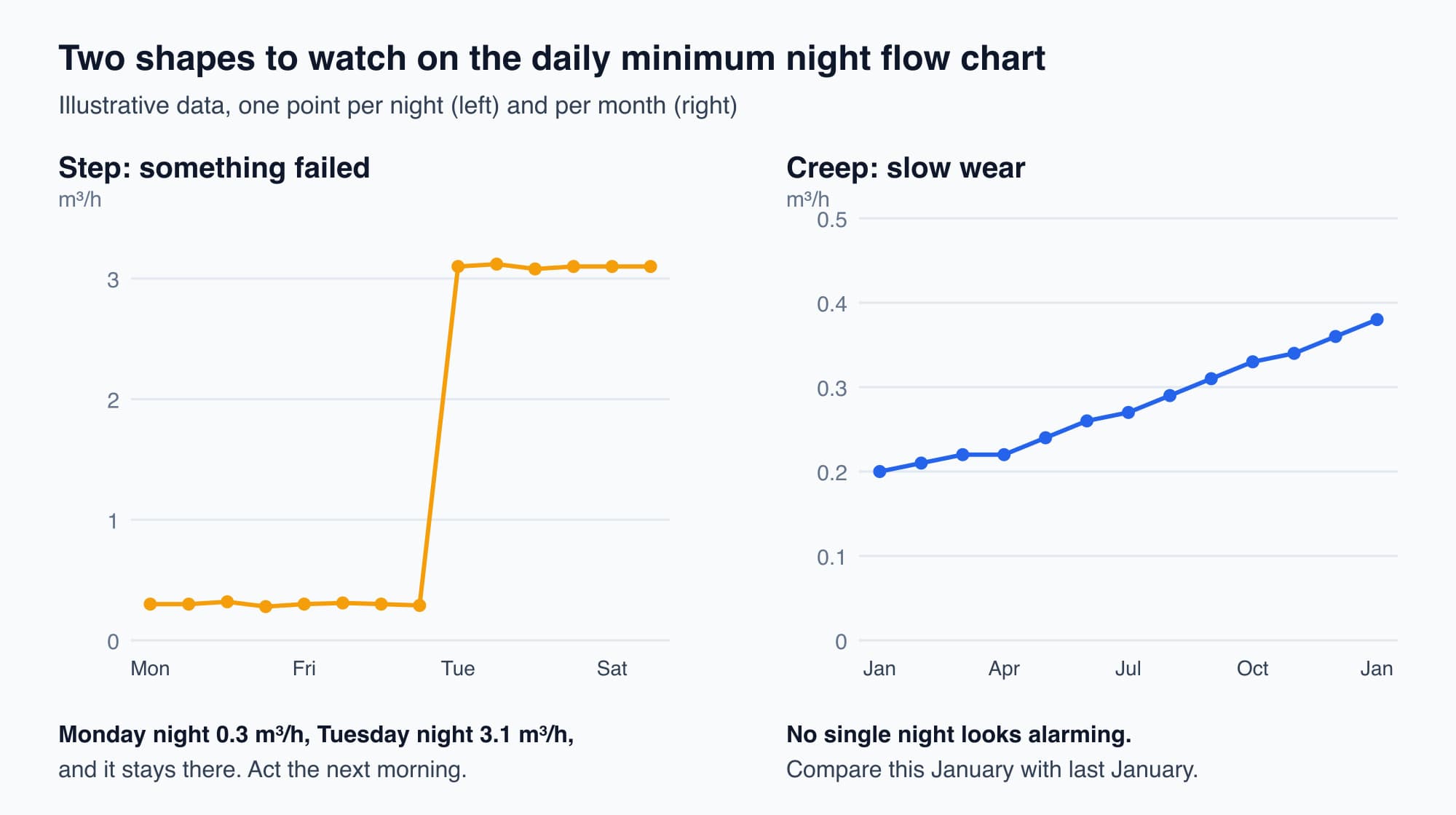
A step means something failed and needs action the next morning. A creep means slow wear, visible only when you compare months or years.
Turn it into an alert somebody acts on
A chart that nobody opens will not find a leak. Two alert rules cover most situations:
- Absolute threshold. If tonight's minimum night flow is above an agreed ceiling for that meter, notify the M&E (mechanical and electrical) team the same morning.
- Change against baseline. If tonight's value is above the median of the previous fortnight's values by an agreed margin, notify, even if it is still under the ceiling. This rule catches a burst in a building that already has a high honest baseline.
Send both to where the facility team will see them, which in Malaysia usually means WhatsApp and email rather than a portal they open once a quarter. Include the number, the usual baseline and the meter name, so the person receiving it can decide whether it is a problem for 7am or for next Monday.
An alert on the bulk meter tells you the building is losing water. Alerts on zone or riser meters also tell you where, which is why sub-metering by zone and by tenant shortens the search from days to hours.
What it is worth in ringgit
The cost of night-time loss is arithmetic. Take the unexplained night flow in m³/h, multiply by 24 hours and by 30 days, and multiply by the cost of one extra cubic metre. For the office tower, Part 7 worked that out as RM4.28 (water plus sewerage). At that rate, the 1.5 m³/h example from the start of this part costs:
1,080 m³ × RM4.28 = RM4,622.40 a month.
On top of the water, a leak inside a wet riser or a basement slab can cost far more to repair and reinstate than the water it wastes.
The test itself is cheap. Once the meters and logging are in place, the leak test runs every night with no labour, no shutdown and no valves to operate. Someone reads the number in the morning.
Worth knowing: A meter after the tanks and the bulk meter see different faults. The zone meters cannot see a suction tank overflowing or a buried pipe leaking before the tank, and the bulk meter at night is swamped by refilling. Watching both, the zone meters for the floors and the tank-corrected bulk figure for everything before them, closes the gap.
Optional detail: Minimum night flow is not new. Water utilities have used it for decades to find leaks in buried mains: they divide their networks into metered districts and watch the flow in the small hours. Inexpensive logging has made the same method practical inside one building.
What comes next
You now have all the tools: the monthly balance, the nightly minimum and the alert. The next part puts them together on one worked problem. Part 11, From Night-Flow Alarm to Verified Repair: A Worked Leak Case, follows a night-flow alarm in the office tower from the first alert to a verified repair. It opens with the question every alarm raises: is it a leak, the tanks refilling, a cleaner working late or a faulty meter, and if it is a leak, where is it and how do you prove it has been fixed?
Check your understanding
- At 3am, the office tower's bulk meter shows 3.0 m³/h. Is there a leak? Not necessarily. The bulk meter may be recording the suction tank refilling. Check the zone meters after the tanks, or correct the bulk meter for the change in stored water. On the normal Tuesday night worked through earlier, the tank-corrected use was only 0.2 m³/h, matching the zone meters.
- Why can the suction tank overflow for weeks without the zone meters noticing? The zone meters sit after the roof tanks, so they only measure what the floors draw. Water lost through the suction tank's overflow never reaches them. It does pass through the bulk meter, so the tank-corrected bulk figure (or the monthly balance) is what shows it.
Recap: Minimum night flow is the lowest 15- or 30-minute average flow in a fixed window, here 2am to 4am, recorded once a night. In a tank-fed building, the bulk meter at night often records the tanks refilling, so use meters after the tanks or correct for the change in storage, and remember that after-tank meters cannot see losses at the tanks. List the legitimate night uses first, including fire tank top-up, and treat a repeatedly starting jockey pump as a leak. A step means a failure, a creep means wear. Alert on both an absolute ceiling and a change against the baseline, and price the loss at the current tariff.
This is Part 10 of 12 in Cobler's Water Fundamentals course. Previous: How to Run a Water Balance Audit on Your Building. Next: From Night-Flow Alarm to Verified Repair: A Worked Leak Case.
Cobler builds CobiNeural, a platform that shows a facility team its building's energy, water and indoor air data as live numbers across the whole site. To see how your building performs, talk to us.
FAQ
Frequently asked questions
Ask us about this topic
Something in this article you want to dig into — or a situation in your own building it doesn't quite cover? Send us your question. We don't run public comments; the team replies to you directly by email.