Blog
Cooling Tower Water Consumption Explained
In most air-conditioned buildings in Malaysia, the cooling tower quietly outdraws every toilet, tap and kitchen combined. Here is where that water goes, why cycles of concentration decide how much you waste, and how make-up metering turns guesswork into a number.
 Tan Kok XinWater Fundamentals
Part 8 of 12 in Cobler's Water Fundamentals course. New here? See the course page.
Part 7 put a price on each cubic metre the office tower buys, and almost half of those cubic metres go to its cooling towers. Why does a cooling tower use so much water, and which part of that use can you control? This part answers both, and shows how to measure it.
(Skip this part if your building has no cooling tower. The shoplot, for instance, is cooled by split units and cassettes. These are direct expansion (DX) systems: each outdoor unit rejects its heat to the air with a fan and uses no water. Buildings on district cooling also have no tower of their own. Go straight to Part 9; its water balance works without a tower.)
When you step out of a swimming pool on a breezy day, you feel cold. The water on your skin evaporates, and evaporation takes heat away with it. A cooling tower uses the same effect on a large scale, which is why cooling tower water consumption is so high: at its peak cooling load of about 900 RT, the office tower's chiller plant turns roughly six cubic metres of water an hour into vapour, and none of it comes back. The tower is not leaking. It is doing its job.
In buildings with a water-cooled chiller plant, the cooling tower is usually the largest single water user on the incoming meter, ahead of the toilets, the kitchen and the landscaping. Part of what it uses can be reduced, but few buildings can tell you how much, because the tower's supply line is rarely metered on its own. The office tower is one of the exceptions: its three chillers (500 RT each) and three roof cooling towers have a make-up sub-meter.
What a cooling tower does, in brief
This course is about water, so here is only as much about cooling as you need. Cobler's Cooling Fundamentals course explains it fully, starting from how a chilled-water system works.
- A chiller makes cold water (chilled water) that is pumped around the building to cool the air. It takes heat out of the building.
- The chiller must get rid of that heat, plus the heat from the electricity its compressor uses. In a water-cooled chiller, this heat warms a second water loop, the condenser water, which is pumped up to the cooling tower.
- The cooling tower sprays the warm condenser water over a packing called fill while fans blow air through it. A small part of the water evaporates, which cools the rest. The cooled water returns to the chiller to collect more heat.
Cooling capacity is often measured in refrigeration tons (RT). One RT equals 3.517 kW of cooling (what is a ton of refrigeration). For the fill, fans, drift eliminators and the condenser water loop in more detail, read how a cooling tower works.
Why the tower is the biggest water user in the building
A cooling tower rejects heat by evaporating part of the water flowing through it. Evaporating a litre of water carries away a large amount of heat, which is why towers work so well, and it also sets how much water they use.
The result to remember: a tower evaporates roughly 1.8 to 2 litres of water per hour for every kW of cooling the chillers deliver, which is about 6.6 litres for every RT-hour (one RT of cooling delivered for one hour). Call it 1 m³ per hour for every 500 kW of chiller load. The office tower at its peak of 900 RT evaporates about 5.9 m³ an hour, before counting a single toilet flush. The optional box at the end shows where the 6.6 litres comes from.
(This assumes all the heat leaves the tower by evaporation. In practice a small part warms the air directly, so real evaporation is a little lower. Treat these figures as a sound upper estimate.)
This water use is not a fault. It is physics, and no amount of maintenance removes it. In Malaysia it also continues all year: there is no winter shutdown, and the plant runs every working day in warm, humid air, with sunlight that feeds algae and bacteria. That is why water treatment matters as much as the water bill.
Where cooling tower water consumption actually goes
The water you buy for the tower is called make-up water, because it makes up for what the tower loses. It leaves by four routes:
- Evaporation. The useful loss. It rises and falls with the cooling load. You cannot reduce it without reducing the cooling delivered, or making the chiller and the building need less cooling.
- Blowdown (or bleed). Water deliberately drained from the tower to keep dissolved minerals under control. This is the stream you can manage, and the next section explains it.
- Drift. Fine droplets carried out of the tower by the fans. Drift eliminators in good condition hold this to a few thousandths of a percent of the circulating flow. Damaged, missing or badly seated eliminators can lose many times more. The signs are a visible mist plume and a mineral film on cars parked downwind.
- Leaks and overflow. Float valves that stick open, cracked basins, a basin overfilling down its overflow pipe, or a make-up valve that never quite closes. These run day and night and are often what a water bill investigation finds.
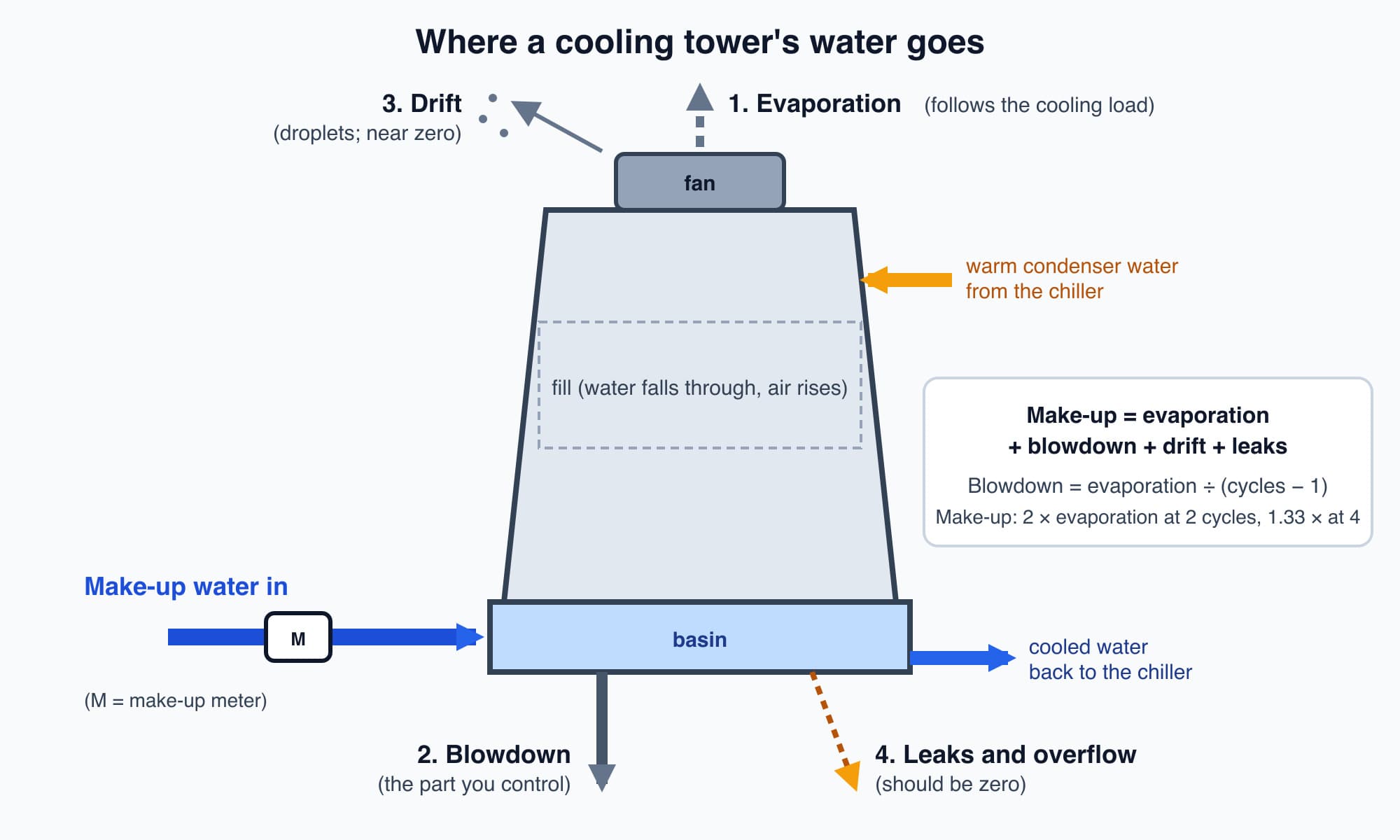
Make-up water replaces evaporation, blowdown, drift and leaks. Evaporation follows the cooling load, drift and leaks should be close to zero, so blowdown is the part you manage.
Evaporation is set by the cooling load, and drift and leaks should be close to zero. So the real control over cooling tower water consumption is blowdown, and blowdown is governed by cycles of concentration.
What are cycles of concentration?
Picture a pot of tap water simmering on a stove. Steam leaves and the water level drops, but every mineral that came in with the tap water stays behind. The water left in the pot gets more and more concentrated. A cooling tower is that pot, running continuously and topped up as it goes.
Cycles of concentration is how many times more concentrated the tower water is than the make-up water. Three cycles means the water circulating in the tower carries three times the dissolved minerals of the supply from Air Selangor or your state operator. It is usually measured with a conductivity probe: divide the conductivity of the tower water by the conductivity of the make-up water.
To stop the minerals building up forever, some tower water is drained (blowdown) and replaced with fresh make-up. The more cycles the tower runs at, the less it needs to drain. Leaving out drift and leaks, the relationship is:
- Blowdown = evaporation ÷ (cycles − 1)
- Make-up = evaporation + blowdown
At two cycles, blowdown equals evaporation, so total make-up is twice the evaporation. You buy two litres for every one that does useful cooling. At four cycles, blowdown falls to a third of evaporation, and make-up is about 1.33 times evaporation. Moving a tower from two cycles to four cuts its total water use by roughly a third for exactly the same cooling. At six cycles, make-up is 1.2 times evaporation, but the savings shrink after four or five cycles.
Using the 6.6 litres of evaporation per RT-hour given earlier:
Cycles of concentration | Make-up ÷ evaporation | Make-up per RT-hour of cooling |
|---|---|---|
2 | 2.0 | about 13 L |
3 | 1.5 | about 10 L |
4 | 1.33 | about 8.8 L |
5 | 1.25 | about 8.3 L |
6 | 1.2 | about 7.9 L |
A worked example. The office tower's make-up meter reads about 1,350 m³ in a typical month (the September 2026 month that Part 7 billed). The water treatment contractor holds about four cycles. At four cycles, make-up is 1.33 times evaporation, so:
- Evaporation ≈ 1,350 ÷ 1.33 ≈ 1,010 m³ a month.
- Blowdown ≈ 1,010 ÷ (4 − 1) ≈ 340 m³ a month.
If the treatment programme and the water chemistry allowed six cycles, make-up would fall to about 1,010 × 1.2 ≈ 1,215 m³, saving about 135 m³ a month. At the RM4.28 cost of one more cubic metre worked out in Part 7, that is about RM578 a month. In the other direction, if a stuck bleed valve dropped the tower to two cycles, make-up would rise to about 2,025 m³, costing about RM2,900 a month more.
Can you just keep running the cycles up?
No. As the cycles rise, calcium, alkalinity, silica and chlorides all concentrate. Once they pass what the make-up water chemistry and the treatment programme can keep dissolved, you get scale on the condenser tubes, corrosion in the pipework, and warm, nutrient-rich water that encourages biofilm and Legionella.
Treated supply in much of Peninsular Malaysia comes from rivers and reservoirs and tends to be relatively soft, which usually allows higher cycles than in hard-water regions. The right limit depends on an analysis of your actual make-up water and on your treatment chemicals. Ask your water treatment contractor two questions: how many cycles is the programme designed for, and how many is the tower actually holding? In many buildings the two numbers are far apart.
The usual causes are ordinary ones:
- A manual bleed valve opened years ago and never adjusted, draining water at a fixed rate whatever the load.
- A conductivity controller whose probe is fouled and reads low, so it bleeds all the time.
- A controller left in manual override since someone was troubleshooting in 2019.
None of these raise an alarm on their own.
Poor treatment shows up twice: water and kilowatts
Scale on condenser tubes acts as insulation. The refrigerant in the condenser then has to run hotter to push the same heat into the condenser water. The gap between the two temperatures is called the condenser approach, and scale widens it. A higher condensing temperature makes the compressor work harder. A common rule of thumb is that each extra 1 °C of condensing temperature costs around 2 to 3 percent of chiller efficiency.
So a tower that is scaling, because cycles were pushed too high or because the treatment programme lapsed, costs you twice: once in make-up water, and again, usually by much more, in chiller electricity every hour the plant runs. On most Malaysian commercial tariffs the electricity penalty is far larger than the water saving that caused it. On a chiller plant, water and energy are one problem.
Tower water is also a health risk. A tower sprays warm water into moving air, and the fine droplets it releases can carry Legionella bacteria if the water is not treated and the tower is not cleaned. Managing that risk is part of running a tower, usually with the help of a water treatment contractor. Legionella in cooling towers explains the risk and how it is managed. Part 5 of this course covers the separate question of keeping drinking water safe.
How to meter make-up water properly
You cannot manage any of this from a monthly bill that combines the tower with every toilet in the building. Start with a dedicated meter on the tower make-up line, with a pulse or Modbus output (Part 6 explains both), logged every fifteen minutes rather than read by hand once a month. Where the piping allows, meter the blowdown line as well. Make-up divided by blowdown then gives you the cycles of concentration continuously (approximately, as long as drift and leaks are small), without anyone climbing to the roof with a conductivity pen.
Once the data is logging, three checks do most of the work:
- Litres per RT-hour of cooling. Compare make-up volume with the chiller load recorded by the building management system (BMS). From the cycles of concentration table, a tower holding three to five cycles should use roughly 8 to 10 litres per RT-hour. The ratio should be stable. If it creeps up, the bleed has opened up or something is leaking.
- The overnight flat line. In an office building where the chillers shut down at night, make-up flow should fall to near zero once the basin has refilled. Steady flow at 3am points to a stuck float valve, a leaking basin or an open bleed, running every night. Part 10 covers night flow in detail.
- Step changes. Use that jumps on a particular date and never returns is a valve position or a controller setting, not a change in weather.
This works best when the tower is one metered branch inside a complete building water balance audit, rather than a separate project.
One more thing to check. Water that evaporates from a tower never reaches the drain, yet the IWK commercial excess charge in Part 7 is based on the water supplied to the premises. IWK's published commercial schedule does not mention an allowance for evaporation. If your tower make-up is separately metered, ask IWK directly whether any adjustment applies to your account, rather than assuming it does or does not.
Worth knowing: Moving a tower from two cycles of concentration to four cuts its total water use by roughly a third for exactly the same cooling. The usual reasons a tower runs at fewer cycles than its treatment programme was designed for are ordinary ones, such as a manual bleed valve left open or a fouled conductivity probe, and none of them raises an alarm on its own.
Optional detail: Where 6.6 litres per RT-hour comes from. Evaporating one kilogram (about one litre) of water absorbs roughly 2,400 kJ. A chiller rejects about 1.25 times its cooling load, because the compressor's energy is added to the heat taken from the building. So for each kW of cooling the tower rejects about 1.25 kW, which over an hour is 1.25 × 3,600 = 4,500 kJ. Evaporating that takes about 4,500 ÷ 2,400 ≈ 1.9 kg of water. One RT is 3.517 kW, so per RT-hour that is 3.517 × 1.9 ≈ 6.6 litres. The table's make-up figures are 6.6 litres multiplied by the ratio in the middle column.
What comes next: the water balance
You now know the largest single user in a building with a cooling tower, and how to estimate its share. The next part, How to Run a Water Balance Audit on Your Building, puts every use side by side: the bulk meter compared with the tower, the washrooms and the other sub-meters, corrected for the water sitting in the tanks. It opens with the question: where did the month's cubic metres on the bill actually go, and how much of them can nobody explain?
Check your understanding
- A tower's make-up meter reads 900 m³ in a month, and the treatment contractor reports three cycles. Roughly how much was evaporation and how much was blowdown? At three cycles, make-up is 1.5 times evaporation. Evaporation ≈ 900 ÷ 1.5 = 600 m³. Blowdown = 600 ÷ (3 − 1) = 300 m³. Together they make the 900 m³ (drift and leaks assumed small).
- In the office tower, the chillers are off overnight, but the tower make-up meter shows a steady 0.5 m³ an hour at 3am every night. What does this suggest? With no cooling load there should be almost no evaporation, so the flow is likely a loss: a float valve stuck open, a basin leaking or overflowing, or a bleed valve left open. At 0.5 m³ an hour for ten night hours on 30 nights, that is about 150 m³ a month, roughly RM640 at RM4.28 a cubic metre.
Recap: A cooling tower cools condenser water by evaporating part of it: about 1.8 to 2 litres per hour per kW of cooling, or about 6.6 litres per RT-hour. Make-up water replaces evaporation, blowdown, drift and leaks. Evaporation follows the load; blowdown depends on cycles of concentration, with blowdown = evaporation ÷ (cycles − 1). Raising cycles saves water but has a limit set by water chemistry and treatment, and scale costs chiller electricity as well as water. Meter the make-up (and ideally the blowdown), and watch litres per RT-hour, night flow and step changes.
This is Part 8 of 12 in Cobler's Water Fundamentals course. Previous: Commercial Water Tariff Malaysia: How Billing Works. Next: How to Run a Water Balance Audit on Your Building.
Cobler builds CobiNeural, a platform that shows a facility team its building's energy, water and indoor air data as live numbers across the whole site. To see how your building performs, talk to us.
FAQ
Frequently asked questions
Ask us about this topic
Something in this article you want to dig into — or a situation in your own building it doesn't quite cover? Send us your question. We don't run public comments; the team replies to you directly by email.