Blog
Commercial Water Tariff Malaysia: How Billing Works
Commercial water in Malaysia is billed by state operators at rates several times domestic, with an IWK sewerage charge often riding on the same meter reading. Here is how the structure works, and why it makes leak detection pay back faster than owners expect.
 Tan Kok XinWater Fundamentals
Part 7 of 12 in Cobler's Water Fundamentals course. New here? See the course page.
Part 6 showed how a meter turns moving water into cubic metres. What does one cubic metre of water actually cost a commercial building, once water and sewerage are both counted? This part answers that, using the tariff that applies in Selangor, Kuala Lumpur and Putrajaya from 1 September 2025, and then puts a ringgit figure on a leak.
Ask a building owner what they pay per unit of electricity and they can usually tell you. Ask what they pay per cubic metre of water and the answer is often a shrug. The bill has two parts: the water itself, charged by the state water operator, and sewerage, charged by Indah Water Konsortium (IWK). We work out both for the office tower (3,000 m³ in September 2026) and the shoplot (120 m³), both supplied by Air Selangor. This is the one part of the course that carries the full money figures; later parts refer back to it.
Who sets the commercial water tariff in Malaysia?
Water supply is run state by state, so there is no single national rate. In Peninsular Malaysia and the Federal Territory of Labuan, the industry is regulated by SPAN (Suruhanjaya Perkhidmatan Air Negara, the National Water Services Commission). SPAN runs a Tariff Setting Mechanism that standardises the categories and how often tariffs are reviewed. An operator applies for a new tariff with its state government's agreement, SPAN reviews it, and the minister responsible and the Cabinet approve it (Air Selangor, FAQ on the 1 September 2025 tariff adjustment).
The operator that bills you is state-based: Air Selangor for Selangor, Kuala Lumpur and Putrajaya, Ranhill SAJ in Johor, PBA in Penang, and other operators in Perak, Melaka, Negeri Sembilan, Pahang, Kedah, Perlis, Terengganu and Kelantan. Sabah and Sarawak are outside SPAN's framework and have their own state water authorities.
Rates differ from state to state, because each operator's costs and debts differ (the same Air Selangor FAQ). A retail chain with outlets in four states pays four different rates, with four different minimum charges. So always use your own operator's current schedule. For Selangor, Kuala Lumpur and Putrajaya it is published at airselangor.com. Tariffs are revised from time to time, so a rate copied into a spreadsheet a few years ago is probably out of date.
Find your tariff category
The operator places every account in a tariff category based on the type of premises, not on what the customer would prefer. Air Selangor's non-domestic category covers commercial and industrial premises, government buildings, schools and public universities, government and private hospitals, and plantations. Places of worship and welfare institutions, shipping and data centres each have their own special category (Air Selangor FAQ).
Air Selangor's rates from 1 September 2025 are shown below, with the domestic rates for comparison (Air Selangor, Water Tariff 2025 table, checked 23 September 2026).
Category | Monthly use | Rate (RM/m³) | Minimum charge (RM/month) |
|---|---|---|---|
Non-domestic | First 35 m³ | 3.51 | 36.00 |
Non-domestic | Above 35 m³ | 3.83 |
|
Domestic | First 20 m³ | 0.65 | 6.50 |
Domestic | Above 20 m³ up to 35 m³ | 1.62 |
|
Domestic | Above 35 m³ | 3.51 |
|
Data centre | Flat rate | 5.31 | 53.10 |
Two points stand out. First, non-domestic water starts expensive: the first non-domestic cubic metre costs RM3.51, more than five times the first domestic block of RM0.65. Second, the non-domestic tariff has only two blocks, and they are close together. Before 1 September 2025 the two non-domestic rates were RM2.70 and RM2.94, so this revision added 81 and 89 sen per cubic metre.
Why is non-domestic water so much more expensive? Air Selangor's FAQ gives the average cost of supplying water across Peninsular Malaysia and Labuan as RM2.43 per cubic metre, against an average tariff of RM2.21 after the adjustment. Household water in the first blocks is priced well below that cost, and commercial and industrial customers pay rates above it.
Work out the water charge block by block
A non-domestic bill is worked out in blocks, like steps. The first 35 m³ of the month are charged at RM3.51. Every cubic metre above 35 is charged at RM3.83. If the total comes to less than RM36.00, the minimum charge of RM36.00 applies instead. Air Selangor's own online bill calculator applies the blocks this way.
For the shoplot, using 120 m³ in September 2026:
- First 35 m³ × RM3.51 = RM122.85
- Remaining 85 m³ × RM3.83 = RM325.55
- Water charge = RM448.40, an average of about RM3.74 per cubic metre.
For the office tower, using 3,000 m³ in September 2026:
- First 35 m³ × RM3.51 = RM122.85
- Remaining 2,965 m³ × RM3.83 = RM11,355.95
- Water charge = RM11,478.80, an average of about RM3.83 per cubic metre.
For any building using more than 35 m³ a month, which includes most shoplots and every office tower, each additional cubic metre costs RM3.83. That includes every cubic metre lost to a leak.
Add the IWK sewerage charge
Almost all the water that enters a building leaves it as wastewater, and someone charges for treating it. In most of Peninsular Malaysia that is Indah Water Konsortium (IWK). Kelantan, Sabah, Sarawak and parts of Johor Bahru are served by other bodies, so check who serves your building.
IWK's charges are set by regulation (details in the optional box at the end), with the current commercial basic charges in force from 1 February 2025. For commercial premises connected to a public sewer, the monthly charge has two parts (IWK, Charges: Commercial, checked 23 September 2026):
- A basic charge based on the premises' annual value, the yearly value used for property assessment. There are 21 bands, from RM8.18 a month for an annual value up to RM2,000, to RM9,821.01 a month above RM7,000,000.
- An excess charge based on water use: nothing for the first 100 m³ in a month, 30 sen per cubic metre from 101 to 200 m³, and 45 sen per cubic metre above 200 m³.
Industrial premises are charged by number of employees instead, and government premises have their own schedule. If IWK does not have your actual water reading when it bills, it estimates from your average monthly use over the previous twelve months and adjusts later.
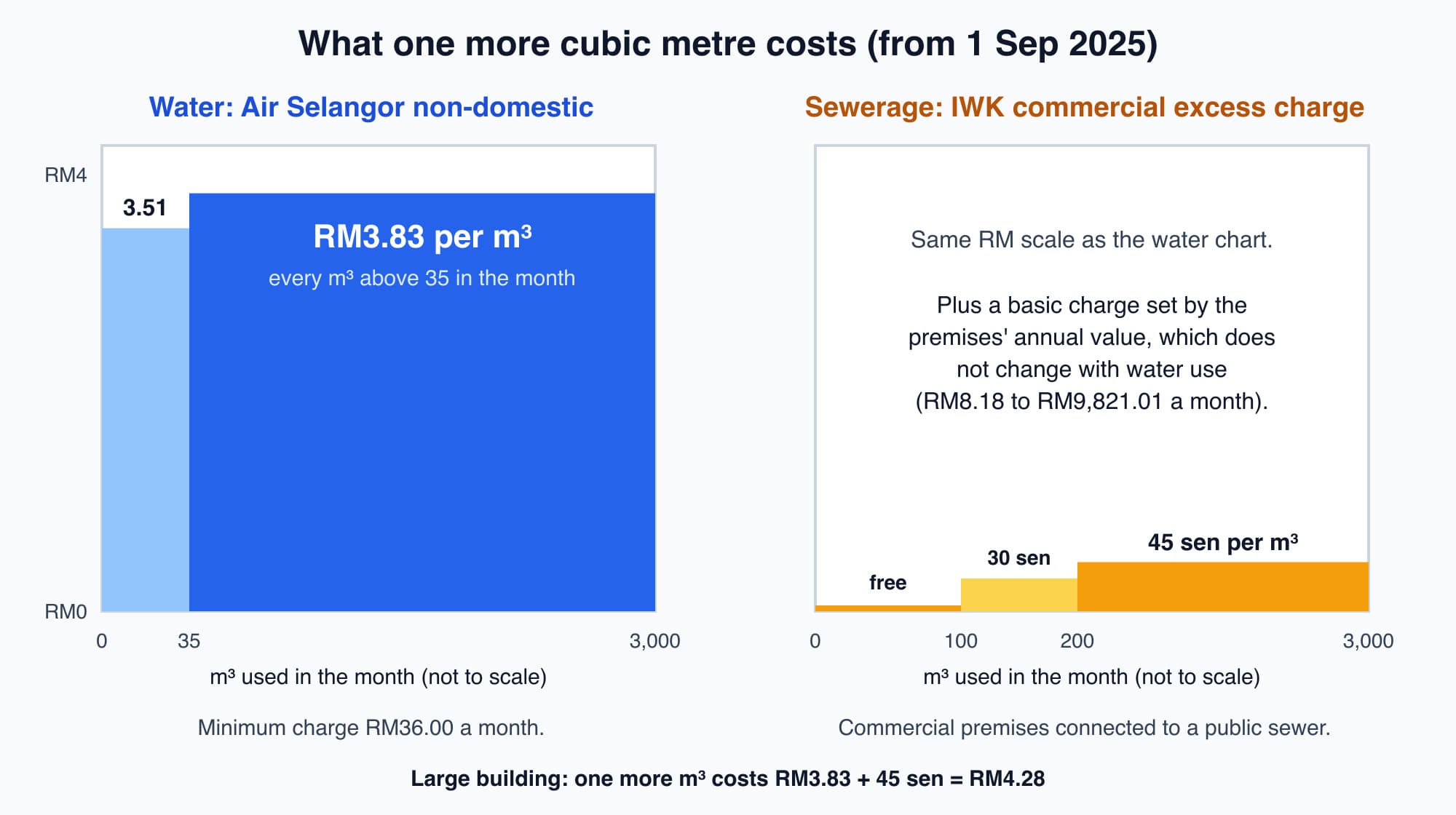
The price of one more cubic metre: RM3.83 for water once you pass 35 m³ a month, plus up to 45 sen for sewerage once you pass 200 m³. The IWK basic charge does not change with water use.
To work out our examples we need each building's annual value. Both are assumptions for these fictional buildings:
- The shoplot has an annual value of RM66,000 (band 9). Basic charge RM41.94. Excess: 120 m³ is 20 m³ above 100, so 20 × 30 sen = RM6.00. Sewerage total RM47.94.
- The office tower has an annual value above RM7,000,000 (band 21), billed as one account. Basic charge RM9,821.01. Excess: 100 m³ × 30 sen + 2,800 m³ × 45 sen = RM30.00 + RM1,260.00 = RM1,290.00. Sewerage total RM11,111.01.
This shows why a saved cubic metre does not cut the sewerage bill in proportion. The basic charge depends only on annual value. Only the excess charge moves with water use, and at most by 45 sen per cubic metre. Also note that the excess charge is based on water supplied, not water that actually reaches the sewer, so water lost to a leak into the ground still counts.
Put the bill together
Here are the two September 2026 bills side by side, before any other fees on the account.
| Example shoplot | Example office tower |
|---|---|---|
Water used | 120 m³ | 3,000 m³ |
Air Selangor water charge | RM448.40 | RM11,478.80 |
IWK basic charge | RM41.94 | RM9,821.01 |
IWK excess charge | RM6.00 | RM1,290.00 |
Total | RM496.34 | RM22,589.81 |
Cost of one more cubic metre | RM4.13 (RM3.83 + 30 sen) | RM4.28 (RM3.83 + 45 sen) |
The last row is the number to use when you value a leak or a water saving. It is the price of one more (or one fewer) cubic metre, not the average price across the bill.
Deposits, minimum charges and other fixed parts
Beyond the rate per cubic metre, a commercial account carries costs that do not change with use. The ones to look for are:
- A security deposit, usually sized by meter diameter or expected monthly use. For a large building with a 100 mm bulk meter this can be a meaningful sum held by the operator and refunded only when the account closes.
- The minimum monthly charge, RM36.00 for Air Selangor non-domestic accounts, payable even when a shoplot is closed for renovation.
- Meter rental or maintenance charges on larger meters, in some states.
- Connection, reconnection and disconnection fees if the account ever falls behind.
Deposit amounts and fees vary by operator, so check your own operator's schedule. None of these change with a leak, but they matter when you plan an extra meter, a sub-meter for a tenant or a second incoming connection.
Price a continuous leak
Now the question from the start: what does lost water cost? Take a 6 mm split in a buried pipe joint. At normal mains pressure it can pass roughly 0.2 litres per second. It runs day and night, never shows up on a walk-round and never stops on public holidays.
- Convert to cubic metres. 0.2 L/s × 3,600 seconds = 720 litres, or 0.72 m³ an hour. Over a day that is about 17 m³ (17.28 m³). Over a 30-day month it is about 518 m³. Over a year (8,760 hours) it is about 6,300 m³ (6,307 m³).
- Multiply by the cost of one more cubic metre. In the office tower that is RM3.83 for water plus 45 sen for sewerage, RM4.28 in total.
- Result. About RM2,219 a month (RM1,985 water plus RM233 sewerage), or about RM27,000 a year (RM24,157 water plus RM2,838 sewerage).
A small leak in a small building shows the same effect at a smaller scale. The half-litre-a-minute leak from Part 6 adds about 21.6 m³ a month. In the shoplot, that costs about RM82.73 in water and RM6.48 in sewerage, RM89.21 a month. That is about 18 percent on top of its RM496.34 bill.
In both cases the yearly cost of one leak running unnoticed can be larger than the cost of fitting meters that would reveal it. To find where the cubic metres go, you need a water balance: the incoming bulk meter compared with sub-meters on the cooling towers, washrooms, kitchens and irrigation. That is the subject of Part 9, How to Run a Water Balance Audit on Your Building. The same sub-meters also let an owner recharge tenants for their actual water use rather than spreading it across the service charge, using the allocation approach explained in tenant electricity billing.
Read your own bill
Pull the last twelve months of water bills and IWK bills and check four things:
- The tariff category printed on the water bill. Is it the right one for your premises?
- Minimum charges. Is a minimum charge being applied, and should it be?
- Actual or estimated readings. Estimated readings can hide a leak for months, then arrive as one large adjustment.
- The pattern of use. A monthly bill cannot show whether water is used at 3 am as well as 3 pm. For that you need interval readings from a meter, as described in Part 6. A building whose use never falls towards zero overnight has something running that should not be.
Worth knowing: IWK's sewerage excess charge is based on the water supplied to the premises, not on the water that actually reaches the sewer. So water lost from a buried pipe into the ground is charged for twice: once by the water operator and again, above 200 m³ a month, at 45 sen per cubic metre by IWK.
Optional detail: Sources and fine print. The tariff-setting process, the reasons rates differ by state, the category list and the average cost figure are in Air Selangor's FAQ on the 1 September 2025 adjustment (questions 4, 6, 7, 9 and 10). Under SPAN's Tariff Setting Mechanism, part of each rate is an electricity surcharge that follows the Automatic Fuel Adjustment charged on water operators' electricity in the previous year (FAQ question 10). Air Selangor's online bill calculator lets you switch that surcharge on or off; with it off, the non-domestic rates are RM3.50 and RM3.82, one sen lower, and the published rates in the table match the calculator with the surcharge included. IWK's charges are set by the Water Services Industry (Sewerage Services Charges) Regulations 2022 (P.U.(A) 297/2022, Second Schedule), with the commercial basic charges replaced by P.U.(A) 46/2025; the twelve-month estimate rule is regulation 4.
What comes next: where the water goes
The bill tells you what the whole building costs. The next module asks where the water actually goes. In an air-conditioned building with a chilled-water plant, the largest single user is often the cooling tower. The next part, Cooling Tower Water Consumption Explained, opens with the question: why does a cooling tower use so much water, and which part of that use can you control?
Check your understanding
- The shoplot's use rises from 120 m³ to 150 m³ in a month. How much does its combined water and sewerage bill rise? The extra 30 m³ are all above 35 m³, so the water charge rises by 30 × RM3.83 = RM114.90. Sewerage: use rises from 20 m³ to 50 m³ above 100, all within the 101 to 200 m³ band, so the excess charge rises by 30 × 30 sen = RM9.00. The basic charge does not change. Total rise: RM123.90.
- A manager says, "If we save 10 percent of our water, our IWK bill will fall by 10 percent." Is that right for the office tower? No. The IWK basic charge of RM9,821.01 depends on the building's annual value, not its water use. Saving 300 m³ cuts only the excess charge, by 300 × 45 sen = RM135, which is about 1.2 percent of the RM11,111.01 sewerage bill.
Recap: Each state has its own water operator and tariff; SPAN regulates Peninsular Malaysia and Labuan. From 1 September 2025, Air Selangor's non-domestic rate is RM3.51/m³ for the first 35 m³ a month and RM3.83/m³ above that, with a RM36.00 minimum charge. IWK's commercial sewerage charge is a basic charge set by annual value plus an excess charge of 30 sen/m³ from 101 to 200 m³ and 45 sen/m³ above 200 m³. For a large building, one more cubic metre costs about RM4.28, so a 0.2 L/s leak costs about RM27,000 a year.
This is Part 7 of 12 in Cobler's Water Fundamentals course. Previous: How Water Meters Work in Buildings. Next: Cooling Tower Water Consumption Explained.
Cobler builds CobiNeural, a platform that shows a facility team its building's energy, water and indoor air data as live numbers across the whole site. To see how your building performs, talk to us.
FAQ
Frequently asked questions
Ask us about this topic
Something in this article you want to dig into — or a situation in your own building it doesn't quite cover? Send us your question. We don't run public comments; the team replies to you directly by email.