Blog
How Water Meters Work in Buildings
How water meters measure flow, why they under-read at low flows, and why your sub-meters never quite agree with the utility's bulk meter.
 Tan Kok XinWater Fundamentals
Part 6 of 12 in Cobler's Water Fundamentals course. New here? See the course page.
Part 5 showed that the water operator's responsibility ends at the meter. So how does a meter turn moving water into the one number that decides your bill, and why can a slow leak pass through it without being recorded? This part answers both, using the office tower's 100 mm bulk meter and the shoplot's 25 mm meter.
Once a month, a meter reader visits the building, reads a number off the water meter and leaves. The meter is the boundary where the operator's supply becomes your water, and it is the only instrument both sides agree to trust.
A water meter counts volume
A water meter measures volume: how much water has passed through it in total. The register on the meter works like a car's odometer. It only counts up, and the bill is based on the difference between two readings.
Two kinds of number appear in this course, so it helps to separate them now:
- Volume is an amount of water, measured in litres (L) or cubic metres (m³). One cubic metre is 1,000 litres, about the water in five full bathtubs. Water is billed per cubic metre.
- Flow rate is how fast water is passing, measured in litres per second (L/s), litres per minute (L/min) or cubic metres per hour (m³/h). One litre per second equals 3.6 m³/h.
A meter measures flow and adds it up over time to give volume. How it measures that flow depends on its type.
What is actually inside a mechanical water meter?
Two families of mechanical meter cover almost everything you will find in a Malaysian building. Both have moving parts inside the water.
Positive displacement meters work by counting. Water fills a chamber of a precisely known volume, and a nutating disc or an oscillating piston sweeps the chamber empty. A magnet passes that motion through the meter wall to the register dial. Every movement equals a fixed number of millilitres. Because the meter counts separate parcels of water rather than measuring speed, it stays accurate at very small flows. That is why it is the traditional choice for 15mm and 20mm connections. The drawback is that grit, scale and pipe debris wear the moving surfaces, and a partly blocked strainer can stop it.
Velocity meters, usually the multi-jet type, work by timing. Water enters a chamber through a ring of ports, the jets spin a small impeller, and the register counts the turns. The number of turns per litre is set by calibration, so the reading is only right when the flow is fast and steady enough to spin the wheel properly. Multi-jet meters are cheap, tolerate dirty water and are the most common type from 15mm to 50mm in commercial buildings here.
Above roughly 50mm you will usually find a Woltmann (or helix) meter: a propeller sitting in the flow. It is used on incoming mains and large risers, such as the office tower's 100 mm bulk meter. It handles very large flows with little pressure loss, but it is poor at measuring small ones.
All of these meters spend a decade or more with moving parts in warm, chlorinated and sometimes sandy water, so they wear. Worn mechanical meters usually slow down, which means they under-read: they record less water than actually passed. Who loses depends on where the meter is:
- On the incoming bulk meter, under-reading favours the building. The operator bills for less water than it supplied.
- On a tenant sub-meter that the owner uses to recharge a tenant, under-reading works against the owner. The owner pays the operator for every cubic metre at the bulk meter but can only recover what the worn sub-meter records.
How ultrasonic meters measure water with no moving parts
An ultrasonic meter puts two sensors (transducers) in the pipe wall, angled towards each other, and sends a sound pulse in each direction. The pulse travelling downstream is carried along by the water and arrives slightly early. The pulse travelling upstream moves against the flow and arrives slightly late. The difference in travel time, measured in billionths of a second (nanoseconds), is proportional to the average speed of the water. Multiply by the known bore of the meter and you have the flow rate; add it up over time and you have the volume.
Nothing rotates, so nothing wears. This has practical consequences:
- It stays accurate at flows far below those a mechanical meter will register. This matters most for finding leaks.
- It measures in both directions, so backflow (Part 5) shows up as reverse flow instead of cancelling out or being ignored.
- It usually has a digital output built in, rather than needing one added.
- Battery-powered units are typically rated for well over a decade and are commonly sealed to IP68 (a rating for equipment that can stay under water), so they can sit in a flooded meter pit, which describes many Malaysian meter pits after a heavy afternoon storm.
The drawback is the purchase price. On a sub-meter serving a small tenant, the cost may not be worth it. On an incoming main, a cooling tower make-up line, or any point where you intend to look for leaks, it usually is.
Why does a water meter under-read at low flow?
Every meter is designed to be accurate over a range of flows, not at every flow. The international standard for water meters describes that range with four flow rates (the standard is named in the optional box at the end):
- Q3, the permanent flow rate: the highest flow the meter is designed to run at in normal use. Meters are named by it, for example "Q3 = 100" means 100 m³/h.
- Q4, the overload flow rate: the highest flow it can handle for a short time. Q4 is 1.25 times Q3.
- Q1, the minimum flow rate: the lowest flow at which the meter must still be accurate.
- Q2, the transitional flow rate: the flow that divides the range into a lower and an upper zone. Q2 is 1.6 times Q1.
The meter's label also shows its R value, which is Q3 divided by Q1. A higher R means the meter stays accurate down to a smaller flow.
The standard allows each zone a maximum error. For the common accuracy class 2 meter, the error may be up to ±2 percent in the upper zone (Q2 to Q4) for water up to 30 °C (±3 percent for warmer water), and up to ±5 percent in the lower zone (Q1 to Q2). Below Q1 there is no requirement at all.
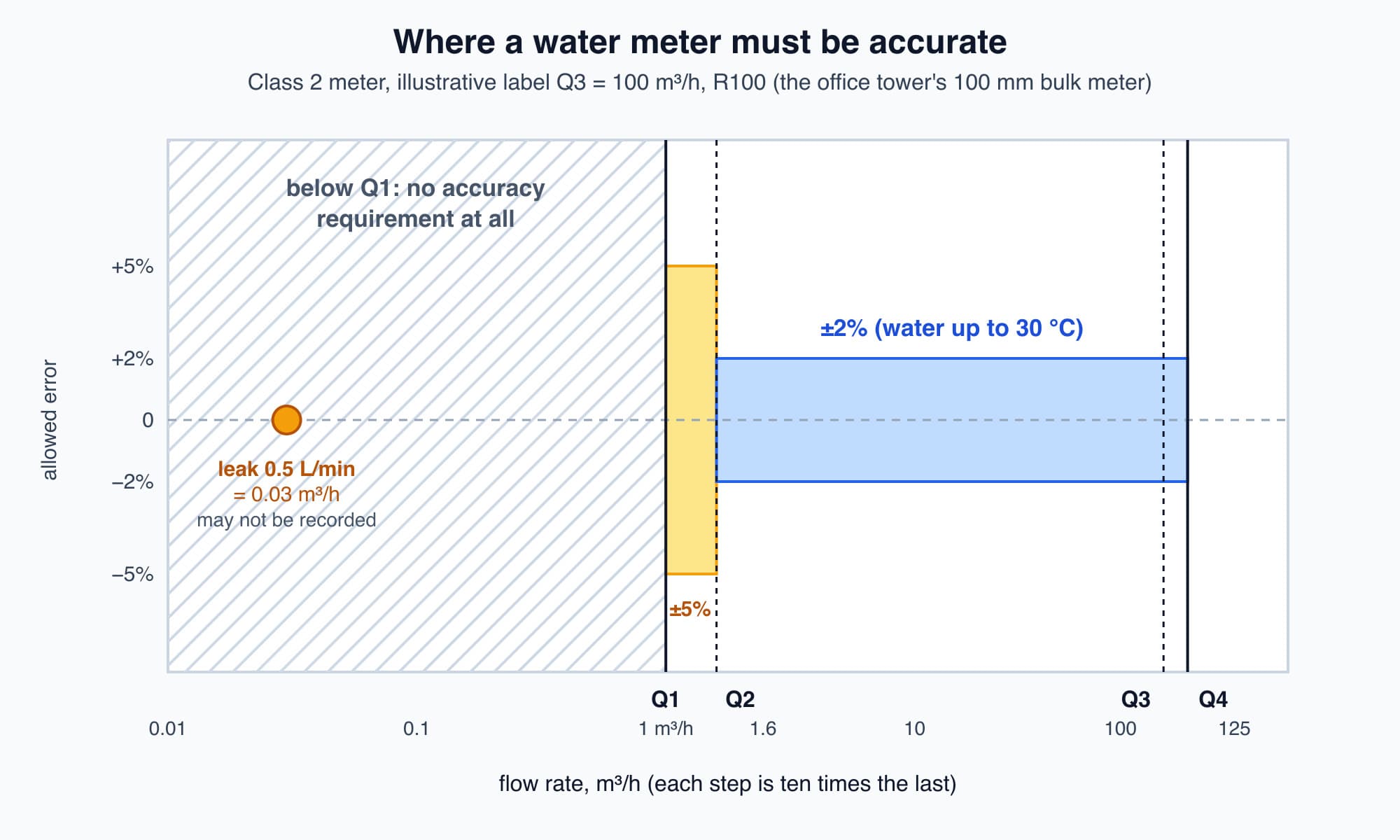
A class 2 meter must stay within ±5% between Q1 and Q2 and within ±2% from Q2 to Q4. Below Q1 nothing is guaranteed, and that is where small leaks sit.
Below Q1, a mechanical meter often does not read badly; it does not read at all. The impeller stays still, or the disc moves so slowly that friction holds it, and water passes through unrecorded.
Now consider what a leak looks like. A dripping flush valve, a pinhole in a buried service pipe or a valve that no longer shuts fully on a disused riser: these are small, constant trickles. A leak of half a litre a minute adds up to about 720 litres a day, or roughly 21 cubic metres a month, running day and night.
Here is how that compares with a large meter. Suppose the office tower's 100 mm bulk meter is labelled Q3 = 100 and R100 (an illustrative label; check the one on your own meter). Then:
- Q1 = 100 ÷ 100 = 1 m³/h, which is about 16.7 litres a minute.
- Q2 = 1.6 × 1 = 1.6 m³/h.
- Q4 = 1.25 × 100 = 125 m³/h.
The half-litre-a-minute leak is 0.03 m³/h, about one thirty-third of Q1. It sits far below the range the meter is built for. On a large multi-jet or Woltmann meter sized for peak demand, a leak like this can stay below the starting flow permanently. It is then invisible on the meter that is supposed to catch it, and invisible on the bill, which is one number a month with nothing to compare it to.
This is the main reason to care about meter type and meter size: the flows a large mechanical meter cannot see are the same size as most leaks.
Size the meter for the flow, not for the pipe
The most common sizing mistake in commercial buildings is choosing the meter to match the pipe. A 100mm main gets a 100mm meter, the installation looks tidy, and for the next fifteen years every small flow goes unrecorded.
Size the meter against the flows it will actually see instead. In most Malaysian buildings, water from the main fills a storage tank and is then pumped up to roof tanks (see how water gets to your tap in a building, Part 1). So the flow through the incoming meter is not smooth. It comes in surges while the tank's inlet valve is open, with real dead periods in between (Part 3 explains the level controls that cause this pattern).
Two practical rules follow:
- Do not simply pick the smallest meter body available. An undersized meter adds pressure loss and wears out sooner.
- Where one meter cannot cover both the peak flow and a 2am trickle, use a meter with a wide range (a high R value, which is where ultrasonic meters earn their price), or a compound meter: a large and a small meter combined, which switches the small one into use at low flow.
Pulse outputs let a logger read the meter
The cheapest way to read a mechanical meter automatically is a pulse output. A magnet on the register passes a reed switch (a small magnetic switch) and closes a contact once for every fixed volume: one pulse per litre, per 10 litres or per 100 litres, depending on the model. A logger or controller counts the pulses.
Two things commonly go wrong:
- The wrong pulse weight. With 100 litres per pulse on a small tenant meter, the overnight data is a flat line with an occasional step, which tells you little about how the water is used. With one litre per pulse on a large main, pulses can arrive faster than a slow input can count them. Choose the pulse weight to suit the flow you expect, not the pipe size.
- Reed switch faults. A reed switch is a mechanical contact. It can bounce and double-count, it can be triggered from outside with a magnet, and it eventually fails. Solid-state sensors (Hall-effect or inductive) avoid most of this.
Ultrasonic meters usually offer a proper digital connection instead, over Modbus or M-Bus. These are communication standards that let a logger or building management system ask the meter for its total and often its current flow rate directly, rather than working it out from pulses. Modbus is widely used in building controls; M-Bus (Meter-Bus) was designed for reading utility meters.
The real benefit of automatic reading is interval data: a reading every fifteen minutes instead of every thirty days. With interval data you can see how flow changes through the day and night. A building with no one in it at 3am should use very little water. If the overnight flow never falls below 300 litres per hour for weeks, something is running or leaking. Night flow is the subject of Part 10, which also explains why a tank refilling at night can look like a leak on the bulk meter.
Why the bulk meter and your sub-meters never agree
The bulk meter and the sum of your sub-meters never agree exactly. Several causes add up.
Real losses come first. Anything leaking between the operator's meter and your sub-meters is water you pay for but never measure downstream. Tank overflows count here, and so does every tap, cooling tower make-up line, landscape point or wash-down hose that has no sub-meter.
Measurement error pulls in both directions at once. The incoming bulk meter is large and blind to small flows, so it under-records the quiet hours. The sub-meters are smaller and more sensitive, but each has its own tolerance. Add twenty sub-meters, each within a few percent, and the errors do not cancel neatly. They add up to a real number.
Timing is the third cause. If the operator reads the bulk meter on the 8th and your sub-meters are logged at midnight on the 1st, you are comparing two different periods. In a building whose use changes quickly, that alone can create several percent of apparent loss. In a tank-fed building, water sitting in the tanks at the start and end of the period also shifts the numbers; Part 9 shows how to correct for it.
Anyone who has reconciled electricity sub-meters will recognise all of this. The argument in why your sub-meter and TNB meter never match (TNB is Tenaga Nasional Berhad, the electricity utility) is the same argument in a different fluid. Aim for a stable, known gap rather than a perfect balance. Track the difference between the bulk meter and the sum of the sub-meters every month, accept the percentage it settles at as your normal, and treat a change in that number as the alarm. A gap that drifts from 6 percent to 14 percent points to a new leak long before anyone finds a wet ceiling.
Worth knowing: A worn meter does not hurt everyone equally. On the incoming bulk meter, under-reading favours the building, because the operator bills for less water than it supplied. On a tenant sub-meter, the same wear works against the owner, who pays for every cubic metre at the bulk meter but can only recharge what the sub-meter records.
Optional detail: The flow rates Q1 to Q4, the ratio R = Q3 ÷ Q1, Q4 = 1.25 × Q3, Q2 = 1.6 × Q1 and the class 2 error limits come from OIML R 49, which matches ISO 4064 (OIML R 49-1:2013, sections 3.3 and 4).
What comes next: turning cubic metres into ringgit
The meter gives you cubic metres. The operator and the sewerage company turn them into a bill. The next part, Commercial Water Tariff Malaysia: How Billing Works, works through dated bills for both example buildings and puts a price on a leak. It opens with the question: what does one cubic metre of water actually cost a commercial building, once water and sewerage are both counted?
Check your understanding
- The office tower's bulk meter is labelled Q3 = 100 and R100. A toilet in the basement leaks 0.5 litres a minute. Will the meter record it? Probably not. Q1 is 100 ÷ 100 = 1 m³/h, about 16.7 litres a minute. The leak is 0.03 m³/h, far below Q1, where the standard sets no accuracy requirement and a mechanical meter may not turn at all. A sub-meter with a much lower Q1 on the pipe after the tank, or an ultrasonic meter, has a better chance of seeing it.
- The owner of the shoplot recharges the café for water through a sub-meter that has worn and now reads 5 percent low. Who loses? The owner. The owner pays Air Selangor for all the water through the building's meter but can only recover what the worn sub-meter records, so 5 percent of the café's use goes unpaid.
Recap: A water meter counts volume by measuring flow and adding it up. Mechanical meters (positive displacement, multi-jet and Woltmann) have moving parts that wear and under-read; ultrasonic meters time sound pulses and have no moving parts. Every meter is accurate only between Q1 and Q4, within ±5 percent in the lower zone and ±2 percent in the upper zone for a class 2 meter, and below Q1 small leaks can go unrecorded. Size meters for the flow, choose pulse weights to suit, and use interval data. Bulk and sub-meters never agree exactly, so watch for changes in the gap.
This is Part 6 of 12 in Cobler's Water Fundamentals course. Previous: Keeping Stored Water Safe in Buildings. Next: Commercial Water Tariff Malaysia: How Billing Works.
Cobler builds CobiNeural, a platform that shows a facility team its building's energy, water and indoor air data as live numbers across the whole site. To see how your building performs, talk to us.
FAQ
Frequently asked questions
Ask us about this topic
Something in this article you want to dig into — or a situation in your own building it doesn't quite cover? Send us your question. We don't run public comments; the team replies to you directly by email.