
Blog
Water Tank Level Control in Buildings
Float valves, level switches and electrode probes decide when your tanks fill and when your pumps run. When one sticks, the water leaves quietly through the overflow pipe and nobody notices for weeks.
 Tan Kok XinWater Fundamentals
Part 3 of 12 in Cobler's Water Fundamentals course. New here? See the course page.
Part 2 showed that the pressure on the office tower's top floors depends on the water level in the roof tanks, and the transfer pumps refill those tanks when the level drops. With nobody watching, what tells each tank when to let water in, and what tells the pumps when to start and stop? This part answers that.
The job is called water tank level control, and it is done by a few small devices: float valves, electrode probes, float switches and level sensors. When they work, nobody thinks about them. When one fails, water can run out of an overflow pipe into a drain for weeks before anyone notices.
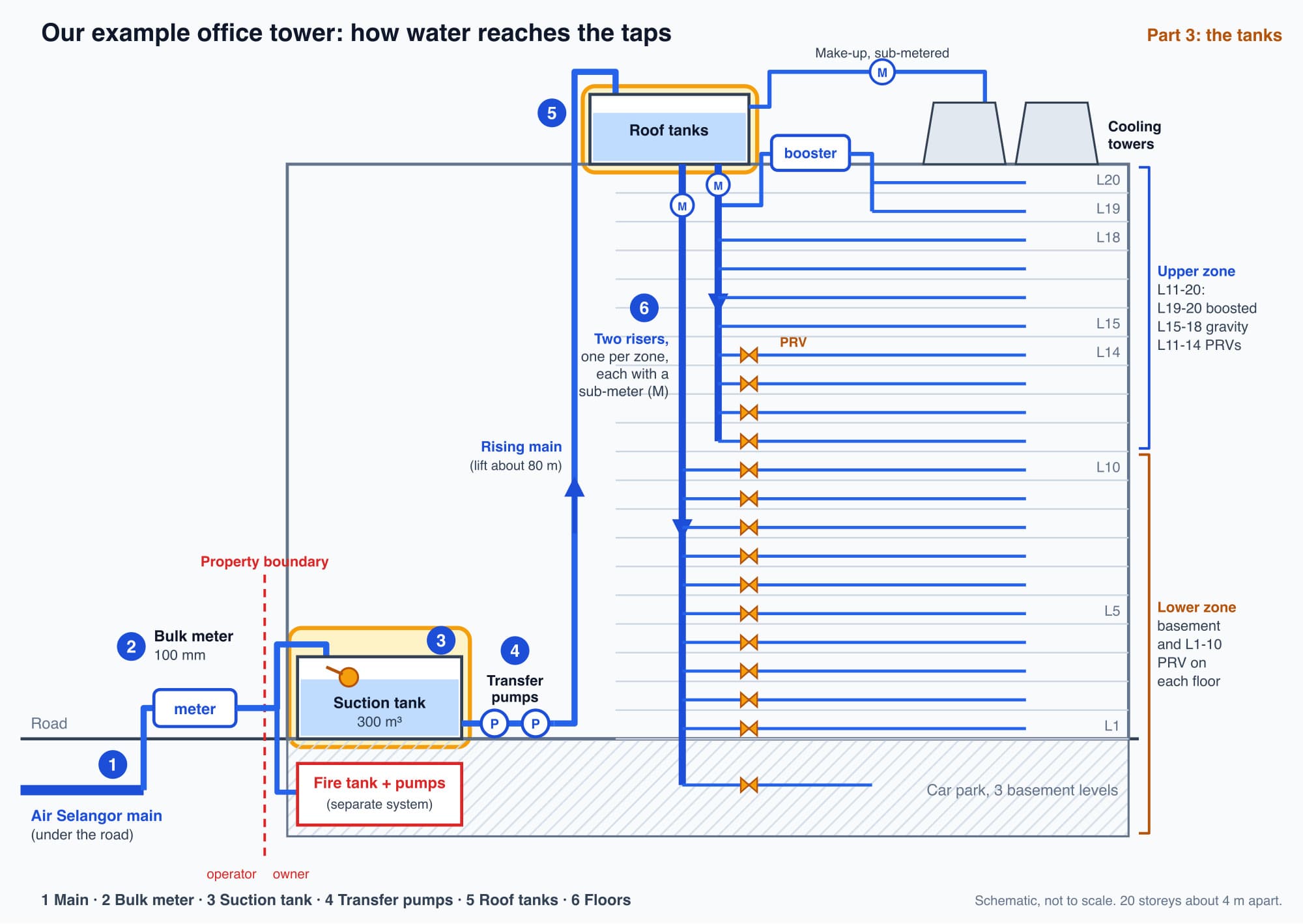
The office tower has two tanks to control: the suction tank at ground level and the roof tanks.
What a water tank level control actually does
Every tank needs two kinds of control:
- Inlet control: let water in when the level drops, and stop it when the tank is full.
- Pump control: start and stop the pumps that fill or empty the tank, and protect them.
In the office tower, the arrangement is as follows. We use it for the rest of the course.
- The suction tank is filled from the bulk meter by the main's own pressure. A float valve on its inlet lets water in and shuts when the tank is full. No electricity is involved.
- The roof tanks are filled by the transfer pumps. Electrode probes in the roof tank tell the pump panel when to start a pump (the level has dropped to the start point) and when to stop it (the level has reached the stop point). The roof tank inlet also has a float valve, as a backup (explained below with the overflow).
- A low-level probe in the suction tank stops the transfer pumps if the suction tank runs low, so they never pump air. A pump that runs dry for a few minutes can destroy its seal.
This matches the plumbing guidelines of SPAN (Suruhanjaya Perkhidmatan Air Negara, the National Water Services Commission), which say the pumps should be run automatically using stainless steel electrodes in both the suction tank and the roof tank, with an alarm when the roof tank level falls below the pump start level.
The shoplot is simpler. The main's pressure reaches its roof tank directly, so the roof tank has a float valve on its inlet and no pumps at all.
Float valves: the float shuts the inlet when the tank is full
A float valve (also called a ball valve or ballcock) is a valve on the tank inlet with a float on an arm. As the water rises, the float rises with it. The arm pushes a washer against a seat inside the valve, and the flow stops. It needs no power, wiring or programming.
The 2014 plumbing rules set three requirements for the inlet of a storage tank:
- It must have a float valve, or another effective way to control the inflow and prevent overflow, that can shut tight against twice its normal working pressure.
- The valve's outlet must be at least 75 mm above the water line. This gap is called an air gap. Because the outlet never touches the water, tank water cannot be sucked back into the supply if the main loses pressure. Part 5 explains air gaps and backflow in full.
- The inlet must discharge at least 25 mm above the tank's overflow level.
Large tanks often use a delayed-action or equilibrium float valve. Instead of slowly closing as the level rises, it stays fully shut until the level has dropped by a set amount, then opens fully. This avoids the constant half-open dribble that wears out seats.
Float valves fail in three common ways:
- The washer hardens or is damaged by grit, so the valve no longer seals and water keeps weeping through even when it is "shut".
- The arm bends or the pivot corrodes, so the valve closes late or not at all.
- The float gets a pinhole, slowly fills with water, sinks, and holds the valve open.
In each case the tank keeps taking water after it is full, and the extra water leaves through the overflow pipe.
How much water can a stuck float valve waste?
A small leak through a float valve adds up fast. Take an illustrative case: a 25 mm float valve fails partly open and passes about 0.3 litres per second into a tank that is already full. That is about 26 cubic metres a day going straight down the overflow, or about 780 cubic metres a month.
If this happened on the office tower's suction tank, all of it would pass through the bulk meter, so all of it would be billed, for water and partly for sewerage too. For comparison, 780 m³ is about a quarter of the tower's normal month. Part 7 puts a ringgit price on each extra cubic metre, and a float valve washer costs very little by comparison.
Probes, switches and sensors turn the water level into a signal
A float valve controls the inlet directly. The pumps, however, are controlled by an electrical panel, and the panel needs to know the water level. Three kinds of device provide it.
Electrode probes (also called conductivity probes) are metal rods hung from the tank lid at different depths. Water conducts a small current, so when the water touches a rod, it completes a circuit between that rod and a longer common rod. One rod marks the pump start level, one the pump stop level and one the high-level alarm. They have no moving parts. Their weakness in warm tanks is fouling: scale and slime coat the rod tips, and the panel stops seeing the water correctly. Clean them whenever the tank is cleaned.
Float switches are sealed plastic floats hanging on a cable. As the water passes them, they tilt and open or close a contact. They are cheap and easy to replace. They fail when the cable wears out where it enters the float, when the float snags on a pipe or ladder, or when someone rehangs it at the wrong depth after cleaning.
Continuous level sensors (also called level transmitters) measure the actual level, in metres or per cent, instead of a few on/off points. One type is an ultrasonic sensor looking down from the lid; another is a pressure sensor at the bottom of the tank. A continuous level lets you see how fast the tank fills and empties, which later parts use to measure the building's water use. The office tower has a level transmitter on the suction tank and on the roof tanks, alongside the probes.
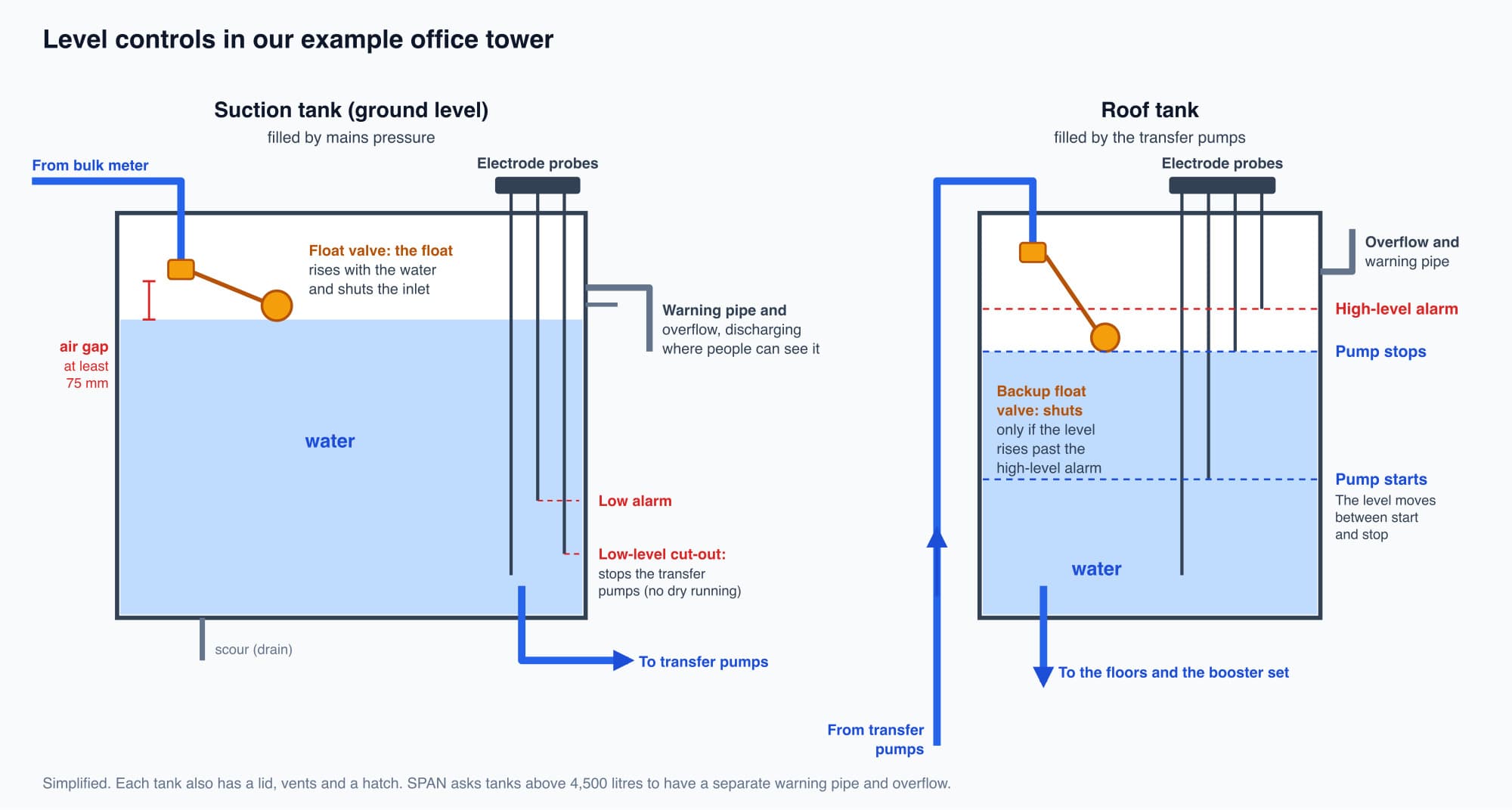
The suction tank's float valve controls its inlet. Probes in the roof tank start and stop the transfer pumps, and a probe in the suction tank stops them if it runs low.
The overflow is the last layer of protection
Good practice is to protect a tank with several layers, each one catching the failure of the one before. For our roof tank, from lowest to highest:
- The pump stop probe is the main control. It stops the transfer pump when the tank is full.
- The high-level alarm probe, a little higher, raises an alarm if the level goes past the stop point.
- The backup float valve on the inlet shuts if the level keeps rising.
- The overflow pipe, higher still, lets water out safely so the tank does not burst or flood the roof.
The suction tank has fewer layers: its float valve is the main control, and the overflow is behind it. If your only protection against overflow is one float valve, a single worn washer is enough to waste water.
An important point for later parts: an overflowing tank is at its highest level. If the roof tank is overflowing and the transfer pump is still running, the stop probe or its panel has failed, and so has the backup float valve. The pump is not "trying to fill" the tank. Part 4 uses this to diagnose pumps.
The overflow is a safety device. It is not meant to carry water in normal use, so any flow through it means something has failed. SPAN's guideline says that tanks larger than 4,500 litres should have a separate warning pipe and overflow, both discharging at a visible place so that people can see an overflow. A warning pipe is a small pipe set just above the normal water line whose outlet is somewhere conspicuous. Smaller tanks can use one overflow pipe as the warning pipe, provided it discharges where people can see it.
Two practical steps make an overflow hard to miss:
- Make the discharge visible. Route it to a place people walk past, not into a hidden floor drain on the roof.
- Put a small flow switch or meter on the overflow and wire it to an alarm, so any flow sends a message. If the tank has a continuous level sensor, a high-level alarm does the same job without changing the pipework.
A passing float valve on the suction tank also shows up on the bulk meter. If the suction tank is full and the meter is still turning in the middle of the night, water is leaving somewhere: through the overflow, or through a leak. Be careful the other way round, too. A bulk meter turning at 3am may simply be the suction tank refilling after the day's use. Part 10 explains how to tell the two apart.
How much storage a building needs
Storage sizing balances two needs. Too little, and a supply interruption empties the building by lunchtime. Too much, and water sits in the tanks for a long time. In warm tanks the disinfectant (chlorine) left in the water fades over time, and stale water becomes a hygiene risk.
The sizing rules for domestic water storage come from SPAN's Uniform Technical Guidelines and the water operator, not from the Uniform Building By-Laws, which mainly deal with fire. SPAN's guideline says the storage should provide one day's water use, and gives minimum figures for different buildings. Two of them match our example buildings:
- Offices and commercial buildings (domestic use): 1,000 litres per 100 square metres of floor area. The office tower has 30,000 square metres, so the minimum is 300,000 litres, or 300 m³.
- Three-storey shop house: 4,100 litres. That is the minimum for a building like the shoplot.
The guideline also says the suction tank should hold 30 to 70 per cent of the total daily storage, with the rest in the roof tanks. The office tower's two roof tanks hold 100 m³ each, so its 300 m³ suction tank is 60 per cent of the 500 m³ total. Hospitals, airports and medium and heavy industries need at least two days' storage. Fire water is always stored separately, because it must never be used up by daily needs.
These are minimum design figures. The water a building actually uses is often lower. Our tower's 1,500 people use about 75 m³ of domestic water on a working day (about 50 litres each), and the cooling towers add roughly 60 m³, so a normal working day is about 100 to 140 m³. The 300 m³ suction tank therefore holds about two to three days of normal use. A year of meter readings tells you your real use. Part 5, Keeping Stored Water Safe, explains why water that stays too long in a tank is a problem.
Inspect the level controls whenever the tank is open
The best time to check the level controls is when the tank is drained for cleaning, because everything inside is reachable. SPAN's guideline says owners of premises such as offices and shops should inspect, clean and disinfect their tanks at regular intervals, on a voluntary basis. It does not set a fixed interval for them. Part 5 explains tank cleaning, water quality and who is responsible.
Use each visit to check the controls:
- Check the float valve seat and washer, and replace worn parts before they fail.
- Check that the float has not taken on water, and that the arm and pivot move freely.
- Clean the electrode probe tips and check that each one still switches at the right level.
- Test the high-level alarm and any inlet valve by raising the level or lifting the float, not by assuming they work.
- Check that the overflow and warning pipe are clear, screened against insects and discharging where someone would notice.
- Check that the lid seals, the vents are screened and no light reaches the water.
Afterwards, write the switching levels on the tank or in the pump panel. The most common fault after a cleaning visit is a float switch or probe rehung at the wrong height. Too small a gap between start and stop makes the transfer pump start and stop very often. A stop point set too high leaves the roof tank much fuller than intended, or lets it reach the overflow.
Worth knowing: The most common level-control fault after a tank cleaning is not a broken part but a probe or float switch rehung at the wrong height. Writing the switching levels on the tank or in the pump panel before the cleaners start takes a few minutes and prevents both a pump that starts every few minutes and a roof tank filled to its overflow.
Optional detail: The inlet requirements (a float valve or equivalent that shuts tight against twice its working pressure, the 75 mm air gap, discharge at least 25 mm above the overflow level) are in rule 47 of the Water Services Industry (Water Reticulation and Plumbing) Rules 2014. The rest of this part draws on SPAN's Uniform Technical Guidelines for Water Reticulation and Plumbing (April 2018): storage of one day's use and the minimum figures per building type (section C.3.3), the separate warning pipe for tanks over 4,500 litres (C.3.3), the air gap (C.4.1), automatic pump control by stainless steel electrodes and the 30 to 70 per cent suction tank share (C.3.5), and voluntary inspection, cleaning and disinfection (C.4.2).
What comes next: pumps
The level controls in this part decide when the transfer pumps start and stop. The next part, Water Pumps in Buildings Explained, explains what the pumps themselves do, the difference between transfer pumps and booster sets, and how to read their behaviour. It opens with the question: what does a pump actually do, and what is it telling you when it starts too often or never stops?
Check your understanding
- At 3am the roof tank's overflow pipe is running and the transfer pump is still on. What has failed? An overflowing tank is at its highest level, so a working stop probe would already have stopped the pump. The stop probe or the pump panel has failed (for example a fouled or disconnected probe, or a panel left in manual), and the backup float valve on the roof tank inlet is not shutting either.
- The roof tank's stop probe already stops the transfer pump when the tank is full. Why does the inlet also have a float valve? It is a backup layer. If the stop probe fouls or its panel fails, the pump keeps running and the level keeps rising. The backup float valve then shuts the inlet before the water reaches the overflow. The high-level alarm, between the two, warns that the first layer has failed.
Recap: Every tank needs inlet control and pump control. In the office tower, a float valve controls the suction tank inlet, and electrode probes in the roof tank start and stop the transfer pumps. A low-level probe in the suction tank protects the pumps from running dry. The 2014 plumbing rules require a float valve or equivalent and a 75 mm air gap on tank inlets. Float valves fail by leaking, sticking or sinking, and a small leak can waste hundreds of cubic metres a month. An overflowing tank is at its highest level, so overflow means a control has failed; overflows should be visible and alarmed. SPAN's guideline sizes storage for one day's use; for our tower that is at least 300 m³.
This is Part 3 of 12 in Cobler's Water Fundamentals course. Previous: Water Pressure in Buildings, Explained. Next: Water Pumps in Buildings Explained.
Cobler builds CobiNeural, a platform that shows a facility team its building's energy, water and indoor air data as live numbers across the whole site. To see how your building performs, talk to us.
FAQ
Frequently asked questions
Ask us about this topic
Something in this article you want to dig into — or a situation in your own building it doesn't quite cover? Send us your question. We don't run public comments; the team replies to you directly by email.