
Blog
Water Pumps in Buildings Explained
Transfer pumps, booster sets, duty/standby arrangements and float interlocks, explained without the hydraulics jargon. Learn what short-cycling and a pump that never stops are trying to tell you, and why every leaking cubic metre costs you twice.
 Tan Kok XinWater Fundamentals
Part 4 of 12 in Cobler's Water Fundamentals course. New here? See the course page.
Part 3 showed how probes in the office tower's roof tanks tell the transfer pumps when to start and stop. That leaves the pumps themselves: what does a pump actually do, and what is it telling you when it starts too often or never stops? This part answers both.
The tower has two sets of pumps: the transfer pumps that lift water from the suction tank to the roof tanks, and the booster set that raises the pressure on levels 19 and 20 (Part 2). Water pumps in buildings are some of the few machines that work around the clock, and they are rarely metered on their own, so their electricity cost is hidden in the building's total bill. They are also a useful diagnostic tool, because their pattern of starts shows things a monthly bill cannot.
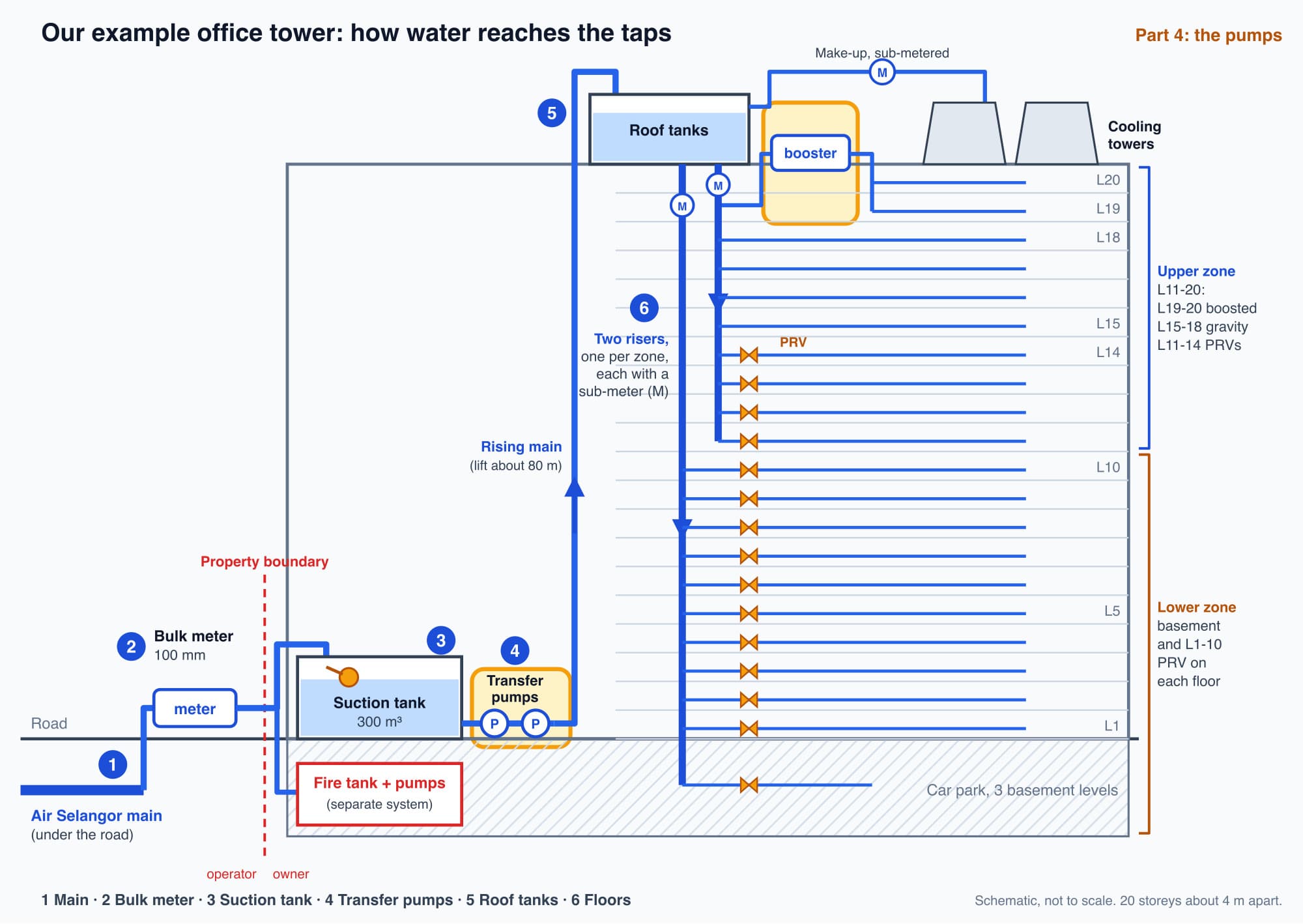
The office tower has two sets of pumps: transfer pumps at ground level and a booster set on the roof.
A pump adds pressure to lift water and push it through pipes
A pump does not make water. It adds pressure, which in water terms is the same as adding height (head). Part 2 gave the rule: about 10 metres of head equals 1 bar. So a pump that adds 3 bar can push water about 30 metres up, if nothing else gets in the way.
Every pump has to provide two things:
- Static lift: the height from the water surface it draws from to the point it delivers to. For our tower's transfer pumps, from the suction tank at ground level to the roof tanks, that is about 80 metres.
- Friction loss: the extra pressure lost as water rubs along pipe walls and passes through valves and bends. Part 2 explained that this grows quickly with flow. Long horizontal runs and undersized pipes add to it, which is why two buildings of the same height can need quite different pumps.
Transfer pumps fill tanks; booster sets hold pressure
These two kinds of pump are often mixed up, but they do different jobs and fail in different ways.
A transfer pump moves water from one tank to another. In our tower, it draws from the suction tank and pushes water up the rising main into the roof tanks. It does not respond to pressure at any tap. It responds only to the roof tank level: when the level falls to the start probe, the pump runs at more or less full flow until the level reaches the stop probe, then it stops (Part 3). SPAN's plumbing guidelines ask that the duty pump be able to fill the roof tank of an office or commercial building within eight hours. Transfer pumps have long runs and few starts.
A booster set holds a pressure instead of filling a tank. In our tower it draws from the roof tank and serves levels 19 and 20, which are too close to the tank for gravity to give enough pressure (Part 2). Taller buildings with several pressure zones may have a booster set for each zone.
A booster set is a package of two or more pumps controlled by a pressure switch or pressure sensor on its outlet pipe. Most also have a pressure vessel: a small tank with a rubber bag (bladder) inside and a cushion of compressed air. The vessel stores a little water under pressure, so a small draw, such as one tap for a few seconds, can be served without starting a pump. SPAN's guideline calls for either a duty and standby set of this kind (called hydro-pneumatic) or a variable speed set.
A variable speed drive (VSD) is an electronic unit that changes the speed of the pump motor. With a VSD, the pump speeds up and slows down to hold a steady pressure, instead of switching fully on and off. Running a pump slower than full speed uses much less power; How Electric Motors Work in the Electricity Fundamentals course explains motors and speed control.
Why there are always at least two pumps
Almost every pump room has pumps in pairs or threes. The usual arrangement is duty and standby: one pump does the work while the other waits. Larger systems use duty, assist and standby: a second pump cuts in when one cannot keep up, and a third waits in reserve. SPAN's guideline also asks that pumping systems in buildings other than landed houses be backed up by a generator, so the water keeps moving during a power cut.
A good control panel swaps the duty pump on every start or on a timer, so the pumps share the running hours. This matters because a pump that has not run for six months often has stiff seals and a corroded shaft, and it may fail on the day the duty pump breaks down. If the standby pump shows zero hours in the log, the building does not really have a standby.
Also check that both pumps can still do the job. Impellers (the spinning part that moves the water) wear, and non-return valves stick. A set that was designed for one pump to do the work can slowly decline until it needs both.
What tells a pump when to run
The two kinds of pump take their orders from different signals:
- Transfer pumps follow the roof tank level. In the office tower, the start and stop probes in the roof tanks switch them, and the low-level probe in the suction tank stops them before they run dry (Part 3 covers these, with the high-level alarm and backup float valve that sit above the stop point).
- Booster sets follow pressure. When a tap opens and the pressure falls below the "cut-in" setting, a pump starts. When the pressure rises to the "cut-out" setting and the flow stops, it stops.
The low-level cut-out and the high-level alarm are interlocks: safety signals that override the normal controls. Many buildings have them installed and have not tested them since the building was handed over.
What does short-cycling mean?
Short-cycling is a pump starting and stopping repeatedly over a short time, sometimes several times a minute. It always has a cause.
On a booster set, the usual cause is a pressure vessel that has lost its air cushion. Without air, the vessel cannot store water under pressure, so the smallest draw makes the pressure fall and a pump starts, runs for a few seconds and stops. Other causes are:
- A leaking non-return valve that lets water flow backwards between starts.
- Cut-in and cut-out pressures set too close together.
- A pump much bigger than the building's actual demand.
On a transfer pump, rapid starting usually means the start and stop probes are set too close together (for example after being rehung during a tank cleaning), or, where float switches are used instead, a float is swinging in rough water.
Short-cycling does not show on the water bill, but it costs money. Each start draws a large burst of current, heats the motor windings and wears the contactors, bearings and seals. A pump designed for a few starts an hour that is doing forty will not reach its design life.
What an unusual pump pattern tells you
The transfer pump's pattern at night, when an office is almost empty, is a good health check. Compare the three nights in the diagram.
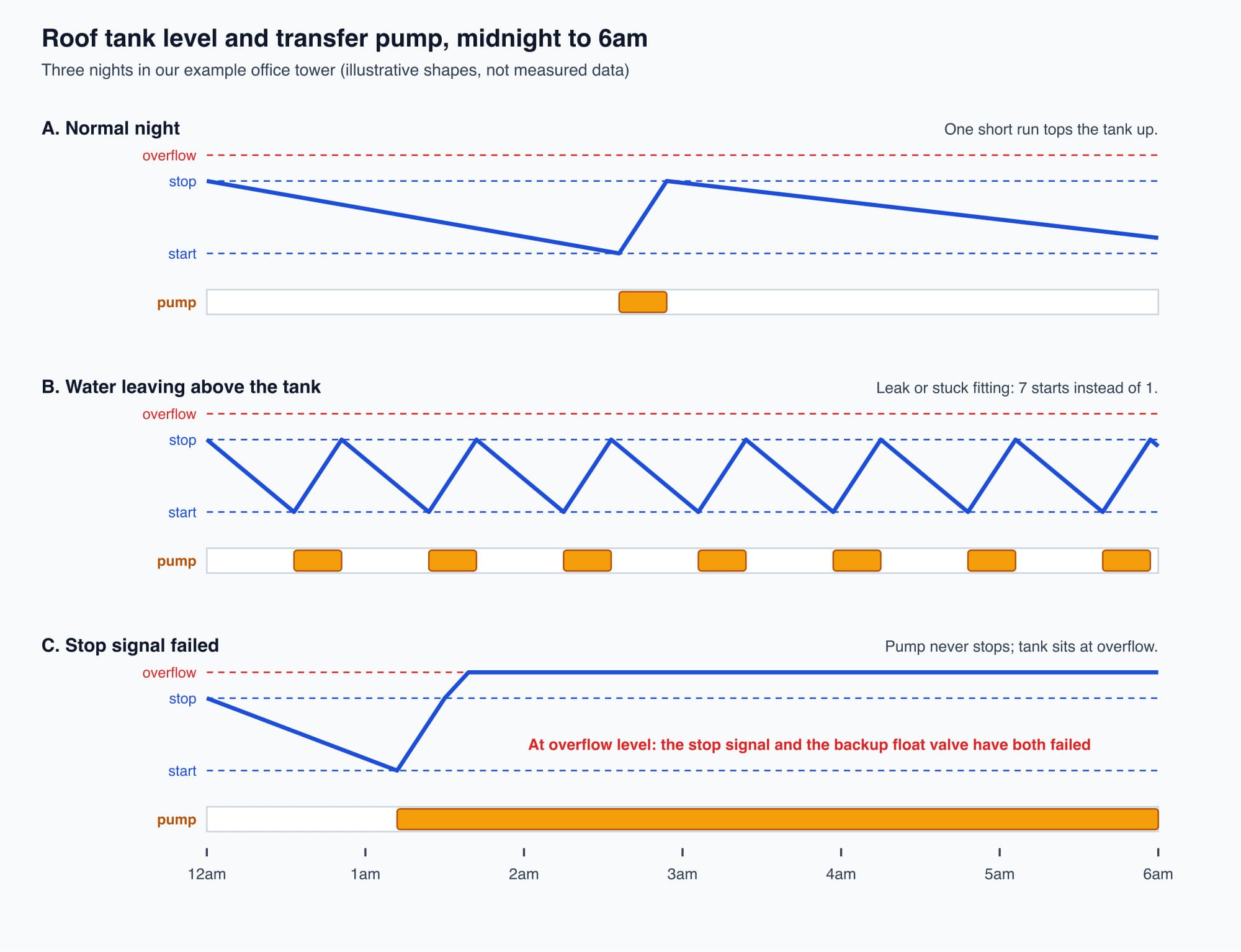
Illustrative nights in the office tower: one run is normal, many runs mean water is leaving, and a pump that never stops with the tank at overflow means the stop signal has failed.
A. A normal night. Very little water is used, so the roof tank level falls slowly. The pump starts once or twice to top it up.
B. Many more starts than usual. Each run moves about the same volume: the water between the start level and the stop level. So more starts means more water is leaving the roof tank. Something above the tank is drawing water: a leak on the riser or floor pipes, a stuck flush valve or tap, or a legitimate night user such as cooling tower make-up while the air-conditioning plant runs. If you know the volume between the start and stop levels, the number of starts tells you roughly how much water went. A pump that used to start twice a night and now starts seven times is worth investigating.
C. The pump never stops, and the roof tank is overflowing. An overflowing tank is at its highest level, so a working stop probe would already have stopped the pump. Here the stop signal has failed: a fouled or disconnected stop probe, a stop probe rehung too high after cleaning, or a panel left in manual mode. The backup float valve on the inlet has also failed to shut. From the ground floor nothing looks wrong. Taps work and tenants are happy, while treated water runs from the roof tank overflow into the drain all night, and the building pays to pump every litre of it up 80 metres. This fault can go on for months, because nobody hears a roof tank overflow from the offices.
Two other patterns are worth knowing:
- The pump never stops, but the tank is not overflowing. If the level is steady just above the high-level alarm, the stop signal has probably failed and the backup float valve has shut. The pump is now running against a closed valve, which heats the pump and can damage it. The high-level alarm should have gone off. If the level is low or falling while the pump runs, the pump is delivering less than the building draws: a worn pump, a partly closed or choked valve, or a large leak on the rising main.
- The suction tank overflows. This is a different fault. The suction tank is filled by mains pressure through its own float valve (Part 3), so the transfer pumps can look normal while the suction tank's float valve lets water run to the overflow.
A booster set that never stops follows the same logic. With no one drawing water, holding pressure should need almost no flow. If a pump keeps running or restarting all night, the zone is losing water somewhere, or a valve is passing.
Every wasted cubic metre was also pumped
When a leak or overflow happens above the transfer pumps, the building pays for the water and also for the electricity to lift it.
Lifting one cubic metre of water 50 metres takes about 0.14 kWh of hydraulic work, which is the energy that ends up in the water. (A kilowatt-hour, kWh, is the unit of energy on an electricity bill; Power vs Energy in the Electricity Fundamentals course explains it.) Real pumps and motors lose some energy as heat. With a combined efficiency of about 50 to 60 per cent, typical for an older set, that becomes about 0.2 to 0.3 kWh drawn from the switchboard for each cubic metre lifted 50 metres. These are illustrative figures: the real number depends on the lift, the pipe sizes and the pump's condition.
Our tower lifts water about 80 metres, which takes about 0.22 kWh of hydraulic work per cubic metre, or roughly 0.4 kWh from the switchboard at the same efficiency. Suppose 780 m³ a month is lost somewhere above the transfer pumps, for example through stuck flush valves (the same size of loss as the float valve example in Part 3):
- Electricity: 780 × 0.4 is about 310 kWh of extra pumping energy a month.
- Water: 780 m³ of water bought and lost, plus part of the sewerage charge, which is also based on water use.
So the pumping cost is real, but for most buildings the water itself costs far more: when Part 7 prices a cubic metre, the water and sewerage come to several ringgit, while lifting it takes well under one kWh. A stop failure like night C usually wastes much more than this, because the pump's full flow goes to the drain for as long as it lasts. And the pumps wear out faster moving water that nobody uses.
How to watch pumps without living in the pump room
Four signals cover most pump problems:
- Running hours for each pump show whether the duty pump is being swapped.
- Starts per hour catch short-cycling before it damages a motor.
- Tank level catches a failed stop signal, a stuck float valve and an overflow.
- Flow at night shows water leaving when the building should be almost empty.
Most pump panels already show the first two on a counter or in the building management system. Tank level needs a continuous level sensor. Night flow needs a meter that records readings through the night, ideally after the tanks; Part 10 explains how to read it.
Worth knowing: A standby pump that shows zero running hours in the log is not really a standby. Pumps that sit for months develop stiff seals and corroded shafts, and they tend to fail on the day the duty pump breaks down. A control panel that swaps the duty pump on every start or on a timer avoids this at no cost.
Optional detail: The eight-hour roof tank filling time, the duty and standby (hydro-pneumatic) or variable speed booster set, and generator backup for pumps in buildings other than landed houses come from SPAN's Uniform Technical Guidelines for Water Reticulation and Plumbing (April 2018, section C.3.5). The same guideline sets minimum pump efficiencies for booster pumps: 45 per cent for pumps below 10 m³/h and 50 per cent for 10 to 30 m³/h. The hydraulic work figure comes from mass × gravity × height: 1,000 kg × 9.81 m/s² × 50 m is about 0.49 MJ, or 0.14 kWh.
What comes next: keeping stored water safe
Parts 1 to 4 followed the water and the equipment that moves it. The next part, Keeping Stored Water Safe, looks at the water itself: what keeps it fit to drink while it sits in tanks and pipes, how backflow is prevented, how tanks are cleaned, and who is responsible. It opens with the question: after all that storing and pumping, is the water still as safe as when it left the treatment plant, and whose job is it to keep it that way?
Check your understanding
- At 3am the transfer pump in the office tower is running and the roof tank is overflowing. The pump panel shows no fault. What has failed? The tank is at its highest level, so a working stop probe would have stopped the pump. The stop signal has failed (for example a fouled or disconnected stop probe, or the panel left in manual), and the backup float valve on the inlet is not shutting either. Water is running to the drain while the building pays to pump it 80 metres up.
- The booster set for levels 19 and 20 starts every few seconds through the night, even though nobody is using water. What is the most likely cause? A pressure vessel that has lost its air cushion, so it can no longer supply small draws and the pressure drops as soon as anything draws water. A leaking non-return valve or cut-in and cut-out settings that are too close together can cause the same pattern. If the pump is also delivering water steadily, check for a leak or a passing valve in the zone.
Recap: A pump adds pressure, which lifts water and overcomes friction in the pipes. Transfer pumps fill the roof tanks and are controlled by tank level; booster sets hold a pressure and are controlled by a pressure switch or sensor, often with a pressure vessel and a variable speed drive. Pumps come in duty and standby sets and should share running hours. Short-cycling usually means a waterlogged pressure vessel, a leaking non-return valve, or start and stop settings too close together. More transfer pump starts at night means water is leaving above the roof tank. A pump that never stops while the roof tank overflows means the stop signal and the backup float valve have failed. Wasted water costs both water charges and pumping electricity, and the water usually costs more.
This is Part 4 of 12 in Cobler's Water Fundamentals course. Previous: Water Tank Level Control in Buildings. Next: Keeping Stored Water Safe in Buildings.
Cobler builds CobiNeural, a platform that shows a facility team its building's energy, water and indoor air data as live numbers across the whole site. To see how your building performs, talk to us.
FAQ
Frequently asked questions
Ask us about this topic
Something in this article you want to dig into — or a situation in your own building it doesn't quite cover? Send us your question. We don't run public comments; the team replies to you directly by email.