
Blog
Water Pressure in Buildings, Explained
Why the top floor trickles while the ground floor hammers, what bar and metres of head actually mean, and how excess pressure quietly raises both your leak rate and your pump bill.
 Tan Kok XinWater Fundamentals
Part 2 of 12 in Cobler's Water Fundamentals course. New here? See the course page.
Part 1 followed water through the office tower, from the bulk meter into the suction tank, up to the roof tanks and down to each floor by gravity. It ended on a question: why is the water pressure different on every floor of the same building, and what does the building do about it? This part answers it.
Picture a tall building fed from a roof tank. On the top floor the tap runs weakly. On the ground floor the toilet flush valve shuts with a bang you can hear from the lift lobby. It is the same water, from the same roof tank, on the same day. Water pressure in buildings changes in a way you can predict from the height of each floor below the roof tank, and the floors with the highest pressure also waste the most water.
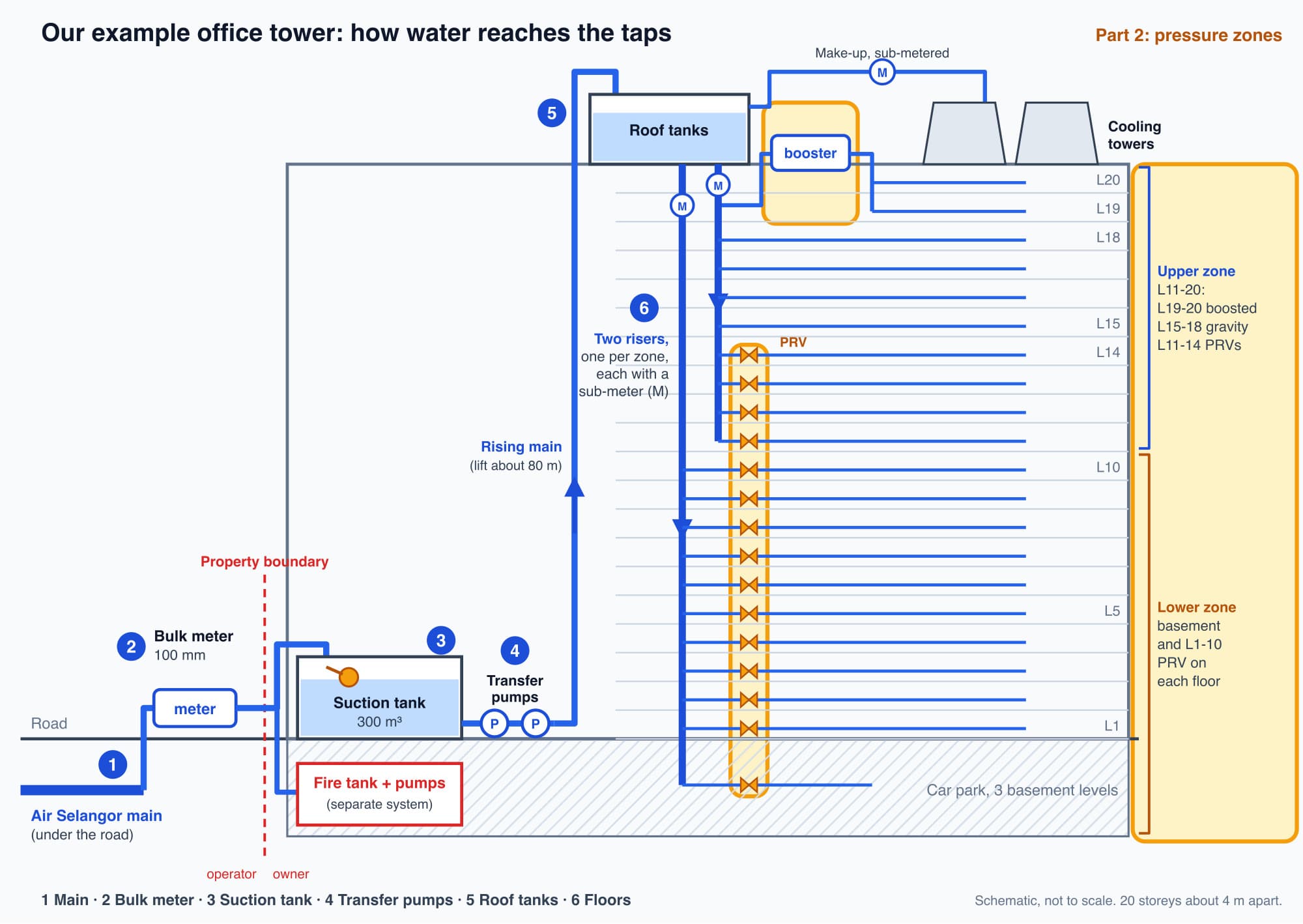
The office tower has two zones, each fed by its own riser: boosted at the very top, straight gravity on levels 15 to 18, and pressure reducing valves from level 14 down.
Pressure is measured in bar or in metres of head
Pressure is how hard the water pushes on each part of the pipe, the tap or a gauge. In building services it is given in two ways.
The first is metres of head. Head is the height of the column of water above the point you measure. If the water surface in the roof tank is 30 metres above a tap, that tap has 30 metres of head. Designers like head because you can see it on a drawing: it is just a height.
The second is bar, which is what a pressure gauge on a pipe usually shows. The two are linked by a simple rule: about 10 metres of head equals 1 bar (more exactly, 1 bar is about 10.2 metres of water). So every metre you go down below the tank adds about 0.1 bar.
How much that adds per storey depends on the building:
- In flats, floors are often about 3 metres apart, so pressure rises about 0.3 bar per storey as you go down.
- In offices, floors are usually further apart. In the office tower they are about 4 metres apart, so pressure rises about 0.4 bar per storey.
Why does water pressure in buildings vary from floor to floor?
In a building fed from a roof tank, the pressure at any tap depends almost entirely on how far the tap is below the water surface in the tank. The deeper the tap, the more water is stacked above it.
In the office tower, the roof tank's water surface is about 83 metres above the ground floor (level 1). Using the 10-metre rule, with no water flowing:
Floor | Height of water above the floor | Pressure (about) |
|---|---|---|
Level 20 | 7 m | 0.7 bar |
Level 19 | 11 m | 1.1 bar |
Level 18 | 15 m | 1.5 bar |
Level 15 | 27 m | 2.7 bar |
Level 10 | 47 m | 4.7 bar |
Level 1 | 83 m | 8.3 bar |
The top floors also feel the tank level going up and down. As the roof tank empties between refills, the water surface drops and the top floors lose pressure first. That is why top-floor complaints often come in bursts. Part 3 explains how the tank level is controlled.
Some buildings have no roof tank. Instead, variable-speed pumps at the bottom push water straight up the risers. The pattern is the same the other way round: pressure is highest at the pumps on the lowest floor and falls with height. Either way, the bottom of the building has far more pressure than the top.
How much pressure taps and toilets need
For offices and other commercial buildings, SPAN (Suruhanjaya Perkhidmatan Air Negara, the National Water Services Commission) sets out the pressures a plumbing system should provide in its plumbing guidelines:
- At least 7 metres of head (about 0.7 bar) at ordinary fixtures such as taps.
- At least 10.5 metres of head (about 1 bar) at flush valves.
- No more than 30 metres of head (about 3 bar) in any distribution pipe. Above that, a pressure reducing valve must be used.
In practice, most fixtures work comfortably at about 1 to 3 bar. Above about 4 or 5 bar, taps spit, flush valves bang and flexible hoses under basins fail early.
Compare those numbers with the floor-by-floor table above. Levels 15 to 18 sit inside the range, so they take water straight from the roof tank. The two ends of the building do not:
- Levels 19 and 20 have too little pressure. At 0.7 to 1.1 bar with no flow, they would drop below the minimum as soon as several taps opened. SPAN's guideline asks for a duty and standby pump set to raise the pressure on the top two floors of high-rise commercial buildings, fed from the roof tank. That is the booster set on our roof. A booster set is a small group of pumps controlled by a pressure sensor: when a tap opens and the pressure falls, a pump runs to hold the pressure at its setting, in our tower about 2 bar at level 20. Part 4 explains how booster sets work.
- Levels 1 to 14 have too much pressure. Their static pressure ranges from about 3.1 bar at level 14 to 8.3 bar at level 1, all above the 3-bar limit. The basement car park, below level 1, is higher still. They get their water through pressure reducing valves, explained below.
Pressure drops when water flows
So far we have talked about static pressure: the pressure when no water is flowing. When taps are open, the pressure you measure is lower. This is called running pressure (SPAN calls it residual pressure; you may also hear "dynamic pressure"). Moving water loses some of its push rubbing against pipe walls and passing through bends, valves and strainers. This loss is called friction loss.
Friction loss grows roughly with the square of the flow. If the flow through a pipe doubles, the pressure lost to friction is about four times as large. That is why a building can have good pressure at 3pm and poor pressure at 8am when everyone arrives and uses the toilets at once.
Measuring both pressures tells you what kind of problem you have:
- Static pressure is fine, but it collapses when two or three fixtures open. Something is restricting the flow: a pipe that is too small, a valve left partly shut, a blocked strainer, or old galvanised pipe narrowed by scale inside.
- Static pressure itself is low. The floor is too close to the tank for gravity to give enough pressure. Cleaning pipes will not help. It needs boosting or a change of layout.
To a tenant the two problems feel the same, but they need very different spending.
What does a pressure reducing valve do?
A pressure reducing valve (PRV) is a valve that keeps the pressure after it at a set value, however high the pressure before it is. Inside is a spring and a diaphragm. When the pressure after the valve rises above the setting, the valve closes a little. When it falls, the valve opens a little.
In the office tower, the risers carry about 3 to 8 bar past levels 1 to 14. A PRV on each of those floors, and on the basement branch, where the floor's pipe leaves the riser, brings the pressure down to about 2.5 bar. PRVs are also fitted at the start of a whole pressure zone, or at the inlet to each tenancy.
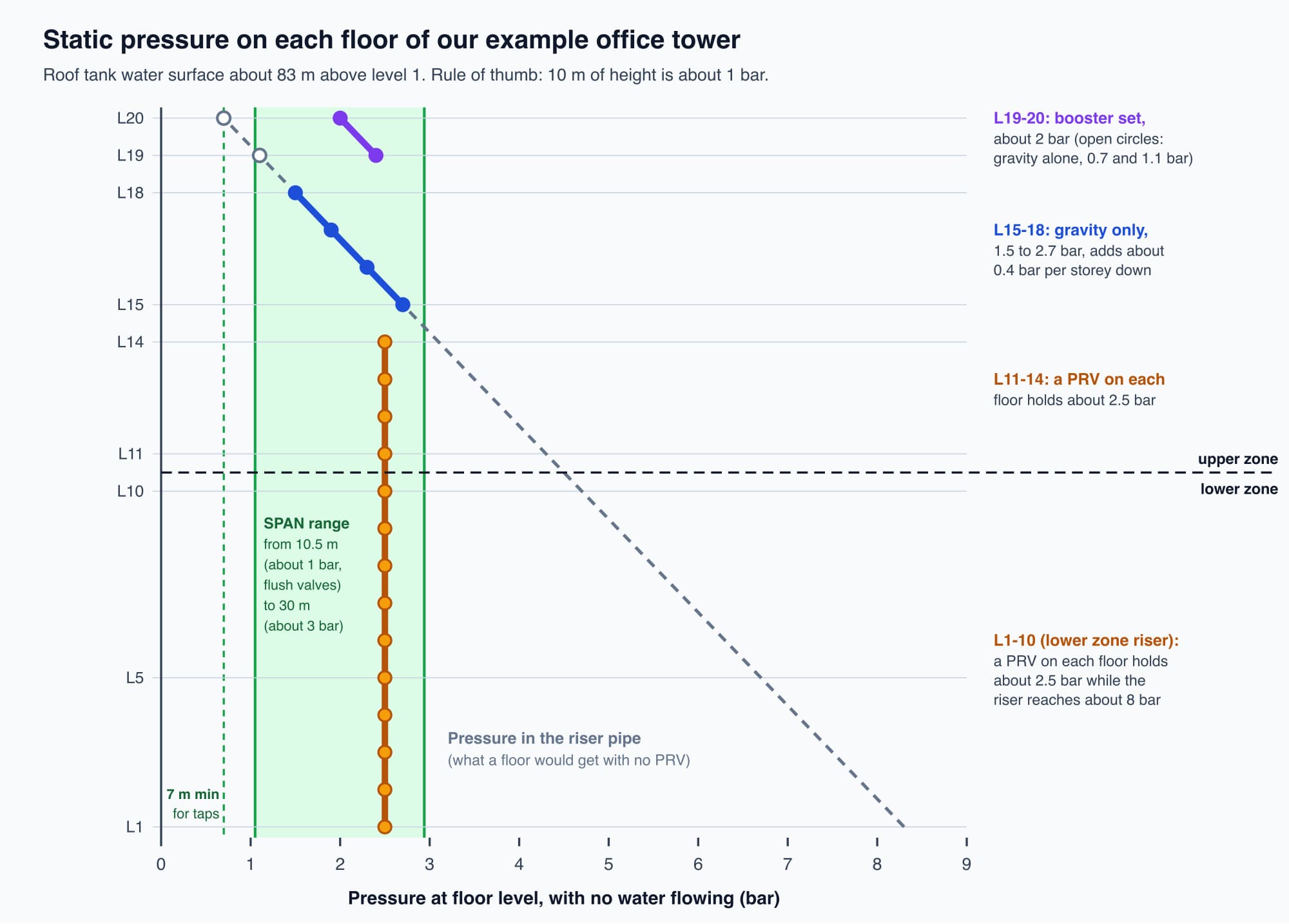
Without the PRVs, the lower floors would get the riser's pressure (dashed line), up to about 8 bar at level 1.
PRVs are simple and last a long time, so they are easy to forget. Three faults are common:
- Creep at night. With no flow, some PRVs let the pressure after them slowly rise. The pressure you measured at 2pm is not what the pipes see at 3am.
- A failed diaphragm. The valve passes the full riser pressure straight through. Often the first sign is burst hoses on the floor below.
- A setting raised years ago after a complaint about a weak shower, and never checked again.
Fit a gauge before and after every PRV. Read both at the busiest time of the morning and again in the middle of the night. If the two gauges read the same, the valve is not reducing anything.
Pressure zones keep each part of a tall building in range
Because pressure rises about 0.4 bar with every office storey, one gravity supply cannot serve a tall building without starving the top or overloading the bottom. So tall buildings are divided vertically into pressure zones. Each zone is a group of floors whose pressure stays within a usable range. With SPAN's 30-metre limit, a gravity zone can cover only about 30 metres of height, which is about 7 office storeys at 4 metres each.
There are three common ways to make zones:
- Intermediate tanks (sometimes called break tanks) on plant floors part-way up, so each zone gets its own short gravity drop from its own tank.
- PRVs, where one tall riser feeds lower zones or floors through valves that cut the pressure back.
- Separate booster sets for each zone, each holding its own pressure setting.
The office tower has two zones, each fed from the roof tanks by its own riser with its own sub-meter. The upper zone serves levels 11 to 20: a booster set for levels 19 and 20, straight gravity for levels 15 to 18, and a PRV on each of levels 11 to 14. The lower zone serves levels 1 to 10 and the basement car park, with a PRV on every floor. Splitting the floors between two risers also means each sub-meter covers a smaller part of the building, which helps later when looking for leaks.
Too much pressure costs water and electricity
It costs water. More pressure pushes more water through any opening. For a fixed hole, flow rises with pressure, though less than in proportion. Real leaks behave worse than a fixed hole, because cracks and loose joints open wider as the pressure rises. So bringing a zone down from, say, 6 bar to 3 bar reduces the loss through every existing leak and makes new failures less frequent. Ordinary use goes up too: an open tap at 5 bar delivers more litres per minute than the same tap at 2 bar, and the person washing their hands does not notice. Part 7 shows what each of those cubic metres costs.
It costs electricity. A pump's power is proportional to the flow it delivers multiplied by the head it adds. If a booster set has held 7 bar since the day it was commissioned, and the highest fixture in its zone only needs 4.5 bar, the building pays for that extra head every hour the pump runs. Lowering the setting, or better, controlling the pump from a pressure sensor at the furthest fixture instead of at the pump outlet, is one of the cheapest water-side energy savings in a plant room.
It causes damage. High static pressure makes every fast-closing valve, such as a solenoid or flush valve, send a pressure shock through the pipes. This is called water hammer, and it is what eventually splits the flexible hose under a basin.
How to tell if your building has a pressure problem
You do not need gauges everywhere. You need gauges in the right places and someone willing to read them at odd hours:
- Static pressure at the lowest occupied floor of each riser, read at night. Anything above about 3 bar (SPAN's 30-metre limit) is worth a look.
- The same gauge at the busiest time of the morning, to tell a static problem from a friction problem, as described earlier.
- A map of complaints by floor. Complaints bunched at the top point to height or tank level. Complaints spread everywhere point to flow restrictions.
- The history of bursts and hose failures. If failures cluster in the bottom third of the building, pressure is the likely cause.
- Readings before and after every PRV. Equal readings mean the valve has failed.
Then write down the intended setting for every zone, booster set and PRV on one sheet. Check the actual readings against it once a year and record what you find. Settings drift: valves get adjusted during complaint calls and never returned, and pumps get replaced with models that run differently.
Gauges only show the moment you read them. Pressure creep at night and slow leaks happen when nobody is there. A meter that logs flow every few minutes shows what happens overnight. Part 10 explains how to read that overnight flow.
Worth knowing: A pressure reducing valve that has failed often announces itself on the floor below it, not on a gauge: the diaphragm gives way, full riser pressure passes straight through, and flexible hoses under basins start to burst. If failures cluster in the bottom third of a building, check the PRVs before replacing any more hoses.
Optional detail: The minimum and maximum pressures (7 m at taps, 10.5 m at flush valves, 30 m in distribution pipes) and the booster set for the top two floors come from SPAN's Uniform Technical Guidelines for Water Reticulation and Plumbing (April 2018), section C.3.4. You may also hear that instant water heaters need a strong supply to switch on. The minimum depends on the model: one Malaysian manufacturer states that its instant heaters need only a little more than 0.1 bar (Joven). Check the manual of the heater you have.
What comes next: tanks and level controls
Pressure on the top floors depends on the water level in the roof tank, and the transfer pumps refill that tank when the level drops. The next part, Water Tank Level Control in Buildings, explains the float valves, probes and switches involved. It opens with the question this raises: with nobody watching, what tells each tank when to let water in, and what tells the pumps when to start and stop?
Check your understanding
- In the office tower, level 10 is about 36 metres above level 1. Roughly what static pressure would it get straight from the roof tank, and what does the building do about it? The roof tank's water surface is about 83 metres above level 1, so level 10 is about 47 metres below it. At about 10 metres per bar, that is about 4.7 bar. That is above SPAN's 30-metre (about 3 bar) limit, so level 10 gets its water through a pressure reducing valve set to about 2.5 bar.
- A tenant on level 16 says the pressure is fine early in the morning but drops badly when two basins and a toilet are used at once. Is this a static pressure problem or a flow problem? A flow problem. The static pressure is fine, because it is good when nothing is flowing. The drop under load means something is restricting the flow, such as a partly closed valve, a blocked strainer or scaled-up pipe. A booster pump would not fix it.
Recap: Pressure can be given as metres of head (the height of water above a point) or in bar; 10 metres is about 1 bar. In a building fed from a roof tank, pressure rises about 0.3 bar per storey in flats and about 0.4 bar per storey in offices as you go down. SPAN's guideline asks for at least 7 metres at taps and 10.5 metres at flush valves, and no more than 30 metres in the pipes. So the top floors need a booster set, and the lower floors need pressure reducing valves or separate zones. Pressure also drops when water flows, because of friction. Too much pressure wastes water, wastes pump energy and damages fittings.
This is Part 2 of 12 in Cobler's Water Fundamentals course. Previous: Building Water Supply System: How Water Reaches Your Tap. Next: Water Tank Level Control in Buildings.
Cobler builds CobiNeural, a platform that shows a facility team its building's energy, water and indoor air data as live numbers across the whole site. To see how your building performs, talk to us.
FAQ
Frequently asked questions
Ask us about this topic
Something in this article you want to dig into — or a situation in your own building it doesn't quite cover? Send us your question. We don't run public comments; the team replies to you directly by email.