
Blog
Power vs Energy: What You Actually Pay For
Power (kW) is the rate right now; energy (kWh) is power times time. Understand the difference — and why nothing runs at nameplate — before you chase savings.
 Tan Kok XinUnderstanding Your Electricity Bill
Part 1 of 7 in Cobler's Understanding Your Electricity Bill course. New here? See the course page.
Aina has just started as the facility executive of our example office tower, a fictional 20-storey office building in Kuala Lumpur that we use throughout this course. On her first week the building owner hands her the September 2026 TNB (Tenaga Nasional Berhad) bill, RM310,532 before tax and the renewable energy levy, and asks two things: why is it so high, and what can we do about it? Before she can answer either, Aina needs to know what the building is actually being charged for.
A car dashboard is a good place to start. It has two different dials. The speedometer shows how fast you are going right now. The odometer shows how far you have driven in total. Electricity has the same pair: power is how fast a building is using electricity at this moment, and energy is how much it has used over a period.
So which one does the electricity bill charge for? The answer depends on the tariff, the price list that applies to the building's account. Every TNB bill charges for energy, in kilowatt-hours. Larger buildings on a medium voltage (MV) or high voltage (HV) supply, like Aina's tower, also pay a separate charge on their highest power of the month, in kilowatts. This part is a short refresher on the two units and on why real equipment rarely draws the power printed on its label. If kW and kWh are new to you, the Electricity Fundamentals lesson Power vs Energy: The Difference Between kW and kWh explains them from the beginning.
Power is the rate right now
Power is how fast a machine is using electricity at one instant. It is measured in kilowatts (kW). One kilowatt is 1,000 watts.
Power is the speedometer. It tells you how hard the equipment is working this second. It says nothing about how long the equipment has been running.
In a building, power is what a clamp meter reads on a cable, or what the switchboard display shows for a running chiller. A 15 kW pump that has just started is drawing power. So is a row of office lights drawing 400 W. Add up every load running at one moment and you get the building's total demand at that moment, in kW.
Energy is power multiplied by time
Energy is power multiplied by how long it is used. It is measured in kilowatt-hours (kWh).
Energy is the odometer. A car doing 60 km/h for two hours covers 120 km. A machine drawing 10 kW for two hours uses 20 kWh:
$$\text{Energy (kWh)} = \text{Power (kW)} \times \text{Time (hours)}$$
Every cost and saving figure in this course starts from this equation.
Here is a worked example. A supply-air fan in the tower draws a steady 8 kW and runs 12 hours a day, every day:
\( 8 \text{ kW} \times 12 \text{ h} \times 365 \text{ days} = 35{,}040 \text{ kWh per year} \)
What drives that figure is not only how big the fan is but how long it runs. Cut the running hours in half and the kWh halve too. Part 3 puts a price on each kWh, and it shows that the price of a kWh depends on which tariff the building is on.
The meter that records these kWh, and the building's demand, is the subject of Part 2, How Electricity Meters Work.
The bill charges for energy, and on MV also for peak power
An MV or HV bill has two main kinds of charge:
- Energy charges, priced on the total kWh used in the month (the odometer).
- Demand charges, priced on the building's highest kW of the month (the highest speedometer reading).
That highest kW is called the maximum demand (MD): the highest average power in any 30-minute period of the month. Aina's tower is on the MV non-domestic General tariff, where the highest half hour counts whenever it happens, day or night. On the MV Time-of-Use (ToU) tariff, only half hours inside a weekday peak window count. HV and special categories have their own rates. Part 3 gives the rates, and Part 4 looks at maximum demand in full.
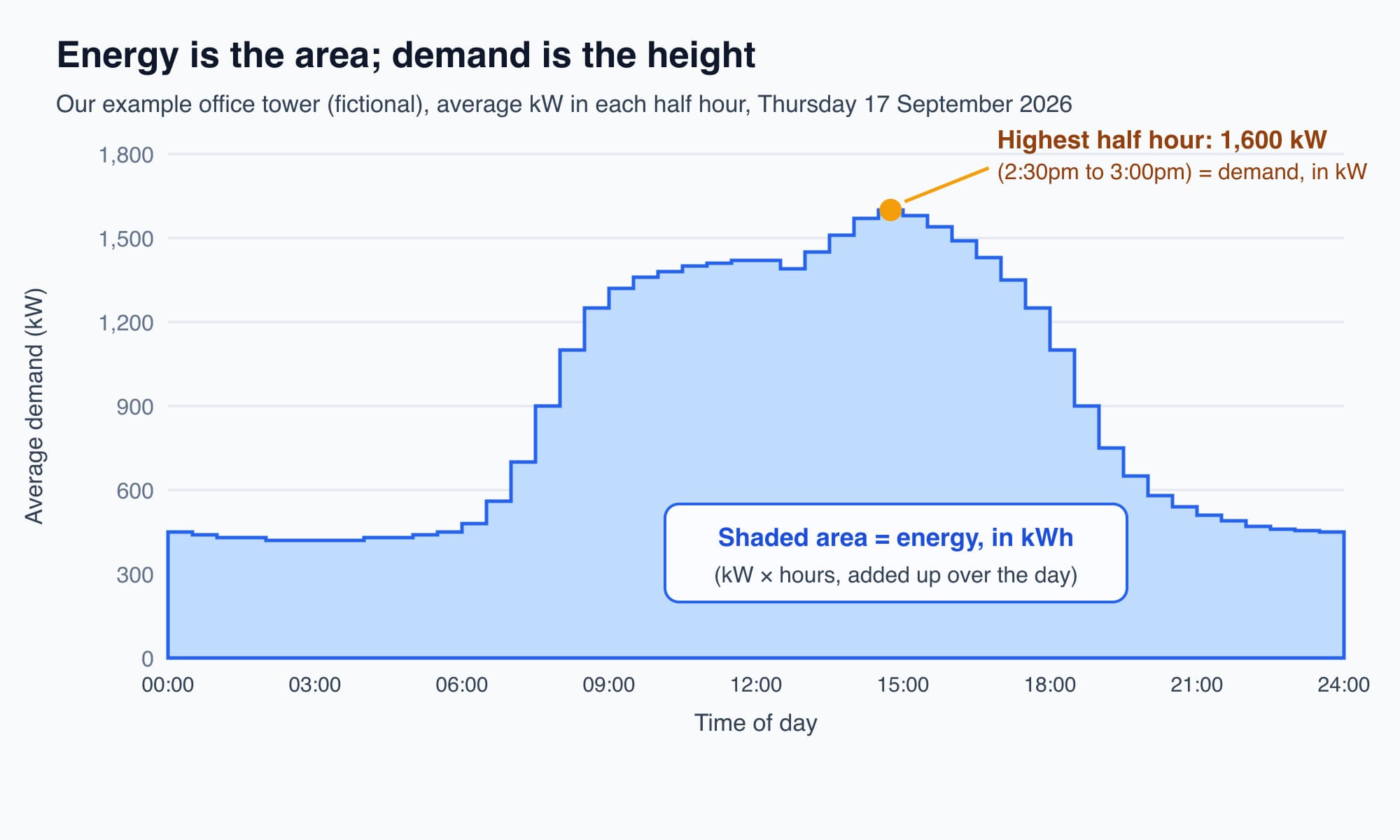
One weekday in the office tower: the shaded area is the energy (kWh) and the highest point, 1,600 kW, is the demand (kW).
A low voltage (LV) bill is different, and our example shoplot shows how. It is a fictional three-storey shoplot in Petaling Jaya, with a café on the ground floor and a small office above, on the LV non-domestic General tariff. The café owner's September 2026 bill was RM4,368 before tax and the renewable energy levy. LV customers such as shops and small offices have no per-kW demand charge. Every line on the café owner's bill, except a small fixed monthly fee, follows the kWh.
Aina's bill is split more evenly. Nearly half of her RM310,532 follows one number, the tower's maximum demand of 1,600 kW, and almost all of the rest follows its 500,000 kWh. So on an MV tariff, two buildings can use exactly the same kWh in a month and pay very different bills, because one of them had a higher peak. Lowering the peak (kW) and running less (kWh) are two different ways to save, and many projects do some of each. Keeping the two apart tells you which part of the bill a project can reduce.
Equipment rarely runs at its nameplate rating
Every motor, pump, fan and chiller has a nameplate: a label stamped with its rated power. It is tempting to multiply that number by the running hours. That usually gives the wrong answer. The nameplate shows what the machine can deliver at full load, and in normal operation most equipment runs below full load.
Take a 30 kW pump motor. The building rarely needs the pump's full flow, so it typically runs at about 70% load. The power it actually draws is roughly:
\( 30 \text{ kW} \times 0.70 = 21 \text{ kW} \)
(For a motor, the nameplate kW is the power at the shaft. The electrical input is a little higher, because the motor itself loses some energy as heat. That is one more reason to measure the input kW at the switchboard rather than work it out from the label.)
The gap between label and reality grows over a year. If the pump runs 6,000 hours a year:
$$\text{Energy} = 21 \text{ kW} \times 6{,}000 \text{ h} = 126{,}000 \text{ kWh/yr}$$
Using the nameplate 30 kW instead would give 180,000 kWh. That overstates consumption by 54,000 kWh a year, and any saving calculated from it would be overstated too.
Worth knowing: A nameplate gives a machine's full-load rating, not what it draws on a normal day. In the pump example, trusting the label adds 54,000 kWh a year that never passed through the meter. If Aina is shown a savings proposal worked out from nameplates, the first question to ask is whether anyone measured the real load.
So savings should be calculated from measured load, not from the nameplate. This is why energy work starts with metering: a figure you have measured can be checked, and a figure you have assumed cannot.
Percent load and part-load efficiency
Two terms explain why the real figure differs from the nameplate.
- Percent load is how heavily a machine is loaded compared with its rating. Our pump at 70% load has a percent load of 70%. A chiller that mostly runs half loaded has a percent load of about 50%. Consumption follows the actual load, not the size of the machine. (Some texts call this the "load factor" of a machine. In this course, load factor means something else: a building's average demand divided by its maximum demand, which Part 4 explains.)
- Part-load efficiency is how efficiently a machine converts electricity into useful work when it is not fully loaded. Many machines are most efficient near their design load and less efficient far below it. An oversized chiller running at 30% load can use more electricity for each unit of cooling than a correctly sized one.
So consumption depends on how loaded a machine is and how efficient it is at that load, not only on how big it is. Cooling is the clearest case: chiller and pump loads change through the day with the weather and the number of people in the building. Our Cooling Fundamentals course explains how.
Fuel is billed separately from electricity
A TNB bill covers electricity only. Many industrial sites, and some commercial ones, also buy fuel to make heat in boilers, steam systems, ovens and kilns, and that fuel arrives on a different bill. An office tower like Aina's usually has little or none, so office and retail readers can skip this section.
Fuel is bought and measured in its own units:
- Natural gas in normal cubic metres (Nm³), a volume corrected to standard temperature and pressure
- Diesel in litres
- Steam in kilograms (kg)
- and the energy content itself in megajoules (MJ)
A factory may spend more on gas for its boilers than on electricity for everything else, so a review that looks only at the TNB bill would miss that. To compare an electrical option with a fuel one, such as an electric heat pump against a gas boiler, both must be in the same unit. The fixed conversion is:
$$1 \text{ kWh} = 3.6 \text{ MJ}$$
For example, a process that needs 500 MJ of heat per hour needs \( 500 \text{ MJ} \div 3.6 = 138.9 \text{ kWh of energy per hour} \). (A fair cost comparison also needs each system's efficiency and each fuel's price. The optional side reading Fuel, Heat and Why Thermal Savings Are the Big Money covers thermal plant.)
What comes next: the meter
Aina now knows that her bill is built from two quantities: the tower's total kWh for the month and its maximum demand in kW. She also knows the café owner's bill works differently, because an LV bill follows kWh almost entirely. Three habits follow from this part:
- Keep kW and kWh apart. kW is the rate and, on MV and HV tariffs, drives the demand charges. kWh is the total and drives the energy charges.
- Use measured load, not the nameplate. A 30 kW motor at 70% load is roughly a 21 kW machine.
- Check what kind of bill you have. An LV bill follows kWh; an MV or HV bill also follows the month's highest half hour.
Her next question is where these two numbers come from: who measured the 500,000 kWh and the 1,600 kW, and how? The next part, How Electricity Meters Work: Disc to Smart Meter, opens the meter and shows what it records. If you already know your building is on an MV supply, Cobler's Maximum Demand Calculator lets you try your own peak.
Check your understanding
- The café owner (LV non-domestic General) and Aina's office tower (MV non-domestic General) both cut their peak power by 50 kW without changing their kWh. Which bill goes down? Only the office tower's. On an MV tariff, part of the bill is charged per kW of maximum demand, so a lower peak lowers the bill. On an LV tariff there is no per-kW charge, so the café owner's bill stays the same unless the kWh fall.
- A pump's nameplate says 30 kW and it runs 6,000 hours a year. Why is 180,000 kWh probably the wrong annual energy? The nameplate is the full-load rating. If the pump normally runs at about 70% load, it draws roughly 21 kW, so it uses about 126,000 kWh a year. The only reliable figure is a measured one.
Recap: Power (kW) is the rate at one moment; energy (kWh) is power multiplied by time. Every TNB bill charges for kWh. MV and HV bills also charge for maximum demand, the highest 30-minute average kW of the month; on MV General it counts at any hour, on MV ToU only in the weekday peak window. LV bills, like the café owner's, have no per-kW charge. Equipment rarely runs at its nameplate rating, so use measured load; "percent load" describes how loaded a machine is. Fuel is billed separately and compared with electricity using 1 kWh = 3.6 MJ.
This is Part 1 of 7 in Cobler's Understanding Your Electricity Bill course. Next: How Electricity Meters Work: Disc to Smart Meter.
Cobler builds CobiNeural, a platform that shows a facility team its building's energy, water and indoor air data as live numbers across the whole site. To see how your building performs, talk to us.
FAQ
Frequently asked questions
Ask us about this topic
Something in this article you want to dig into — or a situation in your own building it doesn't quite cover? Send us your question. We don't run public comments; the team replies to you directly by email.