Blog
Why Saving Energy Is Really About Money (and Carbon)
Energy management economics starts here: every kilowatt-hour you save is a ringgit kept and a kilogram of carbon avoided. See why efficiency is the first fuel.
 Tan Kok XinEnergy Management: The Economics of Saving Energy
Part 1 of 10 in Cobler's Energy Management: The Economics of Saving Energy course. New here? See the course page.
Every month an electricity bill arrives, and every so often someone suggests a way to make it smaller: new lighting, a better air-conditioning schedule, a variable speed drive on a pump. So how do you decide whether a suggestion like that is worth the money, and what it does for your building's carbon emissions?
That decision is what energy management economics is about: using less energy on purpose, and being able to show in ringgit that it was worth doing. The same saved kilowatt-hour lowers the bill and lowers emissions, so one calculation answers both questions. This first part shows that link with one worked example. The rest of the course builds the tools to test a project properly.
Before you start: this course builds on our Understanding Your Electricity Bill course, so take that course first if a bill from TNB (Tenaga Nasional Berhad), Peninsular Malaysia's electricity utility, is still unfamiliar. It explains what each line of the bill charges for: the kilowatt-hours, the maximum demand, the monthly fuel adjustment and the choice of tariff. In that course, Aina, the facility executive of our example office tower, learned to read her building's bill; in this one, she has to show the owner which savings are worth paying for.
One saved kWh changes three numbers at once
Any energy decision in a building, such as replacing an old chiller, switching to LED lighting or tuning a boiler, changes three things at the same time:
- Energy use: how many kilowatt-hours (kWh) of electricity, or how much fuel, you use.
- Cost: what that energy costs you in ringgit on the bill.
- Carbon emissions: how much carbon dioxide (CO2) and other greenhouse gases that energy causes.
This course calls this the Energy–Cost–Carbon Nexus. "Nexus" means a connection. You cannot change the energy you use without moving the cost and the carbon with it.
In Malaysia the link is especially close. According to the country's Biennial Transparency Report (BTR 2024), roughly 80% of national emissions come from the energy sector: between 78.5% and 79.2%. The energy sector means burning fuel, including the fuel burned to generate electricity. So a kWh you do not use is not a small side gesture. It cuts cost and carbon from the country's largest source of emissions.
Put numbers on one saving
Suppose a lighting upgrade in our example shoplot cuts its electricity use by 12,000 kWh a year. (Our example shoplot is a fictional three-storey building in Petaling Jaya with a café and a small office, on the LV non-domestic General tariff. LV means low voltage: the building takes its supply at 400/230 V.)
To turn kWh into ringgit, you multiply by the price of one kWh. On the shoplot's tariff, four charges on the bill are priced per kWh, so all four fall when its kWh fall. With the September 2026 rates, that is 54.35 sen for each kWh saved:
- Energy charge: 27.03 sen/kWh
- Capacity charge: 8.83 sen/kWh
- Network charge: 14.82 sen/kWh
- Automatic Fuel Adjustment (AFA), September 2026: +3.67 sen/kWh
The fixed retail charge of RM20 a month stays the same however little you use, so it is left out. The AFA changes every month, so we assume the September 2026 figure for the whole year. Your TNB Bill, Line by Line, in the bill course, explains each of these lines.
The money saved:
$$\text{Cost saved} = 12{,}000 \text{ kWh} \times \text{RM}0.5435/\text{kWh} = \text{RM}6{,}522 \text{ per year}$$
To turn kWh into carbon, you multiply by the grid emission factor: the average greenhouse gas emitted for each kWh of electricity supplied. For Peninsular Malaysia it is 0.740 kg CO2e/kWh (Suruhanjaya Tenaga, the Energy Commission, 2024 provisional figure). "CO2e" means CO2 equivalent: other greenhouse gases counted as the amount of CO2 with the same warming effect.
The carbon avoided:
$$\text{Carbon saved} = 12{,}000 \text{ kWh} \times 0.740 \text{ kg/kWh} = 8{,}880 \text{ kg} = 8.88 \text{ tonnes CO}_2\text{e per year}$$
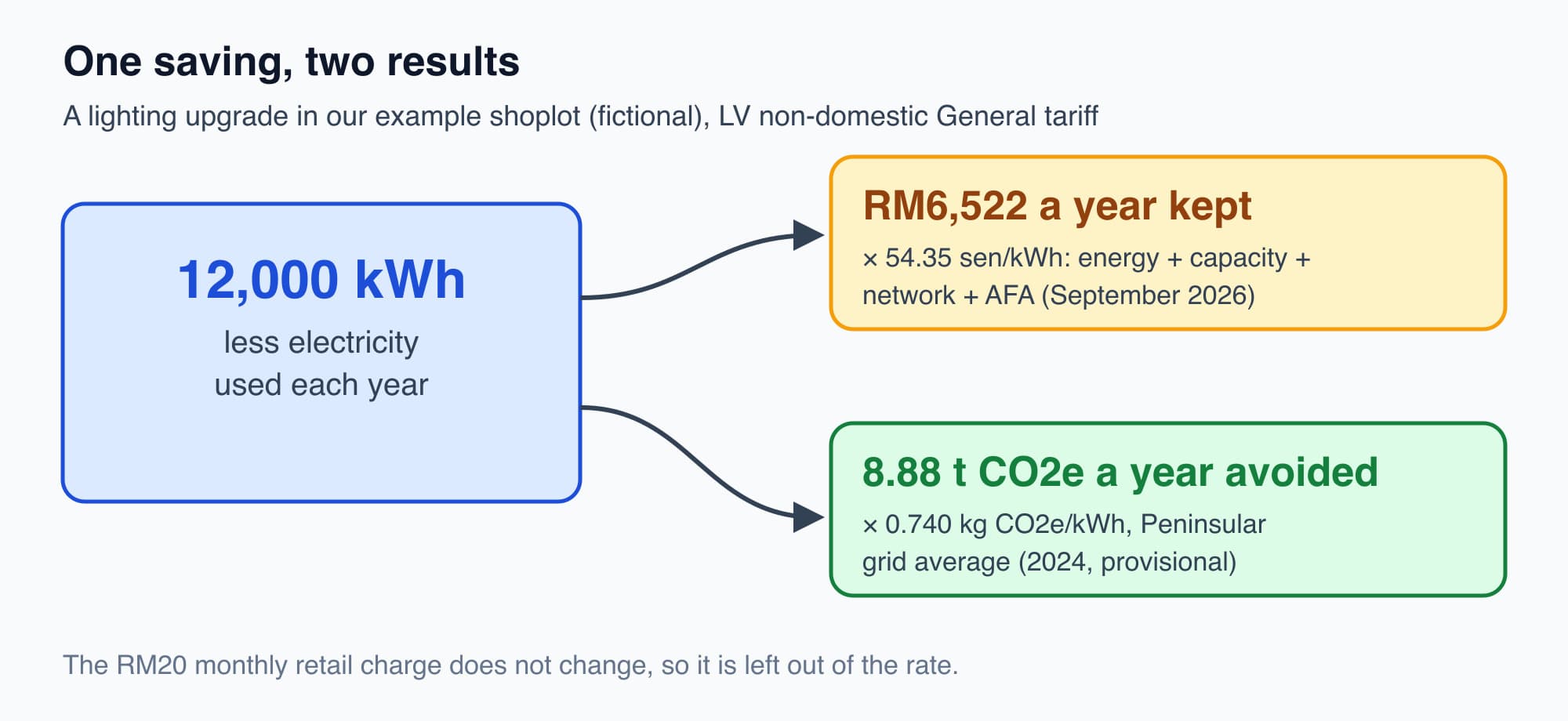
One lighting upgrade in our example shoplot: the same 12,000 kWh gives a ringgit saving and a carbon saving.
One action gave two results. You did not have to choose between saving money and saving carbon, because both come from the same 12,000 kWh.
Two limits apply to this example. First, the price of a saved kWh depends on the tariff. For a large building on a medium voltage (MV) tariff, such as our example office tower, some charges are set by the building's highest demand rather than by its kWh, so a saved kWh is worth less than the average price on its bill. Part 2 works this out. Second, 0.740 is an average for the whole grid, which is the figure used for reporting; the emissions actually avoided by one saved kWh can differ.
If the difference between a kilowatt (kW, a rate) and a kilowatt-hour (kWh, an amount) is unclear, the first lesson of the bill course, Power vs Energy: What You Actually Pay For, explains it using a TNB bill, and Power vs Energy: kW and kWh explained from our Electricity Fundamentals course covers the basics.
The cheapest energy is the energy you do not use
A kWh you avoid costs nothing to generate, emits nothing and never appears on a bill. For this reason the International Energy Agency (IEA) calls energy efficiency the "first fuel": before you buy more energy or build new supply, you can meet part of your needs by needing less.
For a building owner, this means the best energy investment is often not a new source of energy. It is a better chiller sequence, a tighter operating schedule, a variable speed drive or a repaired leak. This course spends most of its time on these measures, because they usually give the most saving for each ringgit spent. Our Cooling Fundamentals and Building Automation & BMS Fundamentals courses explain the equipment side. Here, we stay with the money.
Net zero is a balance, and it is becoming a legal matter
Malaysia has committed to net zero greenhouse gas emissions by 2050, and the National Energy Transition Roadmap (NETR) sets out how the energy sector gets there.
Net zero does not mean zero emissions. It means the emissions you still release are balanced by an equal amount removed from the atmosphere or offset. Written as simply as possible:
$$A + B = 0$$
Here A is what you emit (a positive number) and B is what you remove or offset (a negative number). "Net" means the total after adding the two together. A building that emits 100 tonnes and removes 100 tonnes is net zero, even though it still emits.
Removals and offsets are expensive and limited. The cheapest way to balance the equation is to make A smaller by emitting less in the first place, and the cheapest way to do that is usually efficiency.
The rules are also tightening. Malaysia's updated Nationally Determined Contribution (NDC) pledges to cut carbon intensity per unit of GDP by 45% by 2030, against a 2005 baseline. That means the economy must produce more value for each tonne of carbon. For building owners, the Energy Efficiency and Conservation Act 2024 (EECA), regulated by the Energy Commission, brings large energy users into a formal framework of energy audits, reporting and efficiency obligations. The money case and the compliance case now point the same way.
A business case is one part of energy management. This course teaches you to judge whether a project is worth funding. A full energy management programme also needs a policy, named responsibilities, targets, regular measurement and review. Under EECA, large energy users also have reporting and audit duties. See Cobler's guides to EECA compliance and to ISO 50001 and how it compares with EECA. ISO 50001 is the international standard for running an energy management system.
Every energy decision needs a money number and a carbon number
Every good energy decision needs two numbers: a carbon number and a financial number. The worked numbers earlier gave the shoplot both. The simplest financial test is simple payback: how long the savings take to repay the upfront cost.
$$\text{Payback (years)} = \frac{\text{Upfront cost}}{\text{Annual savings}}$$
Suppose the shoplot's lighting upgrade costs RM10,000 to install and saves RM6,522 a year:
$$\text{Payback} = \frac{\text{RM}10{,}000}{\text{RM}6{,}522/\text{year}} \approx 1.53 \text{ years}$$
After about 18 months, the savings have repaid the cost. Everything saved after that is money the business keeps, as long as the lights keep working and the tariff stays similar. Payback is only a first screen. Later parts add return on investment (ROI), which Part 5 defines, the time value of money (net present value, NPV, and internal rate of return, IRR), and life-cycle cost (LCC), which counts running and replacement costs over the equipment's life.
All of these need good measurements. Many buildings have only one monthly bill for the whole site, with no record of which system or which hour used the energy. How electricity meters work explains what the TNB meter records. Buildings on an MV tariff also pay a charge set by their highest half-hour of demand each month; Maximum Demand: Why One Bad Half-Hour Costs So Much, in the bill course, explains it, and Cobler's Maximum Demand calculator turns a peak into ringgit.
What comes next: what a saved kWh is really worth
The shoplot example used a simple rule: every kWh saved removes 54.35 sen from the bill. On an MV bill such as our example office tower's, that rule no longer holds, because part of the bill follows the monthly peak rather than the kWh. The next part, From Kilowatt-Hours to Ringgit and Tonnes of CO₂, works out what a saved kWh is worth in the tower and values the three measures its facility team has proposed.
Check your understanding
- Our example shoplot saves 12,000 kWh a year. Why does that lower both its bill and its emissions? Each kWh saved is a kWh the shoplot does not buy, so the per-kWh charges on its LV bill fall (54.35 sen per kWh in September 2026). Each kWh is also a kWh the grid does not have to generate, and on average each kWh in Peninsular Malaysia causes 0.740 kg CO2e. So the saving is about RM6,522 and 8.88 tonnes CO2e a year.
- Does net zero mean a building produces no emissions? No. Net zero means the emissions it still produces (A) are balanced by removals or offsets (B), so A + B = 0. Removals and offsets are costly, so the cheapest route is usually to make A smaller through efficiency.
Recap: Energy use, cost and carbon move together, so one saved kWh gives a ringgit saving and a carbon saving. For our example shoplot on LV General, a saved kWh was worth 54.35 sen in September 2026 (energy, capacity, network and AFA), and it avoids about 0.740 kg CO2e on the Peninsular grid average. Efficiency is the "first fuel". Net zero is a balance, and EECA 2024 now requires large energy users to measure and report. A business case is one part of a wider energy management programme. Simple payback is the first financial test; later parts add ROI, NPV, IRR and life-cycle cost.
This is Part 1 of 10 in Cobler's Energy Management: The Economics of Saving Energy course. Next: From Kilowatt-Hours to Ringgit and Tonnes of CO₂.
Cobler builds CobiNeural, a platform that shows a facility team its building's energy, water and indoor air data as live numbers across the whole site. To see how your building performs, talk to us.
FAQ
Frequently asked questions
Ask us about this topic
Something in this article you want to dig into — or a situation in your own building it doesn't quite cover? Send us your question. We don't run public comments; the team replies to you directly by email.