Blog
Simple Payback and ROI: The Quick Screening Tools
Simple payback and ROI are the fastest yardsticks for an energy project. Learn what each one really tells you, the worked maths, and their honest blind spots.
 Tan Kok XinEnergy Management: The Economics of Saving Energy
Part 5 of 10 in Cobler's Energy Management: The Economics of Saving Energy course. New here? See the course page.
Simple Payback and ROI: The Quick Screening Tools
Parts 2 to 4 gave you a savings figure you can defend: valued at the right rate, checked against a baseline and backed by the M&V plan that will prove it. The next question is whether the project is worth its price.
A contractor sends a quote for RM50,000: a variable speed drive (VSD) for a pump, a lighting swap or a new set of controls. The finance director reads it and asks one question: "How long before it pays for itself?"
That question asks for the simple payback. A second number, the return on investment (ROI), answers the same question as a percentage. Both are quick to work out from a quote and a savings estimate, which is why most energy projects are first judged on them. This part shows how to calculate each one, what they tell you, and the four things they leave out.
Simple payback counts the years to get your money back
Simple payback answers one question: how many years of savings does it take to recover the money spent at the start?
$$\text{Simple Payback (years)} = \frac{\text{Capital Cost}}{\text{Annual Savings}}$$
The capital cost is the installed price you pay up front. The annual savings is the money the project saves on the bill each year.
Here is a worked example. A VSD on a chilled-water pump costs RM50,000 installed. The drive slows the pump when the building needs less cooling, which cuts its electricity use. Suppose this saves RM10,000 every year on the bill.
$$\text{Payback} = \frac{\text{RM}50{,}000}{\text{RM}10{,}000\text{/yr}} = 5 \text{ years}$$
After five years, the savings have repaid the RM50,000. Every ringgit saved from year six onwards is money the project earns on top of its cost.
The RM10,000 comes from the method in Part 2: the kilowatt-hours (kWh) the drive saves, valued at the rate those kWh actually cost you. Payback is only as good as that figure. If kilowatts (kW) and kilowatt-hours still feel unclear, read the difference between kW and kWh first. A payback calculation goes wrong quickly if a rate of use (kW) is mixed up with a quantity used (kWh).
Is five years good? Compare it with a screening rule
A payback figure means more when you compare it with a benchmark. Many Malaysian companies use an informal screening rule of thumb:
A simple payback under 3 years is a comfortable "yes." Under 2 years is very attractive. Beyond 4–5 years, the project needs a fuller financial case before it clears the committee.
This "under 3 years" rule is a habit, not a law. It roughly means "this recovers its cost well within the equipment's life and before the next budget cycle". Companies set the bar in different places. A firm short of capital might ask for under 18 months. A utility investing in equipment that lasts decades might accept ten years. Still, if you tell a Malaysian facilities committee that a project has a two-year payback, most people in the room will understand what you mean.
By this rule, our five-year pump drive is a "maybe". It saves real money, but it sits outside the comfortable range. That is what a screening tool is for: it flags a project that needs a closer look before anyone says yes or no.
ROI gives the same answer as a percentage
Payback gives an answer in years. Return on investment (ROI) gives it as a percentage: for every ringgit you invest, how much comes back each year?
$$\text{ROI (\%)} = \left( \frac{\text{Annual Net Savings}}{\text{Investment}} \right) \times 100$$
For the same pump drive, RM10,000 saved each year on a RM50,000 investment:
$$\text{ROI} = \left( \frac{\text{RM}10{,}000}{\text{RM}50{,}000} \right) \times 100 = 20\%$$
The drive returns 20% of its cost every year. A fixed deposit pays a few percent a year. Many companies set a hurdle rate, the minimum yearly return a project must beat, of around 8 to 12%. Against either one, 20% looks attractive.
Now compare the two results. A 5-year payback and a 20% ROI describe the same fact in two ways:
$$\text{ROI} = \frac{1}{\text{Payback}} = \frac{1}{5} = 0.20 = 20\%$$
Simple ROI is the inverse of simple payback. A 4-year payback is a 25% ROI. A 2-year payback is a 50% ROI. A 10-year payback is a 10% ROI. This gives you a quick check on any proposal. If a vendor quotes an ROI and a payback that do not match this way, one of the two numbers uses a different assumption, usually a different definition of "savings". Ask which one.
How this course uses "ROI". You will sometimes see ROI quoted as a lifetime figure: all the savings over the project's life, minus the cost, divided by the cost. That can give very large numbers, such as 500%. In this course, ROI always means the simple annual ROI defined above: annual net savings divided by the investment.
Use the net saving in both formulas
The ROI formula says "net" savings. Net means the energy saving minus any new running cost the project adds, such as extra maintenance, a service contract or replacement filters.
Suppose the pump drive needs RM500 a year of servicing. The net saving is then RM9,500 a year, and the ROI falls to 19%. Quotes often use the gross saving for payback, before these costs. Use the same net figure in both formulas. The payback then becomes RM50,000 ÷ RM9,500, about 5.3 years, and ROI stays exactly one divided by payback. For a first screen the difference is small. For the final decision, always use the net figure.
Four things payback and ROI leave out
Payback and ROI stop counting at the break-even point, and they treat every year's ringgit the same. That leaves four blind spots. Each one can point you to the wrong project.
1. They ignore the time value of money. A ringgit saved in year five is worth less than a ringgit saved today, because today's ringgit could be earning a return in the meantime. Simple payback treats every future ringgit as equal, which makes savings far in the future look better than they are. This is the most important blind spot, and Part 6 shows how discounting fixes it.
2. They ignore everything after payback. Payback counts up to the break-even year and then stops. Compare two projects:
Project | Cost | Annual saving | Payback | Equipment life | Total lifetime saving |
|---|---|---|---|---|---|
LED retrofit | RM20,000 | RM10,000 | 2.0 yr | 6 years | RM60,000 |
Chiller optimisation | RM60,000 | RM15,000 | 4.0 yr | 15 years | RM225,000 |
On payback alone, the LEDs win: two years against four. The last column tells a different story. Over its life, the chiller project saves RM225,000 against the LEDs' RM60,000, which is nearly four times as much. (These totals are the annual saving × years of life, before any discounting.) The fastest payback is not always the most valuable project.
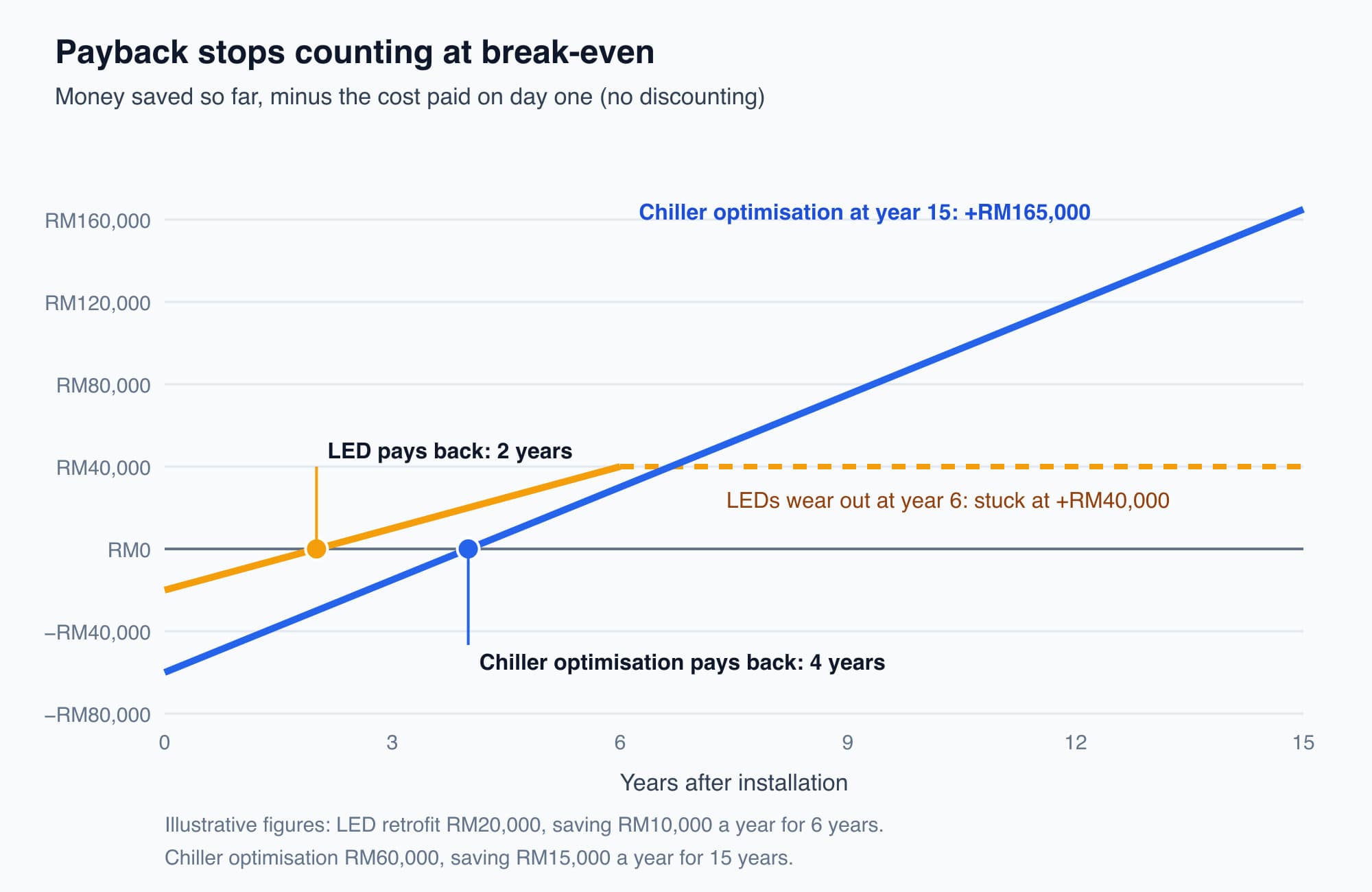
Payback only sees where each line crosses zero; it does not see that the LED line stops at year 6 while the chiller line keeps climbing.
3. They ignore equipment life. This is closely related. A measure that pays back in three years but wears out in four is a poor investment. One that pays back in four years and runs for twenty is a very good one. Payback says nothing about how long the equipment lasts, so both can look the same on a payback list.
4. They ignore future changes in energy prices. Payback uses today's rates for every year. Under RP4 (the TNB tariff structure in force since July 2025), the base rates are set for 1 July 2025 to 31 December 2027, and the Automatic Fuel Adjustment (AFA) changes every month (Your TNB Bill, Line by Line explains both). After 2027 the rates may be revised up or down. A single payback figure at today's rate cannot show how those changes would affect the project. Part 8 shows how to test them in a year-by-year model. To see how much the demand charge adds to a real medium voltage (MV) bill, try our maximum-demand calculator.
Taken together, these four points mean payback and ROI are screening tools, not final answers. They are good for sorting a stack of proposals into "clearly yes", "clearly no" and "look closer". Used as the only test, they tend to under-rate long-life projects that keep saving for many years after break-even.
(For the curious: two ratios fix some of these blind spots. The savings-to-investment ratio (SIR) divides the present value of all lifetime savings by the investment; above 1.0 means the discounted savings exceed the cost. The benefit-cost ratio (BCR) does the same with all benefits and all costs. Both count every year of the project's life and allow for the time value of money. Part 6 summarises when each is used, and the optional side reading SIR, BCR and Discounted Payback works through them in full. You do not need them for the rest of the course.)
Where the quick screen is the right tool
Payback is useful for quick wins: low-cost measures that recover their cost fast, where a detailed model would add little. Examples are changing equipment schedules, fixing a compressed-air leak or a simple lighting swap. If a measure pays back in under a year, you do not need a discounted cash-flow model to know it is worth doing.
The mistake is to use payback as the only test. A payback figure also depends on a trustworthy savings number: what the measure actually saves, not what the brochure claims. That is why Part 4 set out a plan to measure the saving before and after. A measured saving gives you a payback figure you can defend at the next budget review.
What comes next: valuing future ringgit
Payback and ROI treat a ringgit saved in year five the same as a ringgit saved today. That is the first and largest blind spot. The next part, The Time Value of Money: NPV and IRR Explained Simply, shows how to convert future savings into today's money and add them up properly, so a long-life project gets fair credit for every year it runs.
Check your understanding
- A lighting upgrade costs RM30,000 and saves a net RM12,000 a year. What are its simple payback and simple ROI? Payback = RM30,000 ÷ RM12,000 = 2.5 years. ROI = RM12,000 ÷ RM30,000 × 100 = 40%. As a check, 1 ÷ 2.5 = 0.40, so the two agree.
- Project A pays back in 2 years and lasts 6. Project B pays back in 4 years and lasts 15. Why can B be the better investment? Payback stops counting at break-even. After its payback, A saves for only 4 more years, while B saves for 11 more years. Over their whole lives, B can save much more money, as in the LED and chiller example above.
Recap: Simple payback is the capital cost divided by the annual saving, in years. Simple ROI is the annual net saving divided by the investment, as a percentage, and it is exactly one divided by payback (5 years = 20%). In this course, ROI always means this annual figure. Use the net saving in both. Under 3 years is a common Malaysian screening rule. Both tools ignore the time value of money, savings after break-even, equipment life and future price changes, so use them to sort projects, not to make the final decision.
This is Part 5 of 10 in Cobler's Energy Management: The Economics of Saving Energy course. Previous: How to Prove Energy Savings: A Simple M&V Plan. Next: The Time Value of Money: NPV and IRR Explained Simply.
Cobler builds CobiNeural, a platform that shows a facility team its building's energy, water and indoor air data as live numbers across the whole site. To see how your building performs, talk to us.
FAQ
Frequently asked questions
Ask us about this topic
Something in this article you want to dig into — or a situation in your own building it doesn't quite cover? Send us your question. We don't run public comments; the team replies to you directly by email.