
Blog
Time-of-Use, Green Tariffs and Avoidable Penalties
How Malaysian facility managers cut the electricity rate itself: shift load off-peak, buy green power, and stop power-factor and demand penalties leaking cash.
 Tan Kok XinUnderstanding Your Electricity Bill
Part 5 of 7 in Cobler's Understanding Your Electricity Bill course. New here? See the course page.
At the end of Part 4, Aina had a new question. The tower's maximum demand is set at 2:30pm, and on a Time-of-Use (ToU) tariff only weekday afternoons and evenings count. Would the tower pay less on a Time-of-Use tariff, and are there other tariff choices or charges on the bill she should check?
You can sometimes pay less for electricity without using fewer kilowatt-hours. Some kilowatt-hours are cheaper than others, some can be bought at a fixed green price, and some charges are penalties that stop once you fix their cause. This part covers the three places to look on a TNB (Tenaga Nasional Berhad) bill: the time of use tariff, the Green Electricity Tariff, and avoidable penalties such as the connected load charge and the power factor surcharge. Every rate below is from RP4, the TNB tariff structure in force since 1 July 2025, and every example names its tariff.
A ToU tariff charges two prices for a kilowatt-hour
On a General tariff, a kilowatt-hour costs the same at every hour. On a ToU tariff, it has two prices, depending on when you use it. The windows, as Part 3 set out, are:
- Peak: 2pm to 10pm, Monday to Friday.
- Off-peak: every other hour, which means 10pm to 2pm on weekdays and all of Saturday and Sunday.
Part 3 also listed the energy rates. For a medium-voltage (MV) building, they compare like this:
- MV non-domestic General: 29.83 sen/kWh at every hour.
- MV non-domestic ToU: 31.32 sen/kWh in the peak window and 27.23 sen/kWh off-peak.
The low-voltage (LV) rates from Part 3 follow the same pattern. The Automatic Fuel Adjustment (AFA) is added per kWh on top, at the same rate in both windows, so it does not change the comparison.
The ToU tariff also changes how maximum demand (MD) is charged on MV and HV (high voltage) accounts. As Part 4 explained, MV General charges RM89.27 per kW on the highest half hour at any hour of the month. MV ToU charges RM97.06 per kW, but only half hours inside the peak window count. Demand outside the window does not set the charge. LV accounts have no per-kW demand charge at all, so for them only the energy rates matter.
Take a hypothetical factory on MV non-domestic ToU. On its busiest weekday, a batch process starting at 3am pushed its demand to 774 kW, the highest of the day. Inside the peak window, its highest half hour was 717 kW. Only the 717 kW is charged:
$$717 \text{ kW} \times \text{RM}97.06/\text{kW} = \text{RM}69{,}592.02 \text{ per month}$$
The 3am half hour was larger, but it was off-peak, so on MV ToU it does not count. On MV non-domestic General, the 3am half hour would have set the charge.
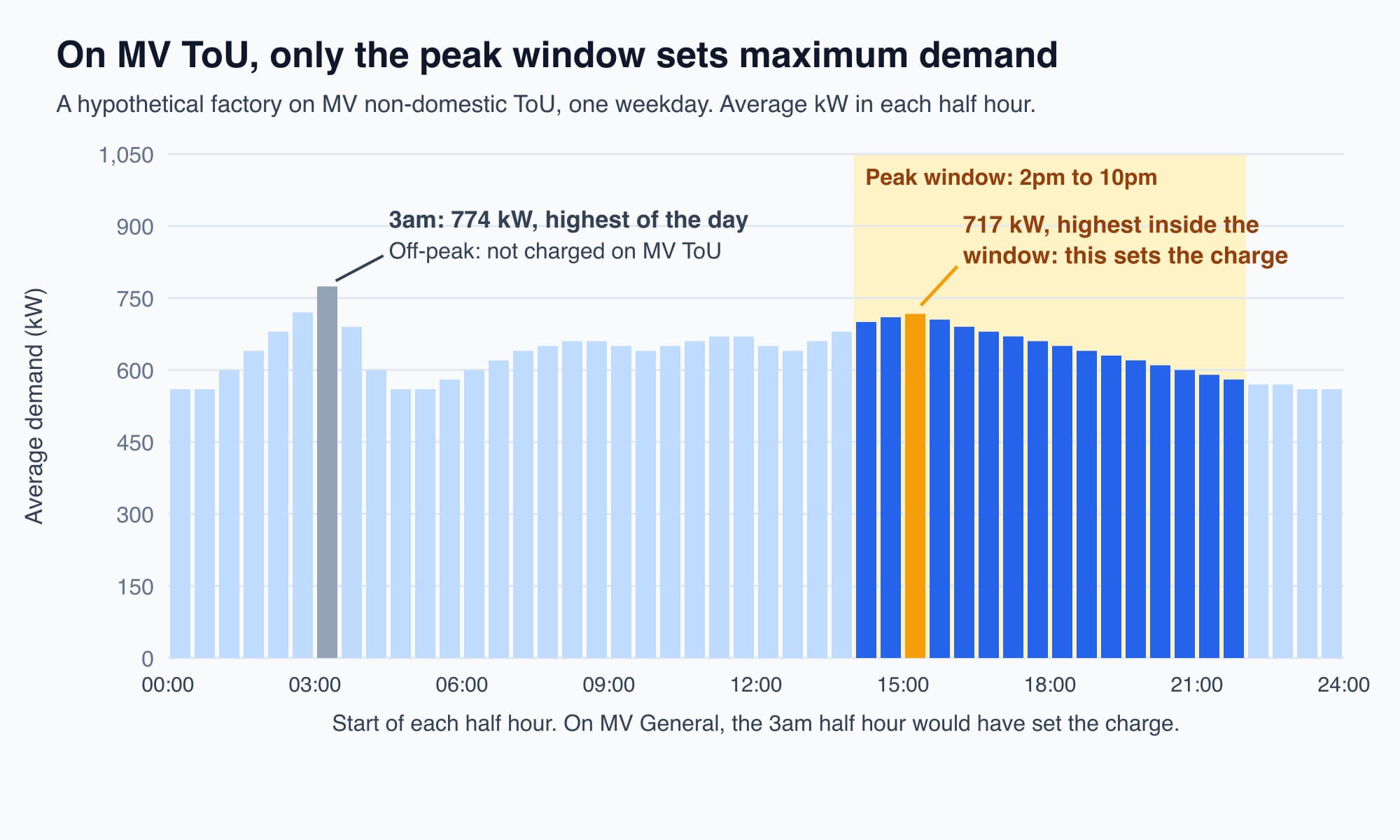
On MV ToU, the 3am half hour is ignored and the highest half hour inside the weekday 2pm to 10pm window sets the charge.
So on MV ToU, when a peak happens matters as much as how big it is.
Moving a load out of the peak window saves on energy, and sometimes on demand
Once the two prices are clear, the first lever follows: on a ToU tariff, move flexible loads out of the 2pm to 10pm window.
Take the same factory on MV non-domestic ToU, and a 200 kW chiller-and-pumping load that runs for 4 hours. That is 800 kWh each run. If those hours sit inside the peak window:
$$\text{Peak cost} = 200 \text{ kW} \times 4 \text{ h} \times \text{RM}0.3132 = \text{RM}250.56$$
If the same run happens off-peak:
$$\text{Off-peak cost} = 200 \text{ kW} \times 4 \text{ h} \times \text{RM}0.2723 = \text{RM}217.84$$
The same work costs RM32.72 less per run, the 4.09 sen difference on 800 kWh. Over 22 working days that is about RM720 a month (RM719.84) on the energy line.
The demand line can matter more. If that 200 kW load was running during the factory's highest peak-window half hour, moving it out of the window could lower the charged MD by up to 200 kW. At RM97.06 per kW, that is up to RM19,412 a month. The words "up to" matter: the MD only falls if the load was part of the highest half hour, and if nothing else then takes its place.
Loads that can often move include:
- a cold room that can pull its temperature down overnight;
- battery or ice storage that charges off-peak and discharges in the peak window;
- a batch process that can start after 10pm.
ToU only helps if you have load that can move. A hospital or a data hall with a flat 24-hour profile has little to shift. Before choosing ToU, look at your half-hourly interval data to see how much of your consumption could really move. Part 2, How Electricity Meters Work, explains where that data comes from.
On a General tariff, the same move saves nothing on energy, because every kWh has the same price. It saves money only if it lowers the month's highest half hour, which is the MD saving from Part 4.
Before switching tariffs, price the same month both ways
ToU is cheaper on energy only if enough of your kWh fall off-peak. On MV, a peak kWh costs 1.49 sen more than on General (31.32 − 29.83), and an off-peak kWh costs 2.60 sen less (29.83 − 27.23). The two balance when about 36% of your kWh are off-peak (1.49 ÷ 4.09 ≈ 0.36). Above that share, the energy line falls on ToU.
The demand line can go either way. ToU charges RM7.79 per kW more (RM97.06 − RM89.27), but only on the peak-window maximum. A factory whose highest half hour is a night-shift start-up can gain a lot. A building whose highest half hour is a weekday afternoon gains nothing and pays the higher rate.
Aina's tower, on MV non-domestic General, shows the second case. In September 2026 it used 500,000 kWh, and about 164,000 kWh of that, roughly a third, fell inside the peak window. Its MD of 1,600 kW was set between 2:30pm and 3:00pm on a Thursday, inside the window.
- Energy on ToU: 164,000 × 31.32 sen + 336,000 × 27.23 sen = RM51,364.80 + RM91,492.80 = RM142,857.60. On General it was RM149,150, so ToU saves RM6,292.40.
- Demand on ToU: 1,600 kW × RM97.06 = RM155,296. On General it was RM142,832 (1,600 × RM89.27), so ToU costs RM12,464 more.
Overall, ToU would cost the tower about RM6,172 more that month. The energy saving is real, but the tower's peak sits in the peak window, so the higher demand rate outweighs it. The tower stays on General.
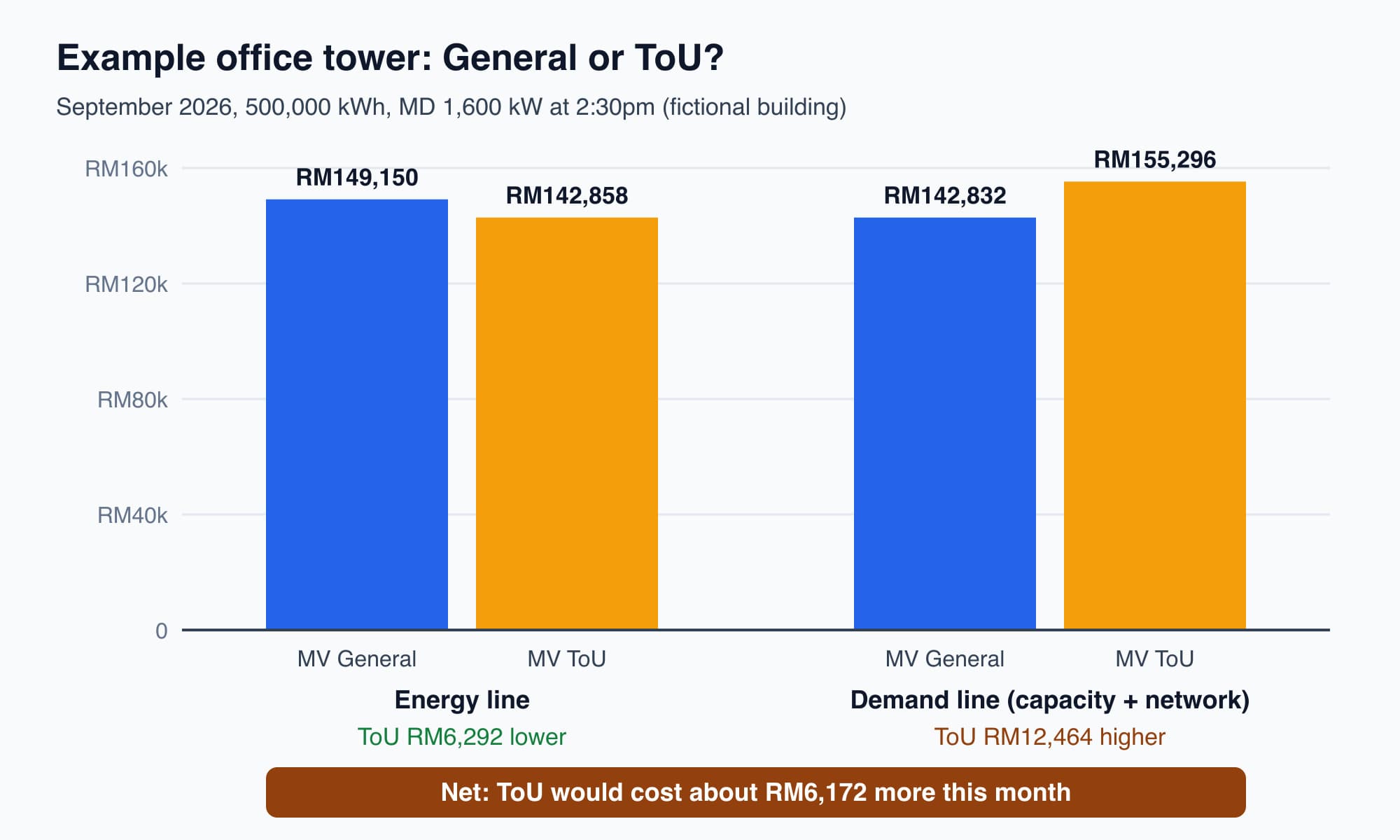
For the office tower, ToU lowers the energy line but raises the demand line by more, because its highest half hour falls inside the peak window.
Worth knowing: On MV ToU, a peak at 7am, or at any time on a Saturday, adds nothing to the demand charge, however high it is. On MV General, the same half hour would set the whole month's demand charge. The tower loses on ToU because its peak comes at 2:30pm on a weekday, not because its afternoon is especially large.
The Green Electricity Tariff buys green units at a fixed premium
The second lever is the Green Electricity Tariff (GET). You keep your normal TNB supply and pay a premium on top of the standard tariff for a chosen number of kWh. Those units are matched to renewable generation, and you receive Malaysia Renewable Energy Certificates (mRECs) for your sustainability report. GET suits owners who want a renewable claim but cannot fit solar on the roof, for example on leased premises, shaded sites or strata-titled buildings.
Since 1 July 2025 the premium depends only on how long you commit: 5 sen/kWh for one year, 4 sen for two years and 3 sen for three years. Two exemptions change the economics:
- GET units are exempt from AFA. TNB applies this exemption to the green units actually used. ST's (Suruhanjaya Tenaga, the Energy Commission) GET guidelines say the government "may exempt" these units, so the exemption is in force now but can be reviewed.
- Since 1 August 2025, GET units are also exempt from the KWTBB levy (the Renewable Energy Fund levy described in Part 3).
The AFA exemption works in both directions. In a surcharge month, you avoid the surcharge. In a rebate month, you give up the rebate. Two dated months show the effect on 100,000 kWh covered by a 3-year GET (3 sen/kWh):
- September 2026, AFA +3.67 sen/kWh. AFA avoided: 100,000 × RM0.0367 = RM3,670. Premium paid: 100,000 × RM0.03 = RM3,000. You come out RM670 ahead, before the KWTBB saving.
- January 2026, AFA −4.99 sen/kWh (a rebate). Rebate given up: 100,000 × RM0.0499 = RM4,990. Add the RM3,000 premium, and you are RM7,990 worse off than without GET that month.
So GET beats the standard tariff in months when the AFA surcharge is higher than your premium (3, 4 or 5 sen, depending on the term). Because the contract fixes the premium for one to three years, judge it over that whole period, not on one month's AFA. Size the subscription from 12 months of data, not last month's bill. Green Electricity Tariff 2026: The AFA Hedge Math covers block sizing, quota and the contract terms.
Penalties you can remove: connected load and power factor
The third lever is to stop paying penalties. These charges buy no service.
The Connected Load Charge (CLC) applies when a site uses much less than the maximum demand it declared when it applied for supply. TNB sets a Reference Maximum Demand from the declared figure: for a new consumer, 85% of the declared MD in years 1 to 4, and 75% in years 5 and 6. If the recorded MD in a month falls below that reference, TNB charges RM8.50 per kW of the shortfall (TNB charges and penalties, checked 23 September 2026). Say you declared 500 kW. In year one the reference is 85% of that, 425 kW. If your recorded MD is 350 kW, you are 75 kW short:
$$\text{CLC} = (425 - 350) \text{ kW} \times \text{RM}8.50 = \text{RM}637.50 \text{ per month}$$
The charge applies to the gap below the reference, not to the whole over-declaration. Declaring a figure close to what your meter will record avoids it. Our maximum demand calculator helps you estimate your real peak before you declare a number.
The power factor surcharge is added when a site's power factor falls below TNB's minimum. Power factor measures how much of the current a site draws does useful work. It needs its own lesson, so Part 6 explains what it is, how the surcharge is worked out and how capacitor banks avoid it. Aina's tower has no surcharge line in September 2026.
What comes next: the power factor line
None of these levers reduces the work the building does. They change the price attached to that work:
- ToU re-prices energy by the hour and, on MV, charges only the peak-window MD. It pays when enough load sits off-peak or can move there. For the tower it would cost about RM6,172 more a month.
- GET swaps the monthly AFA for a fixed premium, which wins in surcharge months and loses in rebate months.
- Penalty checks (connected load and power factor) remove charges that return nothing.
Aina's notes now say: stay on General, and consider GET only if the owner wants a renewable claim. One line on her bill is still unexplained. It shows a power factor of 0.92 and no surcharge, and the plant room has a cabinet of capacitors she has been told to keep an eye on. Her next question is: what does that cabinet do, what would a low power factor cost, and does the cabinet save money? Part 6, Power Factor Correction: What Capacitor Banks Do, answers it.
Check your understanding
- A factory on MV non-domestic ToU records its highest half hour of the month, 900 kW, at 11pm on a Tuesday. Its highest half hour inside the peak window is 700 kW. What demand charge does it pay? Only the peak window counts on MV ToU, so the charged MD is 700 kW. The demand charge is 700 × RM97.06 = RM67,942. The 900 kW at 11pm is off-peak and is not charged.
- An MV building uses 30% of its kWh off-peak. Would its energy line be lower on MV ToU than on MV General? No. The break-even share is about 36% off-peak. For every 100 kWh, the 70 peak kWh cost 70 × 1.49 = 104.3 sen more and the 30 off-peak kWh cost 30 × 2.60 = 78 sen less, so ToU costs about 26 sen more per 100 kWh on energy alone, before any change in the demand line.
Recap: On a ToU tariff, a kWh costs more from 2pm to 10pm on weekdays and less at all other times, and on MV only the peak-window MD is charged. On MV, ToU lowers the energy line once more than about 36% of kWh fall off-peak, but its demand rate is RM7.79/kW higher. Price the same month both ways before switching: the tower, with its peak at 2:30pm, would pay about RM6,172 more a month on ToU. GET replaces the monthly AFA with a fixed premium of 3 to 5 sen/kWh, which helps in surcharge months and costs you the rebate in rebate months. The connected load charge applies to recorded MD below 85% (years 1 to 4) or 75% (years 5 and 6) of the declared figure, at RM8.50 per kW of shortfall. The power factor surcharge is the subject of Part 6.
This is Part 5 of 7 in Cobler's Understanding Your Electricity Bill course. Previous: Maximum Demand: Why One Bad Half-Hour Costs So Much. Next: Power Factor Correction: What Capacitor Banks Do.
Cobler builds CobiNeural, a platform that shows a facility team its building's energy, water and indoor air data as live numbers across the whole site. To see how your building performs, talk to us.
FAQ
Frequently asked questions
Ask us about this topic
Something in this article you want to dig into — or a situation in your own building it doesn't quite cover? Send us your question. We don't run public comments; the team replies to you directly by email.