
Blog
Aircon COP Explained: How Is It 300% Efficient?
A spec sheet says 3.5 kW cooling from 1 kW of power. That is not broken physics. An aircon moves heat instead of making it, and the ratio that measures the leverage is COP.
 Tan Kok XinHVAC & Chiller Plants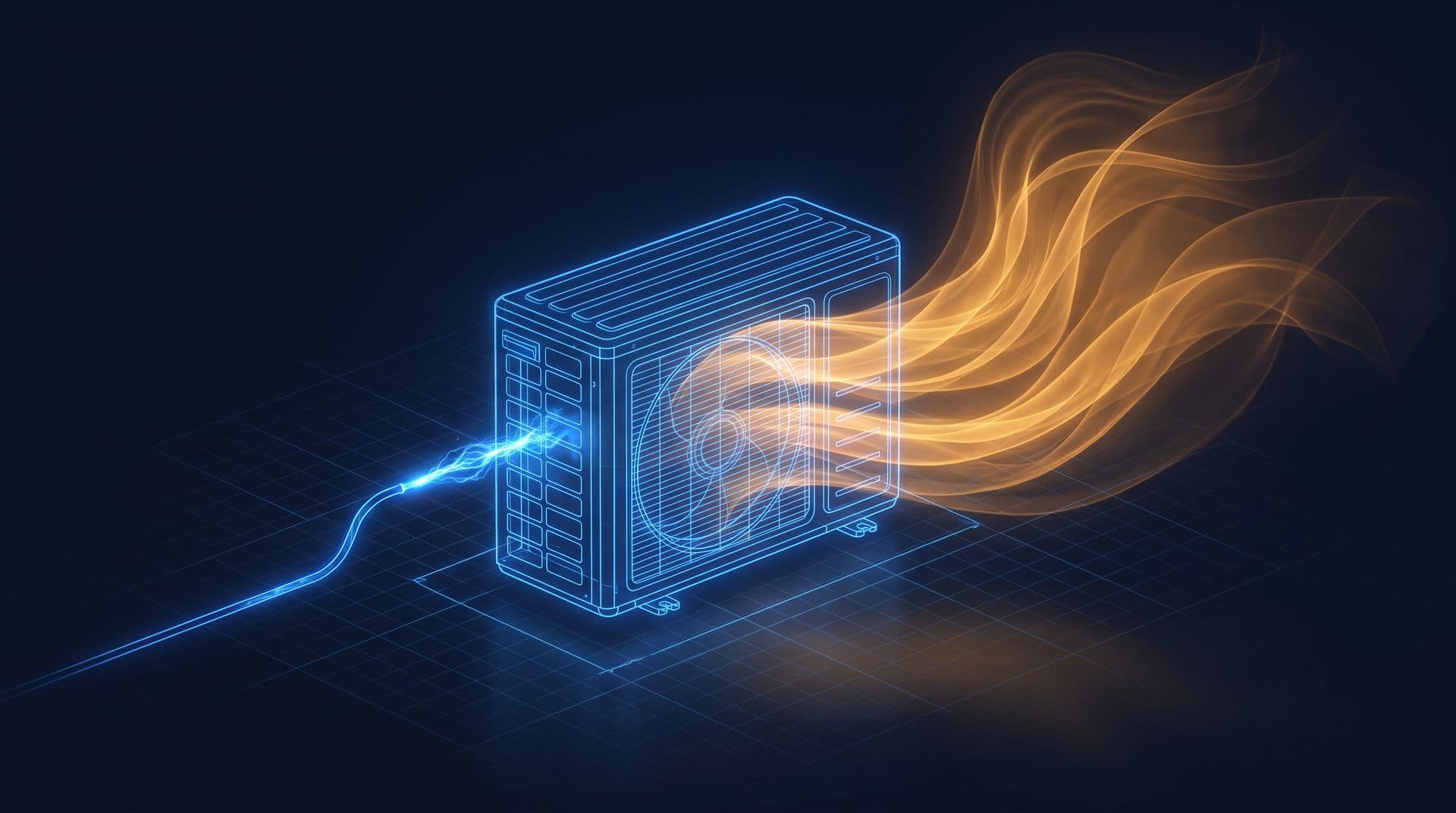
An applied extra to Cobler's Electricity Fundamentals course.
You are holding the spec sheet for a mid-size split unit. Two lines sit near the top. Cooling capacity: 3.5 kW. Power input: 1.0 kW. Read those twice and something should bother you: 1 kW of electricity goes in, and 3.5 kW of cooling comes out. That is 350% of what you put in. Either the spec sheet is lying, or physics is broken.
Neither. The aircon COP number is honest, and physics is fine. The dormant question nobody bothers to answer is simple: how does 1 kW of electricity produce 3.5 kW of cooling? Once you see the trick, the whole thing collapses into one clean idea.
In short
- An aircon's COP (coefficient of performance) can exceed 100% because it moves heat rather than creating it; a typical split unit has a COP around 3 to 5.
- COP is simply useful cooling out divided by electricity in; a 3.5 kW cooling unit on 1.0 kW of power has a COP of 3.5.
- The outdoor unit blows hot air because it is dumping the heat removed from indoors, not generating new heat.
- COP drops on the hottest afternoons because the aircon has to work harder to move heat against a bigger temperature difference.
How can an aircon put out more cooling than the electricity it draws?
Because an aircon does not make cold. It moves heat.
That is the entire answer, and everything else is detail. A heater makes heat: it turns electricity into warmth, and it can never turn 1 kW of electricity into more than 1 kW of heat. A hard ceiling: 100%, no exceptions. An aircon does something completely different. It does not convert electricity into cold, because there is no such thing as cold to convert into. It takes heat that is already sitting in your room and carries it outside. The electricity never becomes the cooling. It only pays for the carrying.
And carrying is cheap compared to making. Think of bailing water out of a boat. You are not manufacturing the water that leaves, just lifting it over the side, so a little effort on the bucket shifts far more water than that effort could ever create from nothing. An aircon is a heat bucket. One kilowatt of pumping effort can shovel three or four kilowatts of heat out of the room, because the heat was already there. It just needed a lift.
That is why engineers do not rate these machines in "% efficiency." A percentage caps out at 100, and this machine sails past it. They use a ratio that is allowed to be bigger than one, and that ratio is the aircon COP.
What actually happens inside the aircon?
A liquid called refrigerant loops around four stations, ferrying heat one bucketful at a time.
Start at the compressor, the noisy part in the outdoor box, driven by an electric motor. It squeezes the refrigerant gas hard, and squeezing a gas makes it hot, the same way a bicycle pump warms up under your hand. Now the refrigerant is hotter than the outdoor air, so when it flows through the outdoor coil and a fan blows outside air across it, it dumps its heat outdoors and cools back into a liquid.
Next it passes through a narrow expansion valve, and the pressure drops suddenly. Expanding does the opposite of squeezing: the refrigerant goes very cold, colder now than your room. It runs through the indoor coil, the indoor fan blows warm room air across it, and because the coil is colder than the room, it soaks up the room's heat. The room loses heat, which is exactly what "cooling" means. The refrigerant, now warmed back to gas, returns to the compressor, and the loop starts again.
Squeeze it hot, dump the heat outside, let it expand cold, soak up heat inside. Four steps, forever. The refrigerant never runs out because it is a courier, not a fuel: it carries heat from the cold side of your wall to the hot side.
Why is the outdoor unit blowing hot air at your legs?
Because that hot blast is your room's heat leaving the building, plus the compressor's effort added on top.
Walk past a row of shophouses and you have felt it: the outdoor units breathing hot air into the back alley. That air is the proof of everything above. All the heat the machine scooped out of the room has to go somewhere, and it leaves through that outdoor coil. So a unit drawing 1 kW of electricity and moving 3.5 kW of heat out of the room dumps roughly 4.5 kW outside: the 3.5 kW it carried out, plus the 1 kW of electrical work the compressor spent carrying it. Nothing vanished. The heat was relocated, the electricity turned into heat too, and both leave by the same door.
This is also why a fridge with its door left open will not cool your kitchen: it only moves heat from inside the box to the coils at the back, and adds its motor's heat on top, so the room warms up on net. The outdoor unit is those coils, mounted so the heat lands outside your wall.
What does "300% efficient" really mean? The aircon COP
It means the unit delivers several times as much cooling as the electricity it eats. 300% is the round figure people quote; your 3.5 sheet is really 350%, three and a half times as much cooling as the power going in. The honest name for that ratio is the Coefficient of Performance, or COP.
COP is the plainest ratio in the building: useful cooling out, divided by electricity in. Our spec sheet unit, 3.5 kW of cooling on 1.0 kW of power, has a COP of 3.5. Modern split units typically land between 3 and 5 (Lennox). Say COP 4 out loud as "400% efficient" and it sounds like a free-energy scam. It is not. It is leverage, the same leverage as the water bucket: you spend a little work to move a lot of heat.
You may also see EER on imported spec sheets. It is the same idea, cooling over electricity, but measured in mixed units (BTU per hour per watt), so the numbers look bigger. Divide EER by 3.412 and you are back to COP (Atlantis Solar). And note the trap the showroom blurs: the HP or kW cooling rating tells you how much heat the unit shifts, not how much electricity it draws, which is exactly the power-versus-energy distinction.
Why does the aircon struggle on the hottest afternoons?
Because COP falls as the outdoor air gets hotter, and the hottest afternoon is when you lean on the unit hardest.
COP is not a fixed badge. It depends on how big a hill the machine has to push heat up. On a mild day the outdoor air is only a little warmer than your setpoint, so dumping heat outside is easy. On a scorching afternoon that air is much hotter, and shoving your room's heat uphill into it takes more compressor work for every kilowatt moved. The gap widens, the effort per bucket rises, and COP drops. A widely cited rule of thumb is that efficiency falls a little over 1% for each degree Fahrenheit the outdoor temperature climbs, roughly 2% per degree Celsius (ACEEE).
This is why a single lab COP measured at one temperature is a weak guide in Malaysia, where it is hot most of the year, and why the yellow star label on every unit is based on a seasonal average, not a single-point number. We walk through that label and the inverter dial that keeps COP high at part load in the companion piece on inverter aircon, so this extra will not repeat it.
Why does a heat-pump water heater beat an ordinary one?
Same trick, aimed at a water tank instead of a room.
An ordinary electric water heater uses a resistive element, a glorified kettle coil. It makes heat from electricity, so its COP is 1: one kilowatt in, one kilowatt of heat, no more, ever. A heat-pump water heater is an aircon running the same four-stage loop, except its cold side faces the room air and its hot side wraps the water tank. It pulls heat out of the surrounding air and pumps it into the water, so it moves heat instead of making it, and its COP sits comfortably above 1. Rheem Malaysia puts the saving at up to around 75% less electricity than a resistive heater for the same hot water (Rheem Malaysia), and Malaysia's constant warmth means there is always plenty of ambient heat to harvest.
Reading any aircon spec sheet, from here on
You can now judge the sheet in front of you. Find the cooling capacity in kW and the power input in kW, divide the first by the second, and you have the COP. Above 4 is good, around 3 is ordinary, below 3 is thirsty. If it quotes EER, divide by 3.412 first. And if it is sold in horsepower, the old Malaysian habit, that is cooling capacity, not motor power: roughly 1 HP is about 2.6 kW of cooling (9,000 BTU/hr), 1.5 HP is 3.5 to 4 kW, and 2 HP is around 5.3 kW (Recommend.my). The electricity to run them is far less, because the machine moves heat rather than making it.
The spec sheet was never lying. One kilowatt in, three and a half out is not broken physics, just a heat bucket with good gearing, and now you can read exactly how good.
This is an applied extra to Cobler's Electricity Fundamentals course. It builds on Power vs Energy: kW and kWh Explained, which untangles the rate-versus-quantity trap the HP rating hides, and How Electric Motors Work, the motor that drives the compressor.
For how a chiller plant fits together end to end, see our free course Cooling Fundamentals.
The same idea, judging a machine by the useful work it delivers per kilowatt drawn, is how a facility team decides whether a chiller or a compressor is earning its electricity. CobiNeural meters input against output on every major load in your building, so efficiency is a measured number, not a nameplate claim. Book a demo and we will show you which machines are pulling their weight.
FAQ
Frequently asked questions
Ask us about this topic
Something in this article you want to dig into — or a situation in your own building it doesn't quite cover? Send us your question. We don't run public comments; the team replies to you directly by email.