
Blog
DX vs Chilled Water: Which Cooling Fits Your Building?
A practical decision guide for Malaysian buildings: where the size crossover between DX and chilled water actually sits, how the two compare on kW/RT, redundancy, space and lifecycle cost, and why one gets metered while the other fails quietly.
 Tan Kok XinHVAC & Chiller Plants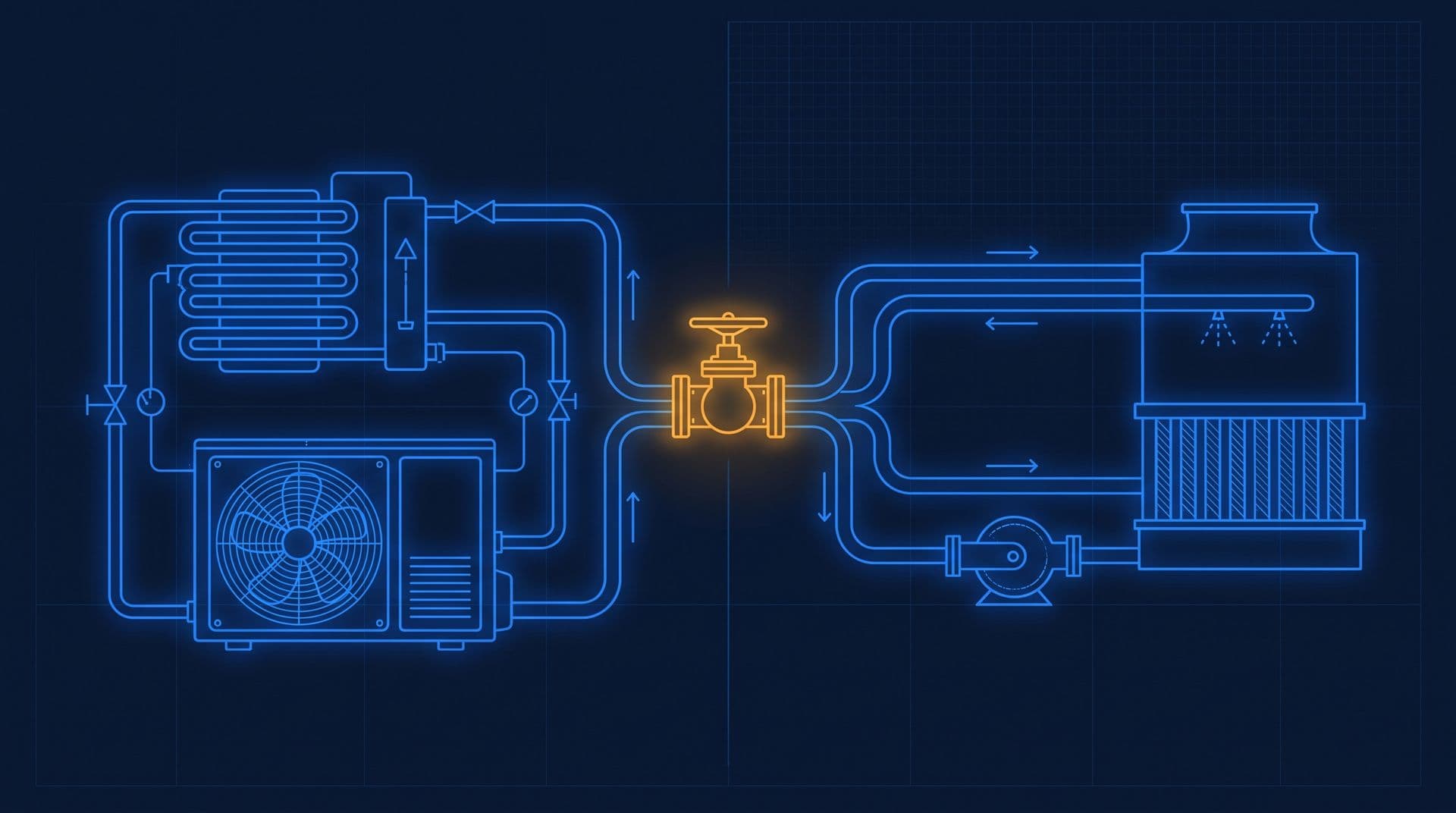
A 1,000 RT chilled water plant running at 0.75 kW/RT draws about 750 kW while it is loaded. On Medium Voltage General under TNB's RP4 tariff, every kW present in the month's single highest 30-minute demand interval is billed at RM89.27 (RM97.06 on Time-of-Use), so cooling alone can carry tens of thousands of ringgit of demand charge before a single kWh is counted. That is the real stake in the DX vs chilled water question: you are not picking equipment, you are picking a cost structure and an operating discipline that your building keeps for the next 15 to 25 years.
In short
- DX systems usually win on capex, especially at small scale; chilled water usually wins on lifecycle cost at large scale because of longer equipment life and efficiency gains that compound over thousands of hours.
- Under RP4, demand charges are billed per kW of peak, so how high your cooling peak climbs matters as much as how many hours it runs.
- Tropical part-load behaviour changes the efficiency comparison compared to temperate-climate assumptions.
- Monitoring cost is a real difference between the two options that most budgets leave out.
What is the actual difference between DX and chilled water?
DX means direct expansion: refrigerant expands in the coil that sits in the airstream you are cooling. Wall splits, cassettes, ducted units, packaged rooftop units and VRF all belong here. The refrigerant circuit runs from the outdoor condensing unit to the indoor coil, and that is the whole system. Nothing is centralised, and there is no water loop.
A chilled water system puts a chiller in between. The chiller cools water to roughly 6 to 7 degrees Celsius, pumps push that water through the building, and AHUs or FCUs transfer heat from the air into the water at the coil. Heat rejection happens at a cooling tower (water-cooled) or at the chiller's own condenser fans (air-cooled). If the mechanics of that loop are new to you, start with how a chilled water system works and then the difference between AHUs and FCUs, because the terminal side is where most of the comfort complaints originate.
The short version: DX moves refrigerant to the load, chilled water moves water to the load. Everything else follows from that.
At what size does chilled water start to make sense?
Below roughly 100 RT, DX wins on almost every axis. Shoplots, clinics, small offices, single-floor factories: a set of splits or a VRF system is cheaper to install, needs no plant room, no water treatment, no cooling tower licence, and no dedicated chargeman-supervised plant routine.
Above a few hundred RT, chilled water usually wins. Central chillers scale efficiently, they concentrate maintenance in one room, and they let you build in redundancy that a distributed DX fleet cannot match cheaply. Hospitals, malls, hotels, data halls, large manufacturing plants and anything above roughly 400 to 500 RT are almost always chilled water for good reasons.
Between 100 and 400 RT is genuinely contested territory. Air-cooled chillers, water-cooled packages and large VRF systems all compete there, and the tiebreaker is usually operating hours, tenancy structure and whether you have a plant room at all. A building running 24/7 pushes toward chilled water. A building running eight hours a day, five days a week, with tenants who want independent control and separate billing, often stays on DX.
Efficiency: DX vs chilled water on kW per RT
Approximate figures, and treat them as bands rather than promises. A well-run water-cooled chilled water plant, counting chiller plus chilled water pumps plus condenser water pumps plus cooling tower fans, lands somewhere around 0.65 to 0.9 kW/RT at the plant level. Air-cooled chillers sit higher because they reject heat to 33 degree Celsius ambient air instead of to evaporative cooling. DX splits and VRF typically run higher still per RT, commonly in the region of 1.0 to 1.4 kW/RT depending on age, refrigerant charge, condenser cleanliness and how badly the outdoor unit is boxed in.
The gap is real, but it is not free. That 0.65 kW/RT number belongs to a plant that is commissioned properly, sequenced properly, has clean tubes and a working control strategy. A neglected chilled water plant will happily deliver 1.1 kW/RT and nobody will notice, because there is no bill line that says so. Our guide to chiller plant efficiency in kW/RT covers how to measure it honestly rather than quoting the nameplate.
VRF deserves a fairer hearing than it usually gets. Inverter compressors modulate well, and in a building with scattered, intermittent loads (a serviced office, a school, a mixed-use podium), a VRF fleet that only runs the zones in use can beat a chilled water plant that has to keep a pump set and a tower running to serve one occupied floor at 10pm.
How does tropical part-load behaviour change the answer?
Malaysian buildings almost never operate at design load. Ambient sits in a narrow band, but internal load and occupancy swing hard, so both system types spend most of their life at 30 to 70 percent capacity. That is where the two diverge.
Chilled water plants degrade at low load unless they are designed for it. Constant-speed pumps, oversized chillers cycling on and off, and low delta-T syndrome (return water coming back at 9 or 10 degrees instead of 12 to 13) all push kW/RT up sharply at part load. Add variable-speed drives on pumps and towers, sensible staging and a decent control sequence and the curve flattens.
DX degrades differently. A fixed-speed split at part load short-cycles, which hurts efficiency but hurts dehumidification more. In our humidity, a coil that never runs long enough to condense properly leaves the space at 65 to 70 percent RH, cold and clammy, and occupants respond by dropping the setpoint. Inverter DX handles this much better. If you are choosing between the DX families, the window, split and VRF comparison sets out where each one lands.
Maintainability, redundancy and space
Chilled water concentrates risk and concentrates attention. One plant room, one set of logs, one contractor, and the option to run N+1 so a chiller trip does not stop the building. That matters for hospitals, cleanrooms, hotels and any process that cannot lose cooling. The cost is space (plant room, riser shafts, tower deck), weight, water treatment, and a maintenance regime that requires actual competence.
DX distributes risk. One condensing unit failing takes out one zone, not the building, which sounds like redundancy and behaves like attrition. A 200-unit split fleet across a campus will always have units that are undercharged, units with blocked condensers and units that have been running on backup electric heat logic nobody configured properly. No single failure is urgent, so no failure gets fixed, and the fleet drifts.
Capex favours DX, particularly at small scale. Lifecycle cost usually favours chilled water at large scale, because equipment life is longer (chillers routinely reach 20 to 25 years, DX condensing units often 10 to 15), and because a few points of kW/RT applied to thousands of operating hours compounds. Under RP4, Medium Voltage energy rates fell to roughly 29 to 31 sen/kWh while capacity and network charges are billed per kW of peak demand, so the weight of the bill has shifted toward how high your cooling peak climbs, not only how many hours it runs. Staging cooling to avoid a coincident peak is now worth real money. Check the current schedule on the official myTNB tariff page before you model anything.
The monitoring difference nobody budgets for
A chilled water plant justifies proper instrumentation because the payback is arithmetic: flow meter, supply and return temperature sensors, and a plant-level power meter give you live kW/RT, which turns "the chillers seem fine" into a number that either meets target or does not. Sub-metering the plant separately from the rest of the building is the single highest-value metering decision most facilities make.
DX fleets get monitored almost never, which is exactly why they bleed. There is no plant room, no flow meter, no obvious place to put a sensor, so the fleet is judged by complaint calls. Panel-level or circuit-level power monitoring solves most of it: a condensing unit running 30 percent longer than its neighbours on the same floor, or drawing more current for the same duty, is telling you about a dirty condenser or a refrigerant leak months before anyone complains.
CobiNeural covers both cases. Chilled-water system monitoring gives plant kW/RT, delta-T and staging behaviour; energy monitoring at circuit level catches DX fleet drift; the real-time Max Demand KPI shows when cooling is what pushes the month's peak interval; and Alerts push the exception to WhatsApp or email rather than waiting for a monthly report. It runs standalone or as an overlay on an existing BMS, PLC or SCADA, so you are not replacing controls to get visibility.
For how a chiller plant fits together end to end, see our free course Cooling Fundamentals.
If you are sizing a plant, comparing an air-cooled retrofit against staying on DX, or trying to work out where your cooling load sits in your TNB peak, send us a month of interval data or a recent bill and we will walk through the numbers with you. Request a demo and bring the messy data, not the tidy version.
FAQ
Frequently asked questions
Ask us about this topic
Something in this article you want to dig into — or a situation in your own building it doesn't quite cover? Send us your question. We don't run public comments; the team replies to you directly by email.