
Blog
How a BMS Runs the Air Side: VAV, Static Pressure Reset and Fresh Air
How a BMS delivers cooling to each zone with VAV boxes, static pressure reset and CO2-based fresh air control — the control side of comfort and air quality.
 Tan Kok XinBuilding Automation & BMS Fundamentals
Part 13 of 16 in Cobler's Building Automation and BMS Fundamentals course. New here? See the course page.
In Part 12, the chiller plant made the chilled water. That left a question: once the chilled water reaches AHU-12A, how does the BMS (building management system) control the airflow, the air temperature and the fresh air on the floor? A meeting room that gets stuffy as people arrive and a corner desk that always feels too cold are both served by the same plant, so each needs its own share.
The BMS runs this "air side" of the building. It controls the fans, chilled water valves and air dampers in the air handling units, fan coil units and zone boxes, so that each space gets enough cool, dry air and enough fresh air, without the fans working harder than they need to. This part follows the cold air from AHU-12A to the rooms it serves.
The air handling unit makes one stream of cold air
The chilled water travels from the plant to every air handling unit (AHU) in the building. An AHU is a large box with a filter, a coil full of chilled water, and a supply fan. The fan pushes air across the cold coil and out into the ducts. The Cooling course explains the machines themselves; here we look at how the BMS controls them.
The office tower has two AHUs on each floor, and AHU-12A serves the east half of level 12. Its seven points from Part 3 cover the supply and return air temperatures, the filter differential pressure, the chilled water valve, the supply fan speed, and the fan's run command and status.
The first job is to make the air cold. The BMS compares the supply air temperature with its setpoint and opens or closes the chilled water valve to hold it there. That is the supply air loop from Part 5. In VAV systems the supply air setpoint is typically around 13 °C; AHU-12A's sequence in Part 6 uses 14 °C.
The coil also dries the air. When humid air touches the cold coil, some of its moisture condenses into water and drains away. In Malaysia this matters a great deal, and we come back to it later in this lesson.
The rest of this part adds to AHU-12A as each control idea needs it: a duct static pressure sensor on the AHU, a temperature sensor and damper in each zone, and, for fresh air control, an outdoor air damper with a carbon dioxide (CO2) sensor.
Each room needs a different amount, so a VAV box sets its share
AHU-12A sends one stream of 14 °C air into a duct that branches to every zone on the floor. But the zones need different amounts. A meeting room with twelve people and a projector needs a lot of cooling. The empty office next door needs almost none. If both got the same airflow, one would be stuffy and the other would be cold.
One older answer was to send a constant airflow everywhere and reheat the air for rooms that needed less cooling. In a tropical office, that means paying to cool the air and then paying again to warm it back up, so ordinary offices here do not reheat for comfort. (Some hospitals, laboratories and cleanrooms do reheat on purpose, because they must control humidity very closely.)
The usual answer in modern offices is variable air volume (VAV). The supply air stays at a fairly steady cold temperature, and each room gets a different amount of it.
Each zone has a VAV box: a short section of duct with a damper, which is a blade that swings to open or close the duct, like a butterfly valve for air. A small actuator moves the damper (Part 2 covered actuators). The box has its own controller, which reads the zone's temperature sensor:
- The room gets warmer than its setpoint, so the controller opens the damper and more cold air flows in.
- The room cools to its setpoint, so the controller closes the damper back towards a minimum airflow.
- The minimum keeps some air moving so the room still gets fresh air.
So one cold stream is shared out, and each room takes the portion it needs.
VAV static pressure reset control slows the supply fan
Opening a VAV damper only helps if there is enough pressure in the duct to push air through it. So the BMS holds a static pressure in the main duct. Static pressure is the push behind the air, like water pressure in a pipe. A pressure sensor sits partway down the main duct, and the BMS changes the supply fan's speed to hold that pressure at a setpoint.
Now think about a late afternoon when the load drops. Rooms reach their setpoints and their VAV dampers close towards minimum. With less air able to escape, the pressure in the duct rises. The BMS responds by slowing the fan to bring the pressure back down to its setpoint. That saves some energy. But if the setpoint is fixed at a value chosen for the hottest, busiest day, the fan still pushes hard against a row of nearly closed dampers.
Static pressure reset lowers the setpoint itself. The BMS reads how far open every VAV damper is:
- If no damper is close to fully open, no zone is short of air. The BMS lowers the pressure setpoint a little, and the fan slows down.
- If one or more dampers are nearly fully open and still asking for more air, those zones are short. The BMS raises the setpoint a little.
- It repeats these small steps every few minutes, so the setpoint settles at the lowest pressure that still keeps every zone supplied.
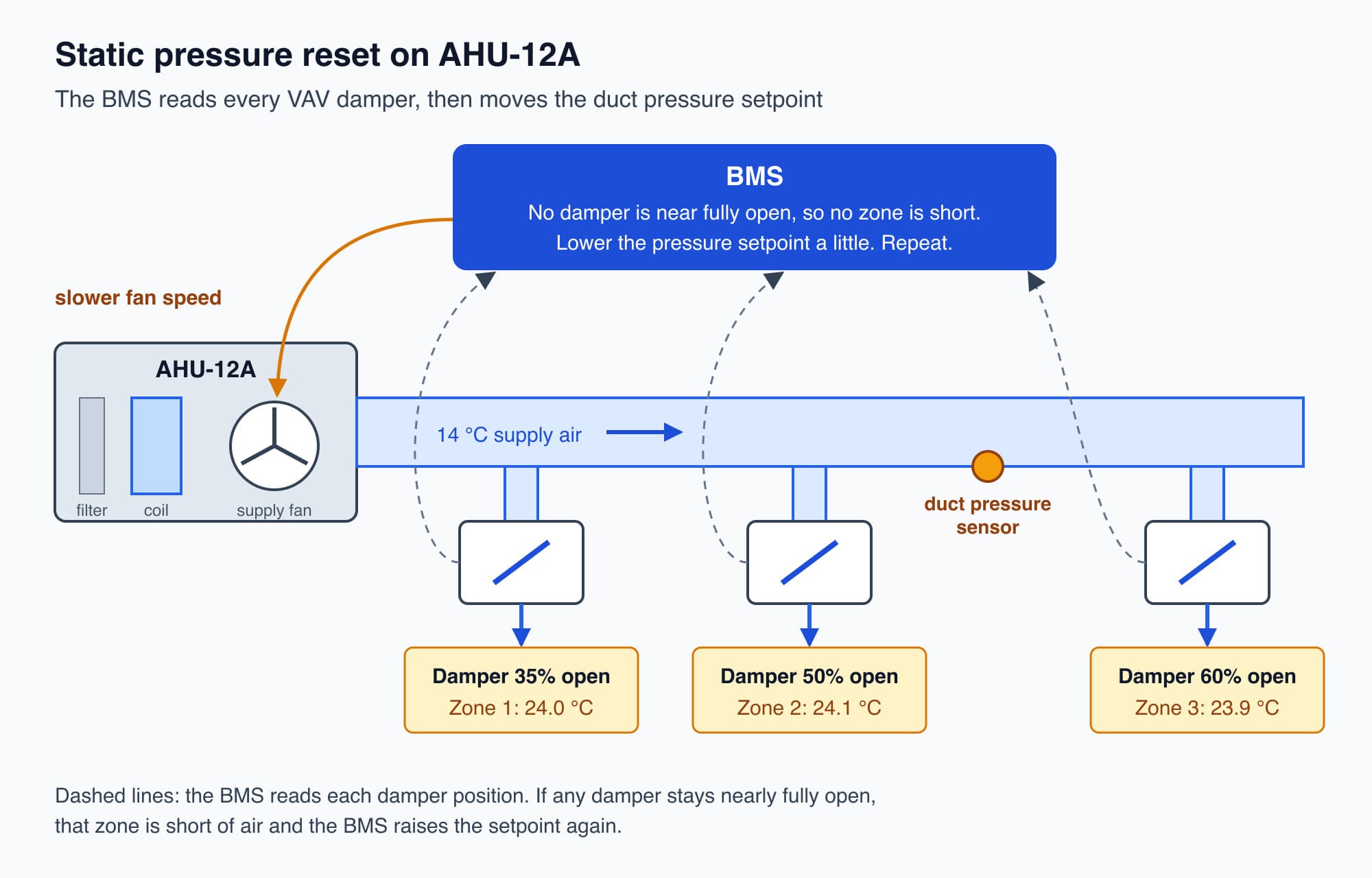
Static pressure reset: the BMS reads every VAV damper and moves the duct pressure setpoint down until one zone is only just satisfied.
One zone can spoil this. If a VAV box is stuck, undersized or has a faulty sensor, its damper stays fully open and keeps asking for more air, so the reset never lowers the setpoint. Commissioning and trend reviews (Part 8) look for such a zone.
A small drop in fan speed saves a large share of fan power
Why does it matter if the fan turns a little slower? Fans follow three rules called the affinity laws, which apply in ideal conditions:
- airflow changes in proportion to fan speed
- pressure changes with the square of speed
- power changes with the cube of speed
The cube is what makes speed so valuable. At 80% speed, the ideal power is 0.8 × 0.8 × 0.8 = 0.51 of full power. So in the ideal case, slowing a fan to about 80% speed cuts its power draw by roughly half, for only a 20% drop in airflow.
A real fan does not follow the ideal curve all the way down, for two reasons. First, the duct must still hold a minimum pressure at the far end, so the fan cannot slow as freely as the ideal law assumes. Second, the motor and its drive become somewhat less efficient at low speed. So the real saving at 80% speed is up to about half, and usually less. It is still large, and fans run for thousands of hours a year.
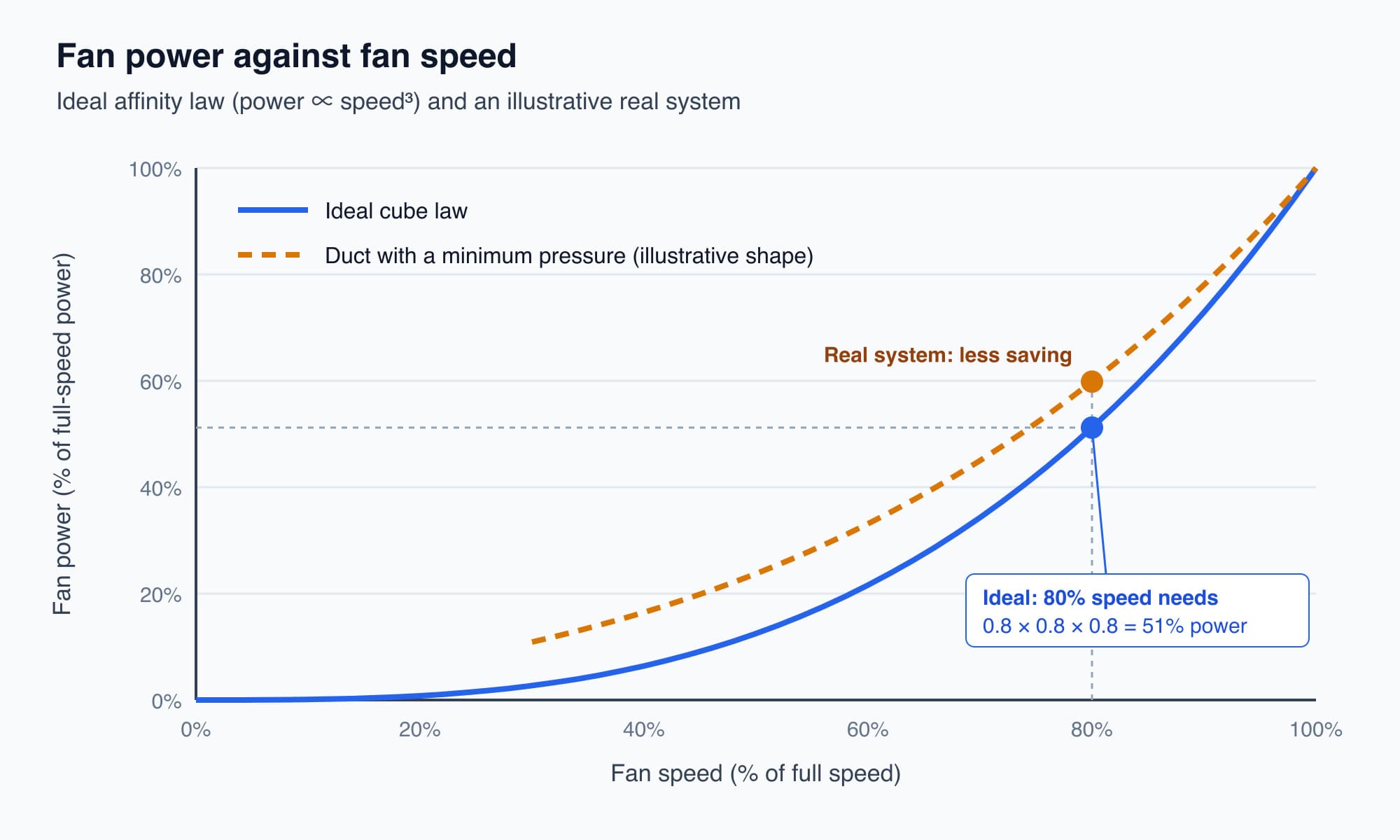
The ideal cube law gives about half the power at 80% speed; a real duct system with a minimum pressure saves less.
As an illustration, suppose AHU-12A's fan draws 6 kW at full speed. In the ideal case, 80% speed would need about 0.51 × 6 kW, or roughly 3.1 kW. The real figure would sit somewhere between that and 6 kW.
The fan is driven by a three-phase motor through the variable speed drive (VSD) from Part 2: the BMS sends the drive a speed signal and the drive makes the motor follow it.
Supply air temperature reset eases the chiller, within a humidity limit
The same idea works on temperature. Making cold supply air takes cold chilled water, and colder water costs the chiller more energy (Part 12).
If every VAV damper on the floor is sitting part-open and no zone is struggling, the air is colder than the zones need. Supply air temperature reset lets the BMS raise the supply air setpoint by a degree or two, for AHU-12A say from 14 to 15 or 16 °C, while it watches that no zone falls behind. Warmer supply air lets the chilled water system work less hard.
There are two limits to this.
- Fan energy. Warmer air carries less cooling per cubic metre, so each room needs more airflow to stay cool. That asks more of the fan, which works against the static pressure reset described earlier. A good sequence balances the two resets rather than pushing either one to its limit.
- Humidity. A warmer coil removes less moisture. In Malaysia's humid air, raising the supply air temperature too far can leave rooms at the right temperature but feeling damp. So the reset needs a humidity limit: if the space humidity rises towards its upper limit, the BMS stops raising the supply air temperature. (Part 2 gave the acceptable range: 40 to 70% relative humidity, with many designs aiming for 50 to 60%.)
Fresh air is needed, but it is costly to cool, so CO2 sets the amount
So far, the AHU has been cooling the same indoor air over and over. But people need fresh outdoor air, to keep the space from feeling stale and to dilute the carbon dioxide we breathe out. So the AHU mixes in some outdoor air through an outdoor air damper.
In Malaysia, outdoor air is hot and very humid. Every cubic metre that comes in must be cooled and dried. The energy used to cool the air is the sensible load. The energy used to condense water out of it is the latent load, and in our climate the latent load is large. The Cooling course lesson on sensible heat, latent heat and dew point explains both. The result is that fresh air is a steady energy cost whenever the building is occupied.
So how much outdoor air should come in? Too little, and the air goes stale. Too much, and you pay to cool and dry outdoor air for rooms that may be half empty. The older approach was to fix the outdoor air damper at a position sized for a full house, and then pay for that amount even at 9 a.m. on a quiet Monday.
Demand-controlled ventilation (DCV) sets the amount from the number of people. The BMS cannot easily count people, but it can measure something they produce: CO2. Each person breathes out CO2, so indoor CO2 rises and falls with occupancy.
ICOP IAQ 2010, from the Department of Occupational Safety and Health (DOSH), uses an indoor CO2 ceiling of 1,000 ppm (parts per million) as an indicator of whether ventilation is working.
To use DCV, AHU-12A would gain two points: a CO2 sensor (in the space or in the return duct) and a control signal to the outdoor air damper. Then:
- As the floor fills and CO2 rises towards the limit set in the sequence (below 1,000 ppm), the BMS opens the outdoor air damper wider.
- As people leave and CO2 falls, the BMS closes the damper back towards a minimum position.
- The minimum stays in place even when the floor is nearly empty, because people are not the only source of indoor pollutants that need diluting.
The fresh air then follows the actual number of people, rather than a guess made at design time.
Most Malaysian floors use fan coil units or constant-volume AHUs
VAV is common in larger modern offices. Many Malaysian buildings, and many spaces inside VAV buildings, use simpler systems. The office tower's ground-floor lobby and café use fan coil units (FCUs). An FCU is a small unit with a fan, a chilled water coil and a filter, usually in the ceiling of the room it serves. The Cooling course compares AHUs and FCUs.
FCU control is simpler than VAV:
- A thermostat, usually on the wall or reading the return air, compares room temperature with its setpoint.
- It opens or closes a two-way valve on the chilled water coil. Many FCUs use a simple open/closed valve with a small deadband, as described in Part 4.
- The fan runs at a speed the occupant or the BMS selects, often one of three fixed speeds.
- Many FCUs have stand-alone thermostats with no BMS connection. When the thermostats are networked, the BMS can switch the FCUs on a schedule, limit how low occupants can set them, and see which ones are running.
A constant-volume AHU has a fan that runs at one speed. (It may have a drive that was set once at commissioning.) With the airflow fixed, the BMS has only the chilled water valve to control. It can control on either of two temperatures:
- Return air temperature, which is close to the average room temperature. This holds the rooms at setpoint, but at light load the valve closes and the coil warms up.
- Supply air temperature, which keeps the coil steadily cold. This keeps drying the air, but on a mild day the rooms may get too cold unless the setpoint is reset.
The humidity problem is the same for FCUs and constant-volume AHUs. When the cooling load is light, the valve throttles back, the coil gets warmer and it removes less moisture. The room can then sit at 24 °C and still feel clammy. Occupants often respond by turning the setpoint down, which overcools the room without fixing the moisture. A better sequence keeps the coil cold enough to dry the air, using a humidity sensor or a lower limit on coil or supply air temperature, and lets the room temperature be managed within that limit.
System | What the BMS varies | What it controls on | In the office tower |
|---|---|---|---|
VAV AHU with VAV boxes | Fan speed, supply air temperature, each zone's airflow | Duct pressure, supply air temperature, each zone's temperature | Office floors (AHU-12A) |
Constant-volume AHU | Chilled water valve only | Return or supply air temperature | Not used; common in older buildings |
Fan coil unit | Chilled water valve (often open/closed), fan speed setting | Room or return air temperature | Lobby and café |
Measuring a condition is not the same as controlling it
Demand-controlled ventilation shows a difference that runs through this whole course. A CO2 sensor on the wall that tells you how stuffy a room is does monitoring: it measures a condition. Turning that reading into an action, such as opening the outdoor air damper or speeding up the fan, is control. The sensor observes. The BMS decides and moves something.
A wall display showing CO2 and humidity is a gauge. It becomes control only when a system is wired and programmed to act on the number. This is worth checking whenever someone says a space "has IAQ control".
The difference also explains why some comfort complaints go unsolved for months. "It feels stuffy in the afternoon" has no number attached, so nobody can tell whether the cause is ventilation, humidity or a zone that is short of air. Continuous measurement of CO2, temperature and humidity turns the complaint into a trend someone can look at. Part 16 returns to this difference between control and measurement.
Worth knowing: At normal office levels, CO2 is not the harm itself. It is a convenient signal of whether the fresh air supply is keeping up with the people in the room. The 1,000 ppm figure is a ventilation check, not a complete air quality test: a room can be under 1,000 ppm and still have other air quality problems.
What comes next
The air side is where most of the building's fan energy goes, and the chiller plant from Part 12 is where most of the rest of the cooling energy goes. Together, they make up the largest part of the building's electricity demand on a hot afternoon. The next part, How a BMS Guards Your Electricity Bill: Load Shedding and Demand Limiting, starts from this question: how can a BMS trim the building's demand for a few minutes at a time to lower the monthly demand charge?
Check your understanding
- On a quiet afternoon, every VAV damper on level 12 is between 30% and 60% open. What should static pressure reset do, and why does it save energy? No damper is close to fully open, so no zone is short of air. The BMS should lower the duct pressure setpoint in small steps, and the fan will slow down. Fan power falls roughly with the cube of speed, so even a modest speed reduction saves a large share of fan power, although less than the ideal cube law suggests.
- The lobby FCU holds 24 °C, but people say the lobby feels clammy. Why can this happen, and what would help? At light load, the FCU's valve throttles back or stays closed for longer, so the coil is warmer and removes less moisture. The room reaches its temperature setpoint while the humidity stays high. Keeping the coil cold enough to dry the air, for example with a humidity sensor or a limit on coil temperature, deals with the moisture. Lowering the thermostat setpoint only overcools the room.
Recap: The AHU makes one stream of cold, dry air by holding a supply air temperature with its chilled water valve. VAV boxes share that air out by opening and closing a damper for each zone. Static pressure reset lowers the duct pressure setpoint until one zone is only just satisfied, and fan power falls steeply with speed, by up to about half at 80% speed. Supply air temperature reset eases the chiller but must respect humidity. Demand-controlled ventilation uses CO2 to set the fresh air to the number of people. FCUs and constant-volume AHUs control only the water valve, so the main risk at light load is poor drying.
Go deeper on video (optional)
This video walks through the VAV box and static pressure loop described earlier, with a duct pressure sensor driving the supply fan's drive. It is optional; you do not need it for the next part.
MEP Academy walks through how VAV boxes serve each zone and how a duct static pressure sensor drives the supply-fan VFD — the exact control loop this article describes.
This is Part 13 of 16 in Cobler's Building Automation and BMS Fundamentals course. Previous: How a BMS Optimises the Chiller Plant: Staging and Temperature Reset. Next: How a BMS Guards Your Electricity Bill: Load Shedding and Demand Limiting.
Cobler builds CobiNeural, a platform that shows a facility team its building's energy, water and indoor air data as live numbers across the whole site. To see how your building performs, talk to us.
FAQ
Frequently asked questions
Ask us about this topic
Something in this article you want to dig into — or a situation in your own building it doesn't quite cover? Send us your question. We don't run public comments; the team replies to you directly by email.