Blog
Maxwell's Equations, Decoded
The four sentences the whole Electricity Fundamentals course has been quoting without attribution, decoded in plain words: charge, magnets, induction and the light that falls out of the maths.
 Tan Kok XinElectricity Fundamentals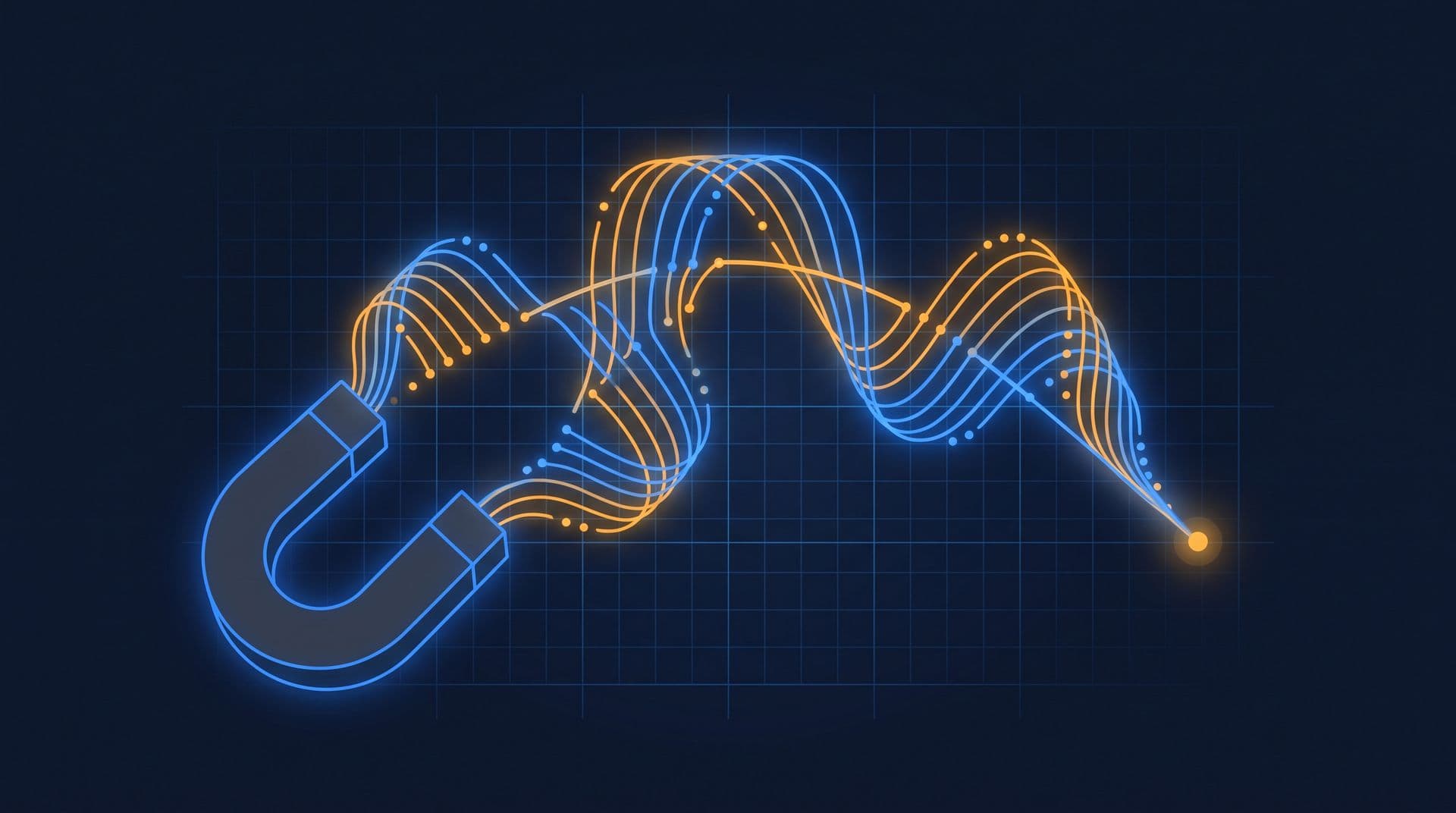
A Math Annex extra to Cobler's Electricity Fundamentals course.
You have seen them on a mug, a T-shirt, a lecture-hall poster: four lines of dense symbols under the words Maxwell's Equations, printed as if to say this is the summit, and you are not invited. Most people read the caption, admire the mystique, and look away. The symbols feel like a locked door. What almost nobody mentions is that behind the door are four plain sentences, and if you have read any of this course, you have already met all four of them wearing work clothes.
Every article here has been quoting Maxwell's equations without attribution
That is the honest frame. The generator that spins in a power station, the transformer humming on a pole, the motor that turns a pump, the field buzzing around a high-voltage line: none of them are separate discoveries. Each is a corollary of the same four short equations, worked out for a particular machine. James Clerk Maxwell gathered the whole of electricity and magnetism into these statements in the 1860s, and everything electrical since has been a footnote to them.
So let us open the door. Four equations, four sentences, each decoded in plain words with the symbols alongside for anyone who wants them. Skip the symbols freely; the sentence is the point.
Gauss's law: charges make the push
Electric charge is the source of the electric field. Put a charge somewhere and it reaches out into the space around it, pushing on any other charge that comes near. The field lines start on positive charge and end on negative charge, like invisible threads running out of one and into the other.
$$\nabla \cdot \mathbf{E} = \frac{\rho}{\varepsilon_0}$$
That is the very first idea in the course, the push that Part 1 opened with, written in its formal clothes. The left side is a way of asking "is field spraying out of this point?" and the right side answers "yes, exactly as much as there is charge sitting there." Charge creates field. Nothing more mysterious than that.
No magnetic monopoles: cut a magnet and you get two magnets
There is no such thing as a lone magnetic pole. Electric charge comes in two separable kinds, plus and minus, and you can hold one on its own. Magnetism refuses to play the same game. Every magnet has a north and a south end bound together, and if you snap a bar magnet in half hoping to isolate the north pole, you do not get a loose north. You get two smaller magnets, each with its own north and south. Snap those, and you get four. The poles will not come apart.
$$\nabla \cdot \mathbf{B} = 0$$
The equation says the same thing in one stroke: magnetic field lines never begin or end anywhere. They only ever form closed loops, running out of the north, around, and back into the south. Because they close on themselves, there is no point you can name as a pure source, which is exactly why the lone pole cannot exist. It is the shortest of the four, and it is the one you can test on your fridge.
Faraday's law: one equation wearing three costumes
A changing magnetic field creates a circulating electric field. Hold a magnet still near a coil and nothing happens. Move it, and the shifting field wraps a loop of electric push around itself, and that push drives a current in the coil. Change is the whole ingredient. A steady field does nothing; a changing one comes alive.
$$\nabla \times \mathbf{E} = -\frac{\partial \mathbf{B}}{\partial t}$$
This single line is three of the machines in this course, wearing three different costumes. Spin a magnet past a coil on purpose and the circulating push is your mains supply: that is how a generator makes electricity. Feed alternating current into one coil so its field swells and collapses beside a second coil, and the changing field induces a voltage across the gap: that is how a transformer works. Sweep a rotating field past the bars of a rotor and the induced currents drag it round: that is the induction motor. Three industries, three lecture chapters, one equation. Once you see it, you cannot unsee that they are the same sentence.
Ampère–Maxwell: currents make magnetism, and so does changing electric field
Electric current creates a circulating magnetic field, and here is Maxwell's audacious addition: so does a changing electric field. The first half was known before him. Run a current down a wire and a magnetic field curls around it; that is the electromagnet, the relay, the motor's torque. Maxwell stared at the equations and noticed they were lopsided. A changing magnetic field made an electric one, by Faraday's law, so symmetry demanded the reverse. He added a term saying a changing electric field must make a circulating magnetic field too, even with no wire, no current, nothing but empty space.
$$\nabla \times \mathbf{B} = \mu_0 \mathbf{J} + \mu_0 \varepsilon_0 \frac{\partial \mathbf{E}}{\partial t}$$
That extra term is one of the great guesses in the history of physics, and it does something wonderful. If a changing electric field makes a magnetic field, and a changing magnetic field makes an electric field, then the two can take turns. Each one, by changing, gives birth to the other, and the pair go leapfrogging through empty space with no wire and no charge to carry them. A self-sustaining ripple of field, chasing itself along. That ripple is light.
The punchline, told properly: Maxwell weighed the light
Here is the moment the four sentences earn the mug. Maxwell's leapfrogging wave travels at a speed set entirely by two constants that you can measure on a laboratory bench, one from electricity and one from magnetism, with no light involved at all.
$$c = \frac{1}{\sqrt{\mu_0 \varepsilon_0}}$$
He put in the two measured numbers, turned the handle, and out came roughly three hundred thousand kilometres per second: the speed of light, already measured by other means. Nothing in his sums had mentioned light. He had built a wave out of pure electricity and magnetism, computed how fast it must go, and landed on the one speed the universe reserves for light. The only honest conclusion was that light is an electromagnetic wave. Maxwell wrote it up in 1865, in a paper called "A Dynamical Theory of the Electromagnetic Field" (Royal Society). It remains one of the most breathtaking predictions ever made from a page of algebra.
For more than twenty years it was only a prediction. Then in 1887 and 1888 Heinrich Hertz built a spark-gap transmitter and a loop of wire to catch the signal, and made the invisible waves in his laboratory, proving they were real and travelled at Maxwell's speed (IEEE/ETHW milestone). Every radio, every phone, every Wi-Fi router since is Hertz's experiment sold at scale.
One footnote closes a loop from elsewhere in this Annex. Maxwell's own equations were a sprawling mess, around twenty of them in an awkward notation. The compact four we quote today were carved out in the mid-1880s by Oliver Heaviside, the self-taught engineer who also gave us the operational shortcut behind the Laplace transform. The four sentences on the mug are as much Heaviside's editing as Maxwell's physics (History of Maxwell's equations).
So why do magnets exist at all? Relativity you can feel
There is a deeper wonder still, and it answers a question the four equations state but never explain: why should a moving charge feel a magnetic force in the first place? The startling answer is that magnetism is not a separate force at all. It is electricity, seen from a moving frame.
Run the argument on a current-carrying wire. Sitting still, the wire is electrically neutral, with as much positive charge in its fixed metal lattice as there is negative charge in its drifting electrons, so it pushes on nothing. Now ride alongside the electrons. From your moving seat the positive and negative charges are travelling at different speeds, so Einstein's length contraction squeezes their spacing by different amounts. The perfect cancellation breaks. The wire now looks charged to you, and a charged wire pushes on a nearby charge with an ordinary electric force. That push is precisely the force that a bystander standing still calls magnetism. Same event, two frames, two names. The magnetic force pinning a photo to your fridge is electricity wearing the disguise of relative motion. Magnetism is relativity you can feel with a fridge magnet.
One honest caveat, because the popular framing overreaches. This clean derivation explains the magnetic force from currents, moving charges in a wire. It does not, on its own, explain the pull of a permanent magnet, which comes from the quantum spin of its electrons, a different and deeper story. The relativity argument is real and rigorous for the wire; it is not the whole account of the lump of iron.
If you want to go further than any article can take you, the person to watch is Walter Lewin, whose MIT 8.02 electricity and magnetism lectures are freely posted and remain the most physical, most alive teaching of these four equations anywhere, demonstrations and all.
Go deeper on video
Reading explains; watching sometimes lands the picture. Full credit to the creators:
"Let There Be Light: Maxwell's Equation EXPLAINED for BEGINNERS" by Parth G
"How Special Relativity Makes Magnets Work" by Veritasium
This is a Math Annex extra to Cobler's Electricity Fundamentals course. It sits behind how generators make electricity and how transformers work, which are Faraday's law at work, and beside where electrical energy flows, the fields these four equations describe.
Cobler builds CobiNeural, which turns those invisible fields into numbers you can act on: real energy, demand and power quality across a Malaysian building or plant. Book a demo to see yours.
FAQ
Frequently asked questions
Ask us about this topic
Something in this article you want to dig into — or a situation in your own building it doesn't quite cover? Send us your question. We don't run public comments; the team replies to you directly by email.