Blog
Why Engineers Learn Laplace Transforms
The one thing every engineer mastered for the exam and never understood. What the Laplace transform is actually for, told without a single equation.
 Tan Kok XinElectricity Fundamentals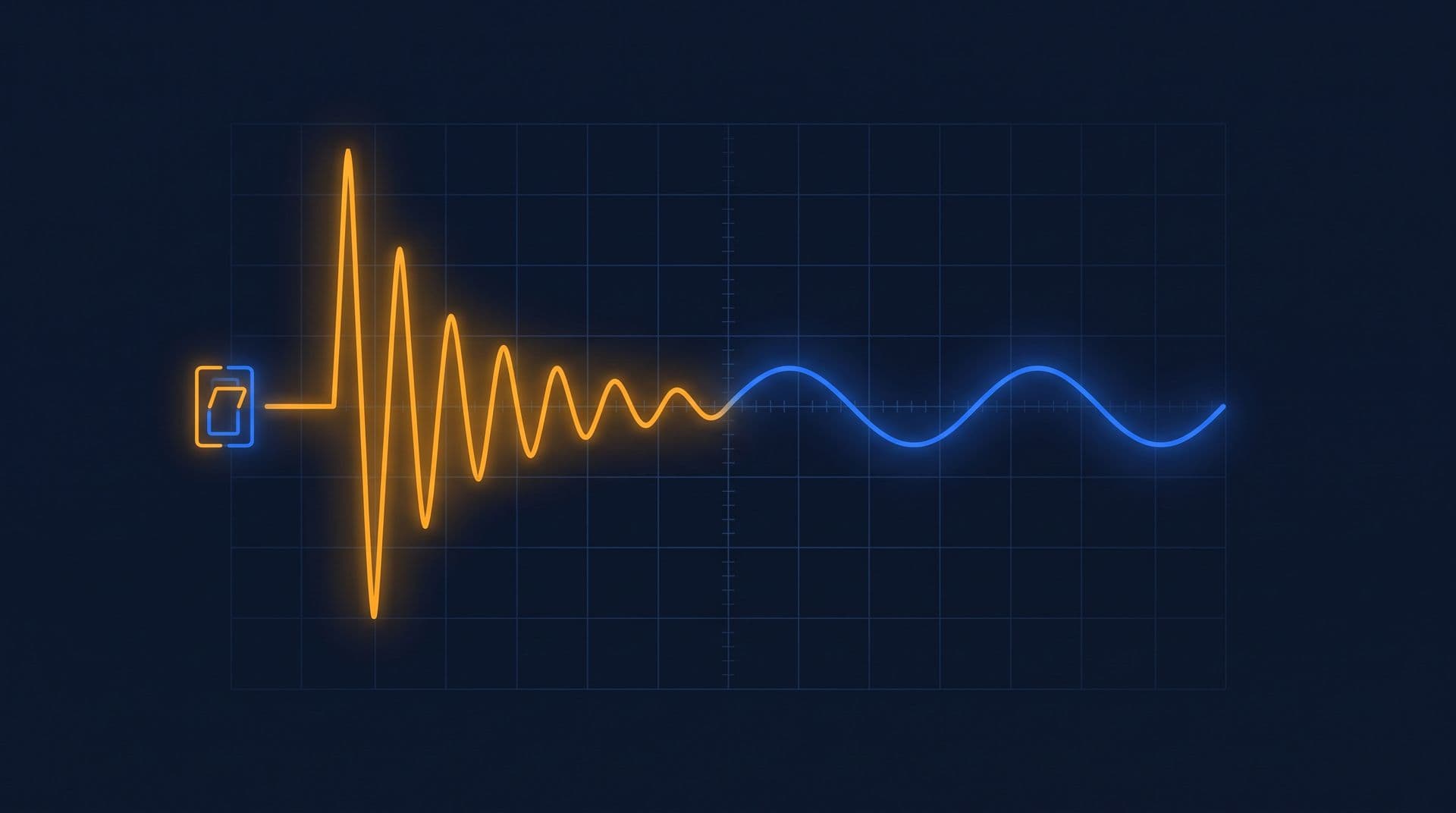
A Math Annex extra to Cobler's Electricity Fundamentals course.
Of all the machinery packed into an engineering degree, one piece stands out for how completely it is mastered and how little it is understood. Students learn to turn a problem into a table of standard pairs, shuffle the symbols, look the answer up in the same table backwards, and hand in a perfect script. Then they graduate having never been told what the ritual was for. The Laplace transform is the thing everyone can do and nobody can explain. What follows is the explanation the lecture hall skipped.
The confession the course has been making all along
Every article in this course has quietly leaned on one assumption: that everything holds steady. Ohm's law, the power triangle, the neat sums on your bill all describe a circuit sitting at a constant hum, current sloshing back and forth in a settled rhythm. That is the easy world, and it is where textbooks live.
The trouble is that the interesting moments are never steady. A breaker closes. A motor starts from standstill. A fault strikes a feeder two suburbs away. In that instant the circuit is not sitting still, it is changing, and two components in every building wake up and start to fight the change.
A coil, an inductor, hates a sudden change in the current running through it. Hold the current steady and a coil is just a length of wire, electrically boring. Try to change that current quickly and the coil pushes back hard, resisting with a voltage of its own. A capacitor is the mirror image: it hates a sudden change in the voltage across it. Steady, it just sits there as a gap in the circuit. Change the voltage on it fast and it shoves back.
While nothing moves, these two sleep. The moment something changes, they come alive, and describing the next few milliseconds becomes a genuinely harder problem, because now the answer depends on how fast things are changing, not just how big they are. That is the exact point where school arithmetic runs out and calculus begins. A circuit with a coil or a capacitor in it, caught mid-change, is described by what mathematicians call a differential equation: an equation written in terms of rates of change rather than plain numbers.
You have already met these violent little moments
Those first few milliseconds after a change have a name. Engineers call them transients, and this course has walked you past several without labelling the maths underneath.
When a big induction motor starts, it gulps six to eight times its normal running current for a second or two, because at standstill nothing yet limits the inrush. That surge is a transient, the coils of the motor resisting the sudden arrival of current.
Pull the plug on something inductive, an old contactor or a motor, and you sometimes get a fat blue spark across the contacts. That is the coil's current refusing to stop instantly. Denied its path, the collapsing magnetic field forces the voltage up until it jumps the gap as a spark. It is the same trick, deliberately engineered, that fires the spark plug in a petrol engine: break a coil's current on purpose and the kick lights the fuel.
Switch a big capacitor bank onto the grid and the capacitors and the supply's own inductance can trade energy back and forth and ring, like a struck bell, before settling. Left unchecked that ringing is a resonance, the sort of thing that damages the bank.
Every one of these is the same physics, a coil or a capacitor caught in a change, and every one of them lives entirely in the first fraction of a second. You saw the downstream cost of transients in the piece on voltage sags: the motor inrush that browns out a control panel and drops a production line is a transient your own plant created. Predicting how deep it goes and how long it lasts is, underneath, a calculus problem.
What does the Laplace transform actually do?
It changes what you describe. Instead of describing a current moment by moment, this many amps now, this many a millisecond later, you describe it as a recipe of standard ingredients, and it happens that circuits are trivially easy to solve one ingredient at a time.
The recipe idea is not new to this Annex. The Fourier piece showed that any repeating wave is a stack of pure sine waves in the right amounts: a recipe. Laplace is Fourier's older cousin with a bigger pantry. His ingredient list includes the steady levels and pure waves, but also the fading versions of each: a level that dies away, a wave that rings down to nothing. Look back at the transients above and you will notice something. The inrush that decays, the spark that snaps and is gone, the capacitor bank that rings like a struck bell and settles: every one of them is exactly a fading level or a fading wiggle. Laplace's pantry was chosen so that transients are what its recipes naturally describe. Transforming a problem just means asking: which ingredients is this made of?
Why does describing it as a recipe kill the calculus?
Because every ingredient in that pantry has one lovely property: its rate of change looks exactly like itself, only scaled. A wave that wiggles five times faster changes five times more steeply. A fade that dies twice as quickly changes twice as sharply. For these ingredients, and only for these, the question "how fast is this changing?" has a one-word answer: multiply. Each ingredient carries its own speed number, and its rate of change is just itself times that number.
Now recall why the problem was calculus in the first place: the coil and the capacitor care about rates of change. Work one ingredient at a time and that menace evaporates. The coil's pushback against a given ingredient is simply that ingredient multiplied by a number; the capacitor's, divided by one. Both components collapse into things that behave like resistors whose value depends on which ingredient is passing through. And a circuit made of resistor-like things is a school problem: Ohm's law, arithmetic, done. You solve it once per ingredient with nothing more than moving symbols around, and what falls out is the answer's recipe. Read that recipe back into time and there is your transient.
Walk it once, in words only. Close a switch onto a big motor coil and ask what the current does in the first moments. In the time world, that is a differential equation. In the recipe world, it is one line of dividing, and the answer's recipe comes back with two ingredients in it: a steady level (the final running current the motor will settle at) and a fading level (the shortfall, dying away at a rate set by the coil and the resistance around it). Translate back: the current starts low, climbs steeply, eases off, and settles. That climb-and-settle IS the transient, and the fade rate in the recipe tells you, in milliseconds, how long the violent part lasts. No calculus was performed; the pantry did the work.
If the overall shape of the move sounds familiar, it should. It is what logarithms did for your grandparents: multiplication was too slow, so numbers were smuggled into the land of addition, handled cheaply there, and smuggled back. The Laplace transform smuggles calculus into the land of algebra the same way. But the pantry is the part the lecture never said out loud: the "other world" you transformed into was never mysterious. It is just the same signal, listed as ingredients that fade.
The equation itself, decoded (optional: skip freely)
Everything above holds without a single symbol. But if you are the reader who sat through the lectures, here is the machine itself, opened up. The transform is:
$$F(s) = \int_0^\infty f(t)\: e^{-st}\: dt$$
Three pieces. f(t) is your signal in time, say the current in the milliseconds after a breaker closes. e^(−st) is the probe, and it is the heart of everything: for one chosen value of s, it is one specific fading wave. Write \(s = \sigma + j\omega\) and the probe splits into two knobs, a fade rate (σ) and a wiggle speed (ω). Every value of s names exactly one ingredient from the pantry: σ alone is a pure decay, ω alone is a pure sine, both together a ringing that dies out. The integral multiplies your signal against that probe at every instant and adds it all up, which is a similarity score: if the signal contains a lot of that particular fading wave, the products reinforce and the result is big. So F(s) is the completed answer sheet, your signal's recipe, indexed by fade and wiggle. That is all "transforming into the s-domain" ever meant. (The integral starts at zero rather than the beginning of time because Laplace is built for "something just switched, what happens next".)
Why that probe and no other? Because exponentials are the one family of shapes that a rate of change cannot alter:
$$\frac{d}{dt}\: e^{st} = s \cdot e^{st}$$
The same shape back, merely multiplied by s. Describe everything in these ingredients and the operation d/dt stops being calculus and becomes the number s. Differentiate: multiply by s. Integrate: divide by s.
Watch it kill the motor-coil problem from earlier. In time, a coil L and resistance R switched onto a voltage V obey a differential equation. Transform it, and the derivative becomes multiplication by s while the switched-on voltage becomes V/s:
$$L\frac{di}{dt} + Ri = V \quad\Longrightarrow\quad LsI(s) + RI(s) = \frac{V}{s}$$
That was the whole solve: one division, and out comes the answer in recipe form. The partial-fractions ritual you ground through in tutorials splits it into pantry items:
$$I(s) = \frac{V}{s(Ls+R)} = \frac{V}{R}\left(\frac{1}{s} - \frac{1}{s + R/L}\right)$$
Each simple fraction is a table pair with a known time shape: 1/s is a steady level, 1/(s+a) is a decay at rate a. Reading it back:
$$i(t) = \frac{V}{R}\left(1 - e^{-(R/L)\:t}\right)$$
Current climbs from zero and settles at V/R, with the violent part over in a few multiples of L/R. The inrush ramp, predicted.
One last secret the lectures buried: look at where the answer's denominator hits zero, at s = 0 and s = −R/L. Engineers call those the poles, and they are the system's natural ingredients read straight off the algebra. A pole further left means a faster-dying transient; poles on the wiggle axis mean something that rings; a pole on the right half of the map means a signal that grows, an instability. That map of poles is the bridge into feedback control, where keeping every pole on the safe side of the map is the whole game.
The self-taught man who invented the shortcut
The method did not arrive from a professor. It came from Oliver Heaviside, an Englishman who left school at sixteen and never attended a university (Wikipedia). Working alone, he did more to shape practical electrical engineering than almost anyone of his century: he coined the words impedance, inductance and reactance, and he compressed Maxwell's sprawling equations of electromagnetism down to the compact four still taught today (All About Circuits).
In the 1880s Heaviside worked out an "operational" shortcut that treated the calculus operation itself as an algebraic symbol you could shuffle around, which is the engineer's version of the whole transform trick. It worked. It gave right answers to problems that had stumped better-credentialled men. And professional mathematicians attacked it, because Heaviside could not rigorously justify why it worked, only that it did.
His reply became legend. The idea, usually paraphrased as "should I refuse my dinner because I do not fully understand the process of digestion," is authentically Heaviside in spirit, though the crisp one-liner people quote is a later tidying-up rather than a sentence found word for word in his writing (Wikiquote). The point stands: he ate the dinner. The rigorous justification came afterwards, when mathematicians dressed his shortcut in the formal clothes of an older integral studied by Pierre-Simon Laplace, and gave the tidied method the name students now curse.
Where the Laplace transform is hiding today
You will never write one out by hand at work. A computer does it, millions of times, out of sight.
Every circuit simulator, the SPICE engines that sit inside the design tools for anything electronic, works by solving exactly these differential equations for the transient behaviour of a circuit. Every protection study for a switchroom does the same. When an engineer sizes a breaker, the number that matters is not the steady current but the first savage cycle of a fault, the peak the breaker has to survive making and breaking, and that peak is a transient. When someone checks that a new capacitor bank will not ring against the supply, that too is a transient calculation. In each case the Laplace method, or the numerical descendants that grew from it, is doing the arithmetic under the hood so that the grid, the switchgear and the plant are built to survive their own worst first moment.
Nobody needed you to love this at twenty. They needed the electrical world around you designed by people who could predict the first ten milliseconds after a switch closes, before the coils and capacitors settle down and the simple steady world takes over again. That prediction is the entire job. The Laplace transform is just the pencil that made it quick.
Go deeper on video
Reading explains; watching sometimes lands the picture. Full credit to the creators:
"What does the Laplace Transform really tell us?" by Zach Star
"The Laplace Transform: A Generalized Fourier Transform" by Steve Brunton
This is a Math Annex extra to Cobler's Electricity Fundamentals course. It sits closest to the course parts on electric circuits, motors and their starting inrush, and voltage sags, where these transients do their damage.
Cobler builds CobiNeural, which watches the real transients on a Malaysian building or plant, the inrush, the sag, the swell, and timestamps them so they stop being invisible. Book a demo to see yours.
FAQ
Frequently asked questions
Ask us about this topic
Something in this article you want to dig into — or a situation in your own building it doesn't quite cover? Send us your question. We don't run public comments; the team replies to you directly by email.