Blog
Fourier Analysis: Why Every Wave Is a Sum of Sines
The harmonics article asked you to take it on faith that any jagged wave is a stack of pure sines. Fourier analysis is that promise paid off, and it runs inside every power-quality analyser on your bus.
 Tan Kok XinElectricity Fundamentals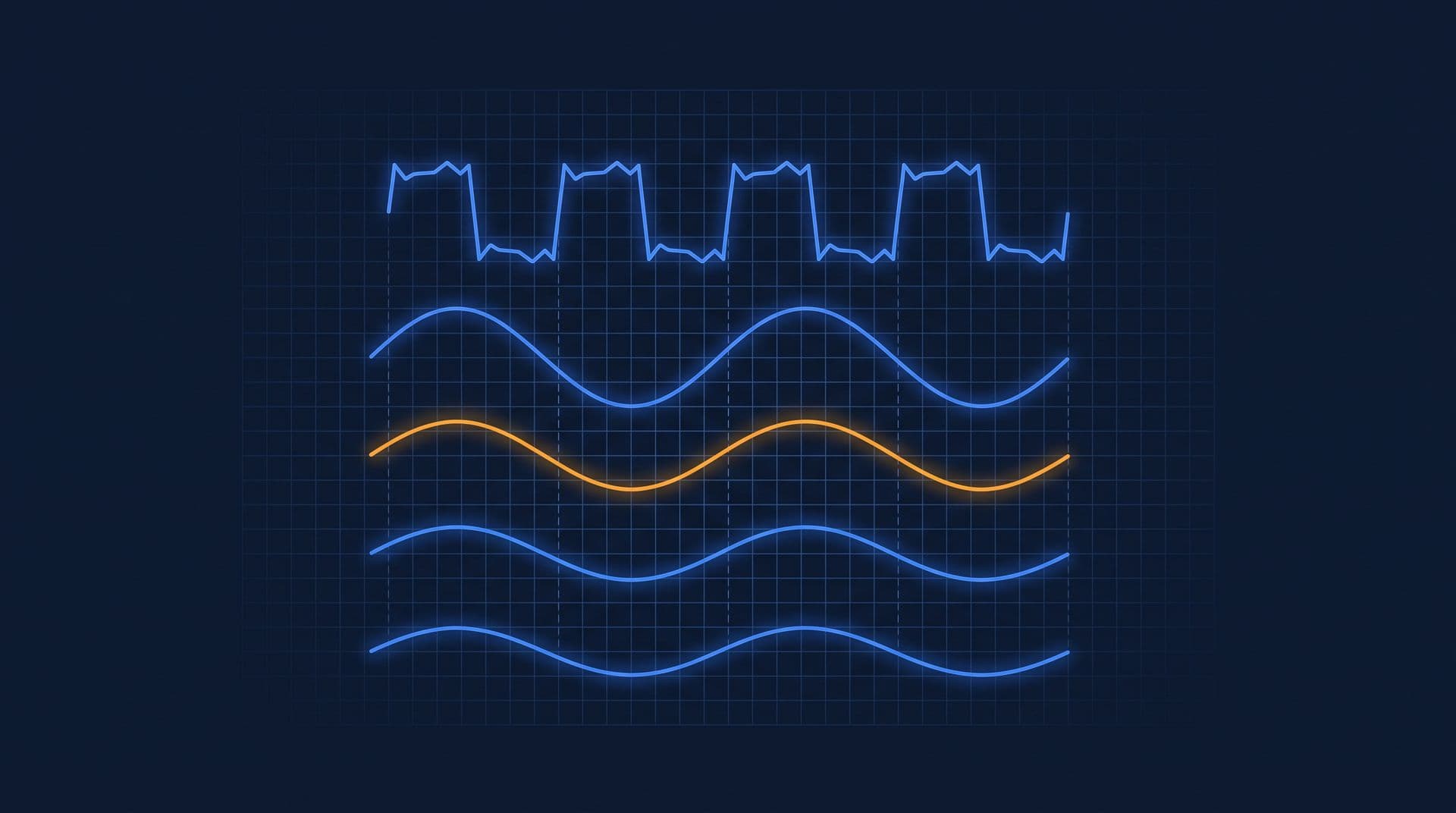
A Math Annex extra to Cobler's Electricity Fundamentals course.
Somewhere in your second year they handed you a jagged shape, a square wave or a sawtooth, and told you to prove it was really a pile of sine waves stacked on top of each other. You filled three pages with integrals, got a number for each sine, and were never once told what the exercise was for. That exercise was Fourier analysis, and this article pays its debt. A few parts back, in Electrical Harmonics, we asked you to swallow the same claim on faith: that any distorted current wave, however ragged, can be rebuilt by adding pure sine waves at multiples of the base frequency. That was Fourier, unnamed. Here is what it actually is, and why the man who found it was not thinking about electricity at all.
What is Fourier analysis, in one sentence?
Fourier analysis is the claim that any repeating wave, no matter how jagged or spiky or square, is nothing more than a stack of smooth sine waves at whole-number multiples of one base frequency, added together in the right amounts. The recipe is the whole idea: so much of the base note, so much of the one twice as fast, so much of the one three times as fast, and on up the ladder.
You already run this decomposition without thinking, several times a day, with your ears. A violin and a flute play the exact same note, the same fundamental pitch, and yet you never confuse the two for a moment. The reason is that neither instrument produces a pure tone. Each piles its own recipe of overtones on top of the shared fundamental: the violin heavy on the higher, brighter ingredients, the flute mellow and nearly pure. Same base note, different recipe, different instrument. Your ear pulls the stack apart into its ingredients effortlessly, which is exactly the sum a signals lecturer spent a semester making you compute by hand.
Why did a heat problem hand us a music tool?
Here is the twist the lecture never mentioned: Fourier was not studying sound. Jean-Baptiste Joseph Fourier was studying heat, how it creeps through a bar of metal, and his sine recipe fell out of that thermal problem (MacTutor). He presented the idea to the Paris Institute in 1807, and it was not welcomed. The examiner was Joseph-Louis Lagrange, one of the great mathematicians of the age, and he did not buy it. The notion that a smooth, gentle sine could be added up to make a shape with sharp corners struck him as unsound, and the memoir went unpublished for years. Fourier only got the full theory into print in 1822, in The Analytical Theory of Heat (MacTutor).
Lagrange was not simply being stubborn: proving the sine series really does converge to a jagged shape is genuinely subtle, and it took the rest of the nineteenth century to nail down. The physics was right before the rigour caught up.
The man himself was no cloistered academic. Fourier had sailed to Egypt with Napoleon's 1798 expedition as a scientific adviser, run munitions workshops when the British fleet cut the army off, then served as Napoleon's prefect, the governor, of the Isère region around Grenoble, draining swamps and building roads while doing the heat mathematics on the side (Britannica). Napoleon made him a baron in 1809. The recipe for every wave came out of a working administrator's spare hours.
Why does an electrical engineer care about any of this?
Because on a power system the recipe is not a metaphor. It is a measurement you can clamp onto a busbar.
Take the ragged current a variable frequency drive pulls, the ugly flat-topped gulps from the harmonics article. Clip a power-quality analyser onto that bus and it hands you back a bar chart: so much fundamental at 50 Hz, so much 5th harmonic at 250 Hz, so much 7th at 350 Hz, each bar a percentage. That bar chart is not a summary of the waveform. It is the waveform, written as its Fourier recipe. The analyser has done to the current exactly what your ear does to a violin, pulled one jagged shape apart into the list of pure ingredients that make it.
The catch is that computing that recipe honestly, ingredient by ingredient, is a mountain of arithmetic, far too much to grind out by hand on a live signal. That mountain is why analysers stayed dumb for decades. What changed was 1965, when James Cooley and John Tukey published a shortcut, the Fast Fourier Transform, that cut the work from unmanageable to instant on the new digital computers (IEEE Spectrum). Every power-quality meter, every THD reading, every harmonic bar chart on a modern site is the FFT quietly running Fourier's 1807 idea a few thousand times a second. The same instrument that timestamps a voltage sag to the millisecond is, on its other channels, decomposing your current into Fourier ingredients.
Where else has Fourier been hiding all day?
Everywhere you looked at a screen or listened to anything. The equaliser bars bouncing on a music app are a live Fourier recipe of the song, the bass ingredients on the left, the treble on the right. A JPEG photo and an MP3 track both shrink to a fraction of their size by the same trick: break the picture or the sound into Fourier ingredients, then quietly throw away the ones your eye or ear will never miss. The reason a song is small enough to stream is that Fourier lets an algorithm decide which overtones you were never going to notice, and delete them without you hearing the hole.
The equations themselves, decoded (optional: skip freely)
The recipe language above is exactly what the formulas say, and seen this way they are almost disappointingly honest. Fourier's claim, the synthesis, is one line:
$$f(t) = a_0 + \sum_{n=1}^{\infty} \Big[ a_n \cos(n\omega t) + b_n \sin(n\omega t) \Big]$$
Read it as words: the wave f(t) equals a flat level \(a_0\), plus some amount \(a_1, b_1\) of the base tone, plus some amount of the tone twice as fast, three times as fast, and on up. The a's and b's ARE the recipe. The summation sign is just "stack the ingredients."
The interesting question is the reverse one: given a jagged wave, how do you measure how much of ingredient n it contains? That is the analysis integral, the one you filled three pages with:
$$a_n = \frac{2}{T} \int_0^T f(t) \cos(n\omega t)\: dt$$
In words: multiply your signal, moment by moment, against a pure copy of the tone you are testing for, and average over one full cycle. It is a similarity score. Where your signal moves with the probe tone, the products come out positive; where it moves against it, negative; and the average tallies the agreement. And here is the elegant part, the property the whole method stands on: run that same test against any tone other than the signal's own ingredient and the positives and negatives cancel perfectly to zero over a full period. Mathematicians call it orthogonality. In recipe terms, each probe is deaf to every ingredient except its own twin, which is why you can measure the 5th harmonic without the 3rd and 7th shouting over it: the integral simply cannot hear them.
The compact modern form rolls the cosine and sine probes into one spinning arrow, the phasor from the imaginary-numbers piece:
$$F(\omega) = \int_{-\infty}^{\infty} f(t)\: e^{-j\omega t}\: dt$$
The probe \(e^{-j\omega t}\) is an arrow spinning backwards at frequency ω, and multiplying by it asks: how much of this signal rotates at exactly this speed? Line that up beside the Laplace transform in the Laplace piece and the family resemblance is exact: Laplace's probe is \(e^{-st}\) with \(s = \sigma + j\omega\), the same spinning arrow with a fade knob added. Fourier is the σ = 0 slice of Laplace: the ingredients that never decay.
One last number to appreciate what 1965 changed. Measuring the recipe honestly means running that integral once per ingredient, which for a million-sample waveform costs on the order of a trillion multiplications the direct way. The Cooley-Tukey FFT reorganises the arithmetic so the same answer costs tens of millions instead, roughly fifty thousand times cheaper, which is the entire difference between Fourier analysis as a mathematician's luxury and Fourier analysis running live on a RM2,000 power-quality meter clamped to your busbar.
The operator's payoff: the whole harmonic toolbox is one recipe
Once the recipe view clicks, the entire harmonic toolbox from Part 18 stops being a bag of unrelated tricks and becomes cooking from one ingredient list.
When the harmonics article warned that triplen harmonics "add in the neutral" instead of cancelling, it was really saying that certain ingredients of the recipe, the 3rd and its odd multiples, happen to line up across all three phases and stack rather than cancel, which is why they pile heat into a neutral conductor nobody sized for it. A detuned reactor works because it parks a capacitor bank's resonance in the empty gap between named ingredients, so the bank can never sing along with the 5th. An active filter is the purest expression of the idea: it reads the live recipe of the distortion and injects the exact anti-recipe, the same ingredients turned upside down, cancelling them on the bus in real time.
None of that is reachable without Fourier's claim that the jagged current has a definite recipe in the first place. And it ties back to where the clean wave came from: a spinning generator produces one smooth sine because rotation itself is smooth, so a pure 50 Hz tone is what a healthy grid sounds like. Every harmonic is an overtone some non-linear load bolted onto that fundamental after the fact. The three-page integral they made you grind through in second year was the machinery for reading exactly which overtones, and in what amounts. That is all it ever was.
Go deeper on video
Reading explains; watching sometimes lands the picture. Full credit to the creators:
"But what is the Fourier Transform? A visual introduction" by 3Blue1Brown
This is a Math Annex extra to Cobler's Electricity Fundamentals course. It applies most directly to Part 18, Electrical Harmonics, and to Part 10, How Generators Make Electricity, where the pure sine begins.
The harmonic recipe on your own busbar is a live number, not a theory. See how CobiNeural measures it.
FAQ
Frequently asked questions
Ask us about this topic
Something in this article you want to dig into — or a situation in your own building it doesn't quite cover? Send us your question. We don't run public comments; the team replies to you directly by email.