Blog
Why Engineers Use Imaginary Numbers for Real Power
First-year EE hits the letter j, hears "the square root of minus one," and half the room gives up. Here is the picture the lecturer skipped: an AC voltage is a spinning arrow, and imaginary numbers are just the arithmetic of arrows.
 Tan Kok XinElectricity Fundamentals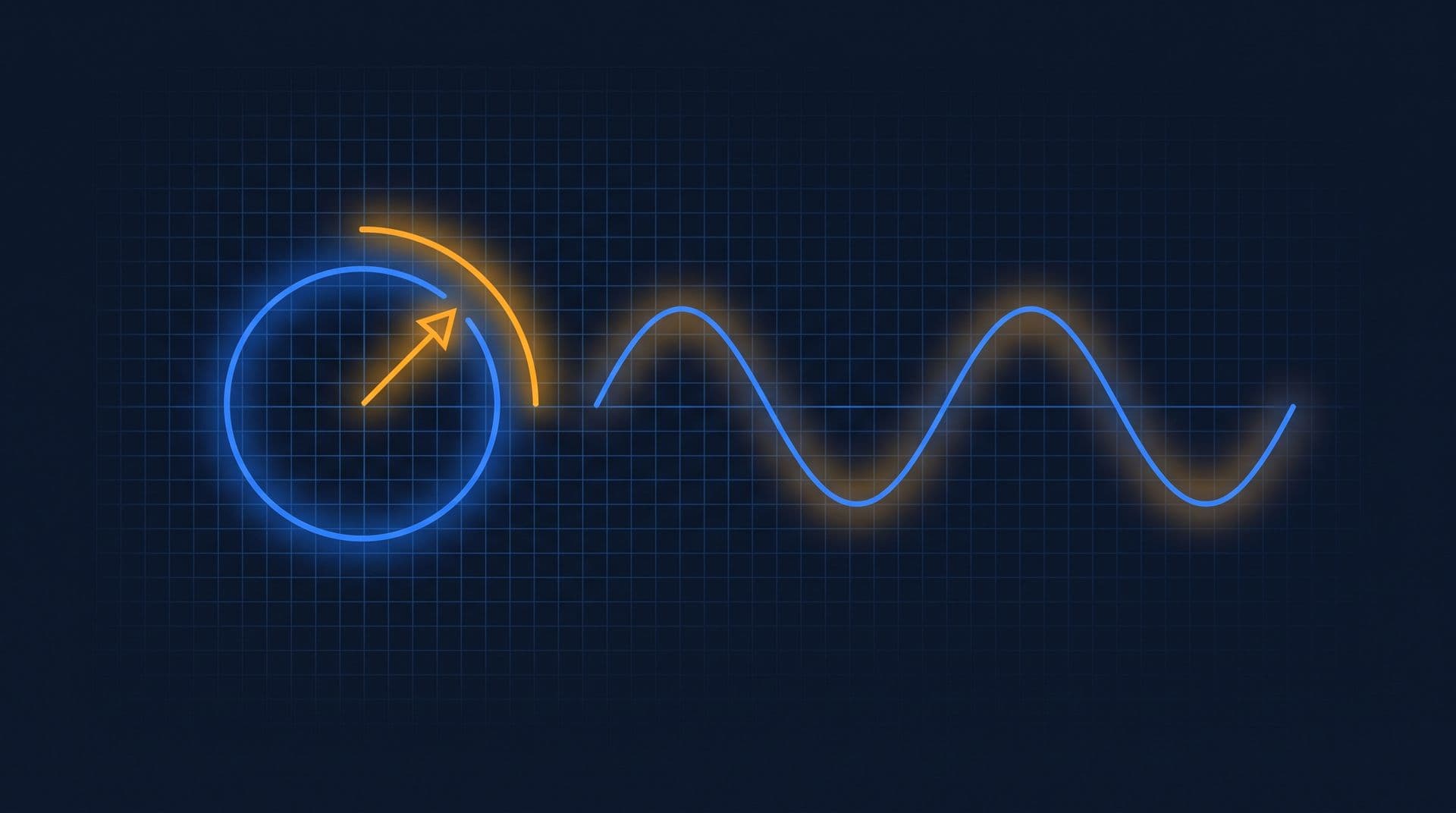
A Math Annex extra to Cobler's Electricity Fundamentals course.
Somewhere in the third week of a first-year electrical engineering course, the lecturer writes a single letter on the board. The letter is j. Then, almost as an aside, comes the definition: the square root of minus one. The very real 230 volts waiting in the wall socket behind you is about to be described using a number that, by its own name, does not exist. Half the room quietly gives up on ever understanding why.
It should not be that way. The use of imaginary numbers in electrical engineering loses more capable people than any other moment in the subject, and it loses them over a picture the lecturer forgot to draw. With that picture the whole mystery collapses into something you could explain to a child: a spinning arrow, and the arithmetic of arrows. Nobody imported imaginary numbers because electricity is imaginary; they imported the one number system whose multiplication happens to turn things, because AC electricity is a turning thing. That is the entire story.
Why do imaginary numbers in electrical engineering exist at all?
They don't have to exist for this. Electricity needs a way to handle rotation, and imaginary numbers are the cleanest one on the shelf.
Start with where the electricity comes from. In the generator article we watched a magnet spin inside a ring of coils and saw the voltage it produces glide up and down in a smooth wave, one full cycle per turn, simply because the magnet is going round and round. Alternating current is not a design choice; it is what rotation looks like read off a coil. The grid alternates fifty times a second because distant machines spin fifty times a second, a point we unpack in AC vs DC.
Behind every AC sine wave there is something actually rotating. So why force the engineer to work with the wave when they could work with the rotation directly?
The sine wave is the shadow of a spinning arrow
Here is the picture the lecturer skipped. Draw an arrow from the centre of a clock face to its edge and spin it steadily. Now watch only its height, how far the tip sits above or below the centre line. As the arrow sweeps round, that height rises to a peak, falls through zero, drops to a trough, and returns, over and over. Plot it against time and you have drawn a perfect sine wave.
That is all a sine wave is: the shadow of a spinning arrow, bobbing up and down as the arrow goes round. The wave on your oscilloscope and the arrow on the clock face are the same fact told two ways. Engineers call the arrow a phasor.
The move the whole subject rests on is this: stop drawing the wobbling shadow and keep only the arrow. An AC voltage becomes an arrow of a certain length pointing in a certain direction. Its length is the size of the swing; its direction is how far this wave leads or lags another.
Two things become easy the moment everything is an arrow
Once every AC quantity is an arrow, two jobs that were ugly with waves turn trivial.
First, adding. If two voltages meet in a circuit, their waves add together, and adding two sine waves that are out of step is a fiddly piece of trigonometry. As arrows, you just lay them tip to tail, like two legs of a journey, and the arrow from start to end is the answer.
Second, shifting. AC problems are full of quantities that lag or lead each other by a quarter of a cycle. In wave language that is an awkward phase shift. In arrow language a quarter of a cycle is a quarter turn of the clock, ninety degrees, and nothing more.
Multiplying by j is nothing but a quarter turn
So the engineer wants a number that can point in a direction and be rotated, not just sit on a line. That number system already existed, invented by mathematicians long before anyone needed it for power. It puts numbers on a flat plane, and it has the one property that got it drafted into electrical work: multiplying by the special quantity called j swings any arrow exactly ninety degrees.
That is what j does. It is not a ghost, it is a quarter-turn instruction. And "the square root of minus one," the phrase that emptied half the lecture hall, means only this: do the quarter turn twice and you have turned a half circle, so your arrow now points backwards, which is precisely what multiplying an ordinary number by minus one does. j is just the thing you apply twice to face the other way. (Electrical engineers write j rather than the mathematicians' i, because i was already taken: it means current.)
Read that back and the imported machinery deflates: engineers reached for the one number system whose multiplication rotates arrows, because AC quantities are arrows and every question about them is a question about turning.
For the curious, the one line that packs all of this in is Euler's formula:
$$e^{j\theta} = \cos\theta + j\sin\theta$$
It says the exponential of an imaginary angle is a point on a circle: the arrow at angle theta, its shadow on the ground the cosine, its height the sine. It is why the probes elsewhere in this Annex, Fourier's \(e^{-j\omega t}\) and Laplace's \(e^{-st}\), are all the same object: this arrow, spinning.
You already own the payoff: the power triangle is a phasor diagram
If you have read the power triangle, you have already drawn a phasor diagram without being told. Real power (kW) runs along the base, reactive power (kVAR) points straight up, and apparent power (kVA) is the sloping hypotenuse. That right angle between the base and the upright is not decoration. It is the ninety-degree quarter turn, the multiply-by-j, made visible.
Reactive power sits at ninety degrees for a physical reason. The magnetising current that builds the field inside a motor lags the voltage by a quarter of a cycle, so its arrow points a quarter turn away from the working current's arrow. Stack the two and you get the triangle. The reason reactive power is not wasted energy is the same reason it stands at right angles on that diagram: an arrow pointing straight up does no work along the ground, yet it is still fully there, still carried by every cable. The triangle on your utility bill is the arrow picture in a hard hat.
The four-foot engineer who turned research into a desk job
Someone had to notice all this. Charles Proteus Steinmetz was a German émigré, about four feet tall from congenital dwarfism and a spinal condition, who fled a police investigation over his socialist politics and joined General Electric when it absorbed his employer in 1893 (Smithsonian). That same year he presented a paper, "Complex Quantities and Their Use in Electrical Engineering," to an audience gathered around the International Electrical Congress in Chicago (Wikipedia).
Before Steinmetz, analysing an AC circuit meant setting up and solving a differential equation in time, one hard calculus problem per circuit, which is why AC design was still closer to research than to engineering. His phasor method replaced the calculus with arrows and ordinary arithmetic on them. A problem that had taken a specialist a week became a desk job an ordinary engineer could finish before lunch. Most of his first audience could not follow the mathematics; his textbooks taught the next generation how.
He is also the subject of one of engineering's favourite stories, and honesty requires flagging it. As the tale goes, a giant generator had failed, no one could fix it, and Steinmetz was called in, listened, chalked one mark on the casing, named the coil to repair, and billed ten thousand dollars: one dollar for the chalk mark, nine thousand nine hundred and ninety-nine for knowing where to put it. It is a lovely story and almost certainly embellished. The version naming Steinmetz first surfaced in a 1965 letter to Life magazine, forty-two years after his death, and the same "knowing where to tap" parable was already in newspapers by 1907, attached to anonymous engineers (Quote Investigator). Enjoy it as a fable about the value of knowing where, not as history.
Where you meet the arrows today
The phasor is not a chalkboard relic. On the modern grid, devices called phasor measurement units, or synchrophasors, sit in substations and do literally what this article describes: they measure a voltage arrow's length and angle and stream it out, typically thirty to sixty readings a second, every one stamped with GPS time so that arrows measured hundreds of kilometres apart can be compared on one clock (NASPI). Operators watch those angles swing to see the grid strain and recover in real time, the same swing the generator article described as thousands of tonnes of steel pulling into step. The spinning arrow the lecturer never drew is now live grid telemetry.
The student who gave up on j did not give up on mathematics. They gave up on a wobbling shadow that was never explained to them as a shadow. Once you have seen the arrow turning behind the wave, you cannot unsee it, and the letter that emptied the lecture hall turns out to have meant nothing more alarming than "turn ninety degrees."
Go deeper on video
Reading explains; watching sometimes lands the picture. Full credit to the creators:
"Imaginary Numbers Are Real (Part 1)" by Welch Labs
This is a Math Annex extra to Cobler's Electricity Fundamentals course. It applies most directly to Part 7, the kW, kVA and kVAR power triangle and Part 8, why reactive power is not wasted energy: both are phasor diagrams in disguise.
The arrows in this article are exactly what CobiNeural measures on a live site: real power, reactive power and the angle between them, equipment by equipment, so a drifting power factor shows up as a moving arrow rather than a surcharge next month. Book a demo and we will show you your building's phasors, not a textbook's.
FAQ
Frequently asked questions
Ask us about this topic
Something in this article you want to dig into — or a situation in your own building it doesn't quite cover? Send us your question. We don't run public comments; the team replies to you directly by email.