Blog
Restaurant Chain Energy Management in Malaysia
Hood fans at full speed all day, walk-ins that never stop, kitchens switched on hours before opening. How Malaysian F&B chains cut outlet energy: demand-controlled ventilation, cold-room discipline, the right RP4 tariff reading and fair outlet-by-outlet benchmarks.
 Tan Kok XinIndustry Guides
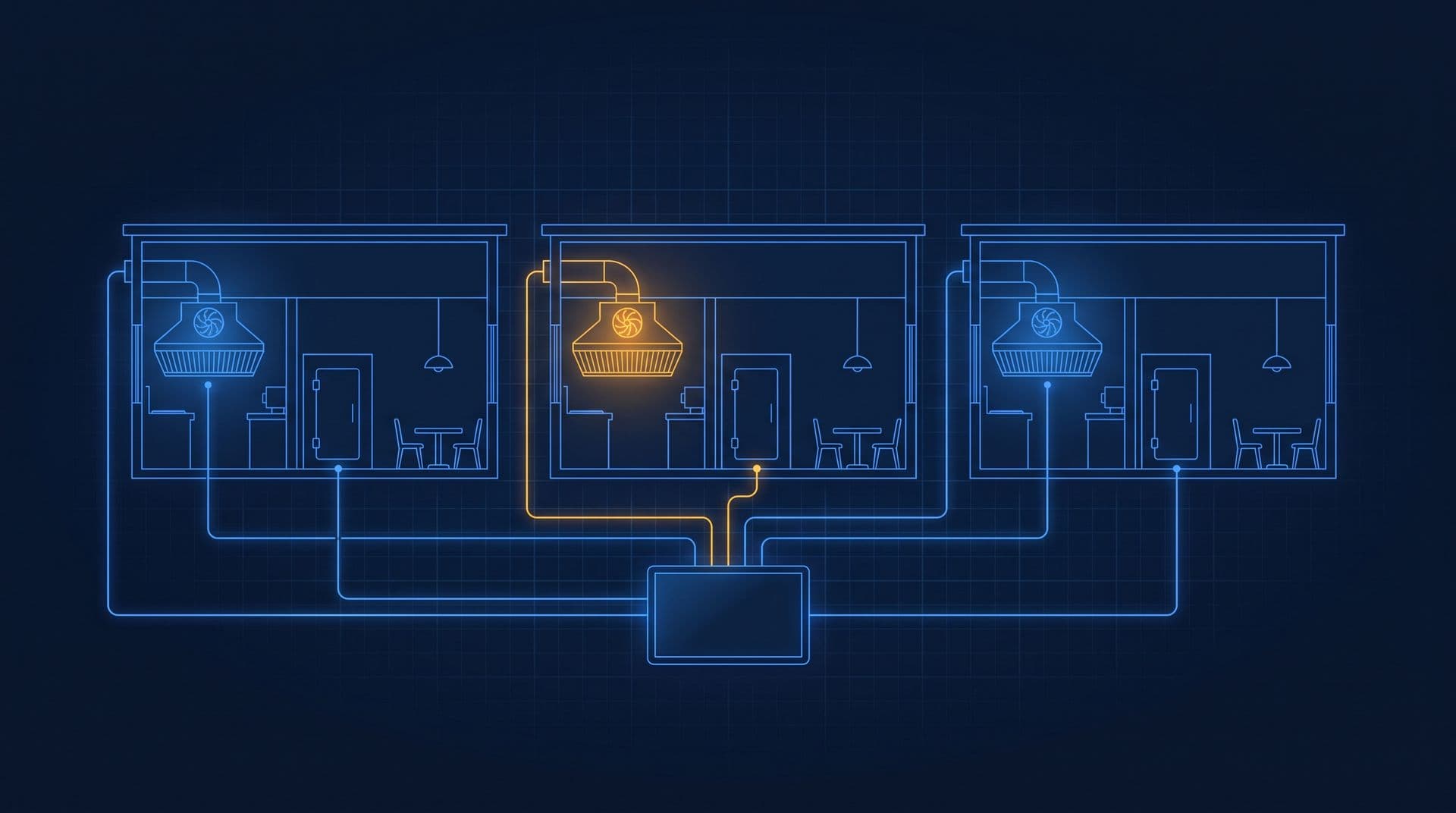
Picture outlet 14 of a 30-outlet casual-dining chain in the Klang Valley. The shutters go up at 10 a.m. At 7:30 a.m. the kitchen exhaust is already running at full speed, the dining-room air conditioning is cooling empty tables, and two fryers are holding hot oil for a lunch rush that is hours away. Nobody broke a rule. The opening checklist says "switch everything on" and never says when. Multiply that by 30 outlets and 365 mornings and you get a cost no outlet manager ever sees. Restaurant chain energy management is the work of making that cost visible: measuring each outlet, comparing outlets fairly, and getting an alert while the waste is still happening.
Where does a restaurant outlet's electricity go?
Into cooking, ventilation, cooling, refrigeration, dishwashing and lighting. ENERGY STAR, the US government's efficiency programme, says restaurants use about five to seven times more energy per square foot than other commercial buildings, and high-volume quick-service restaurants (QSRs) up to ten times more (ENERGY STAR). Its kitchen guide, produced with PG&E's Food Service Technology Center, gives this split for a typical US full-service restaurant (ENERGY STAR guide):
End use | Share of total energy (US example) | In a Malaysian outlet |
|---|---|---|
Food preparation | 35% | Often LPG, so on the gas bill |
HVAC (heating, ventilation, air conditioning) | 28% | No heating; cooling all year |
Sanitation (dishwashing, hot water) | 18% | Electric units hit the TNB bill |
Lighting | 13% | Similar |
Refrigeration | 6% | Small, but never off |
Read it with care: it counts gas and electricity together, in a country that heats its restaurants. For electricity alone, ENERGY STAR says refrigeration comes first, then lighting, then cooling. With no heating load and hot, humid weather all year, a Malaysian outlet should meter its air conditioning, walk-ins and hood fans first.
Electric cooking is heavy too: ENERGY STAR puts a typical electric deep fryer at more than 18,000 kWh a year, about RM9,100 at the low-voltage rate below.
Malaysian data is thin. A 2022 study by University of Malaya researchers looked at one free-standing fast-food restaurant and worked out that savings measures could bring its building energy index (BEI), the yearly kWh per square metre of floor, down to 856.4 (Sustainability, 2022). One restaurant is not a benchmark, so your own outlets become the benchmark.
Why does kitchen ventilation waste so much energy?
Because most hood fans run at full speed from opening to closing, while the cooking line is only flat out at lunch and dinner. A UC Davis compilation of kitchen case studies notes that ventilation can account for half of the HVAC energy in restaurants and dining facilities (UC Davis WCEC). The loss is double: you pay to run the fans, and if the make-up air comes from the air-conditioned dining room, you are throwing out air you already paid to cool.
Demand-controlled kitchen ventilation (DCKV) fixes this. Temperature probes in the exhaust duct and optical or infrared sensors across the hood detect heat and smoke. A controller then slows the exhaust and make-up air fans through variable speed drives (VSDs) when cooking is light, and speeds them up when the wok station fires. ENERGY STAR says demand ventilation could cut exhaust system costs by 30 to 50 percent; the university kitchens in the UC Davis compilation averaged 62% electrical savings.
The savings are large because of the fan affinity law: fan power varies with the cube of fan speed.
$$\frac{P_2}{P_1} = \left(\frac{N_2}{N_1}\right)^3$$
Here \(P\) is power and \(N\) is speed. At 70% speed a fan draws \(0.7^3 = 0.343\) of full power, about a third.
A worked example, with illustrative figures. An outlet's exhaust and make-up air fans total 5 kW and run at full speed for 13 hours a day.
- Without DCKV: 5 kW × 13 h = 65 kWh a day.
- With DCKV: 4 peak hours at full speed (20 kWh) plus 9 quieter hours at 70% speed (5 × 0.343 × 9 ≈ 15.4 kWh) = about 35.4 kWh a day.
- Saving: about 29.6 kWh a day, or 45%. That is roughly 10,800 kWh a year, about RM5,500 at 50.68 sen/kWh, or RM164,000 across 30 outlets.
Drives lose a little at low speed, so measure the saving. The hood must still capture smoke and grease at every speed, so the minimum speed is set at commissioning.
How do you cut refrigeration energy without risking food safety?
Keep the cold in, let the heat out, and log the temperature so the same data proves food safety. Walk-ins never close, so a small leak runs 8,760 hours a year.
Door discipline. Malaysia's Food Hygiene Regulations 2009 already ask for it: regulation 25(5) says cold-room doors must have an air curtain "or other effective means to avoid loss of cold air" (Food Hygiene Regulations 2009). ENERGY STAR says strip curtains can cut outside air infiltration by about 75%. Add door closers and replace worn gaskets.
Condenser coils. The condensing unit throws out the heat the walk-in removes. It often sits in a hot back corridor or loading bay, coated in grease and dust, which makes the compressor work harder and longer. Clean the coils on a schedule and give the unit free air. The same regulations want a cold store's air vent away from warm air, ovens and air-conditioning outlets (regulation 25(4)(e)).
Temperature logs that double as evidence. Regulation 38(3) sets the bands for food held for retail sale: chilled between −1°C and 10°C, frozen at or below −18°C (wording fixed by the 2010 amendment). Regulation 25(4)(d) says any device recording temperature in a cold store must be accurate to ±1°C, and regulation 11 requires records on the storing of food to be kept for inspection. The rules set no log format or interval, but a continuous record from an accurate probe is stronger evidence than a clipboard filled in at the end of a shift, and breaching regulation 38 carries a fine of up to RM10,000 or up to two years' imprisonment.
The energy and food-safety signals often match. A freezer compressor that never cycles off at 3 a.m. points to a door left ajar, a failed gasket, an iced-up coil or a dirty condenser.
What do TNB tariffs mean for a restaurant chain?
It depends on how each outlet is supplied, and most chains have all three cases.
Street and shoplot outlets are usually low-voltage (LV) customers. Under RP4 (Regulatory Period 4, the tariff period from 1 July 2025 to 31 December 2027), the LV non-domestic general tariff, Bukan Domestik Voltan Rendah Am, has no maximum demand charge. Capacity and network are charged per kWh instead (Energy Commission schedule): energy 27.03 + capacity 8.83 + network 14.82 = 50.68 sen/kWh, plus a RM20 monthly retail charge. The monthly Automatic Fuel Adjustment (AFA) and the 1.6% KWTBB renewable energy fund levy come on top.
Every kWh costs the same at any hour, so the game is using fewer of them. The LV time-of-use (ToU) option charges 28.52 sen peak and 24.43 sen off-peak for energy, but peak runs 2pm to 10pm on weekdays (TNB), right across dinner service. It only pays if more than about 36% of an outlet's kWh fall off-peak, so check interval data first (should you switch to ToU?).
Mall outlets usually get no TNB bill at all. The landlord holds the account and recovers the cost from each tenant through a check meter, as the tenancy agreement sets out, often with a separate charge for chilled water (tenant electricity billing).
Large central kitchens may be medium-voltage (MV) customers, where maximum demand is billed: RM89.27 per kW on the general tariff (capacity RM29.43 plus network RM59.84), or RM97.06 per kW on ToU, set by the month's worst 30-minute demand (on ToU, the worst inside the peak window). Every 10 kW trimmed saves about RM893 a month on the general tariff, so stagger the morning start of combi ovens, kettles and blast chillers (RP4 demand charges).
How does restaurant chain energy management compare outlets fairly?
Divide each outlet's energy by something that drives it, then rank:
- kWh per outlet per day: simplest; fine within one format.
- kWh per trading hour: fair when hours differ, such as a 24-hour drive-through against a mall outlet that closes at 10 p.m.
- kWh per transaction: ties energy to trade, so a busy outlet is not punished for being busy.
Compare like with like: a street outlet paying for its own cooling will never match a mall outlet on the landlord's chilled water. Group by format, then hunt for outliers.
Two patterns show up fast in half-hourly data. Pre-opening creep is the morning step when everything comes on hours before the doors open, as at outlet 14. Close-down creep is its mirror: hoods and dining air conditioning still running after the cleaners leave. ENERGY STAR's fix is a start-up and shutdown plan, "using only the equipment that you need, when you need it". For 30 outlets that only works with every outlet on one screen, which is what multi-site energy management means.
Then alerts. At 3 a.m. the walk-in freezer door at outlet 22 has not latched, and its compressor has run without a break since 1 a.m. A WhatsApp alert to the area manager at 3:10 a.m. can save the stock. A report the next morning saves nothing.
What CobiNeural does for a restaurant chain
CobiNeural is Cobler's Smart Operation Platform. For a chain, it does four plain things.
- Insights → Energy shows each outlet's consumption and load profile, down to the sub-metered loads you choose: hoods, walk-ins, air conditioning.
- Dashboards put every outlet on one screen, so the outliers in each group stand out.
- Alerts send WhatsApp or email messages when a reading crosses a limit inside the hours you choose. Cobler sets the rules up with you, for example "hood fan power above 1 kW after 23:00", "outlet power above 10 kW before 08:00" or "walk-in freezer warmer than −15 °C".
- Overlay or standalone: it reads an outlet's existing building management system (BMS), controllers and meters (what overlay means), or runs on its own meters where there is only a distribution board.
It does not clean coils or replace gaskets. It tells you which outlet, which load and which hour, so the technician goes to the right place first.
If nobody in your chain can say which outlet uses the most energy per transaction, request a demo and we will sketch a metering plan with you.
FAQ
Frequently asked questions
Ask us about this topic
Something in this article you want to dig into — or a situation in your own building it doesn't quite cover? Send us your question. We don't run public comments; the team replies to you directly by email.