Blog
Why Blackouts Happen (and Restarting a Grid Is Hard)
The whole street goes dark at once, then returns in blocks. Here is why blackouts happen, and the black start problem that means a dead grid can't just be switched back on.
 Tan Kok XinElectricity Fundamentals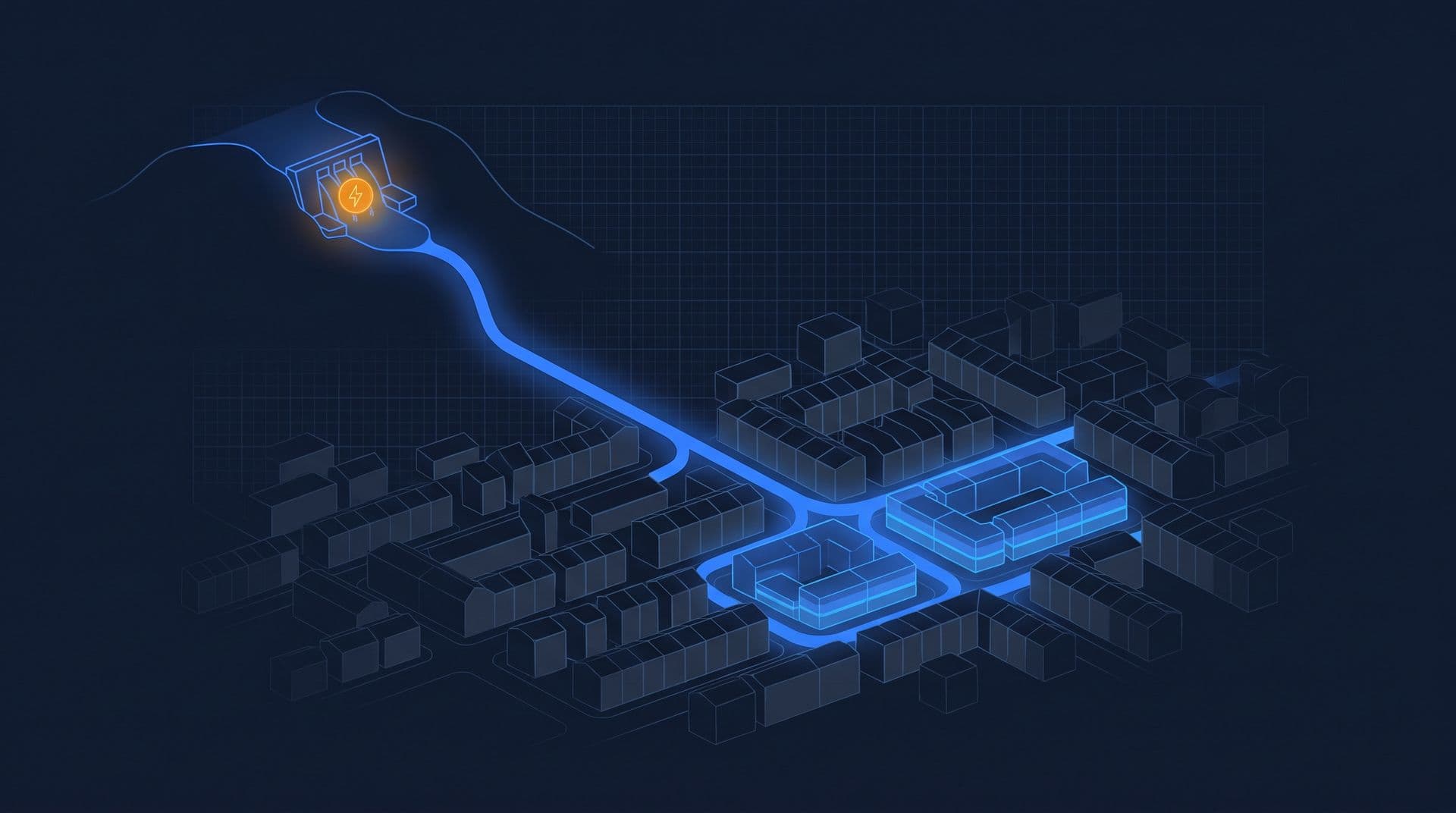
An applied extra to Cobler's Electricity Fundamentals course.
The whole street goes dark at once. The fridge falls silent, the aircon winds down, and from the window you can see the neighbours' houses gone black too, the whole neighbourhood swallowed. Then an hour or two later it comes back, but never all together. Your row lights up, then the shophouses two streets over, then somewhere further off, in blocks, minutes apart. You have watched this happen. Almost nobody stops to ask why blackouts happen the way they do: why the power leaves all at once but returns in pieces.
The answer is one of the quietly amazing things about the machine you plug into every day, and it explains why blackouts happen in the first place.
Why blackouts happen: the balance is lost faster than the controls can catch it
A blackout happens because the grid is a live balancing act, and the balance was lost quicker than the automatic controls could restore it.
The grid has to produce exactly as much power as the whole country is using, instant by instant. There is no big battery in the middle soaking up the difference. When you switch on a kettle, a generator somewhere works a fraction harder that same second. The proof that this balance is holding is the grid frequency: 50 Hz in Malaysia, the shared spinning speed of every large generator on the network. When demand and supply match, it sits at 50. When demand suddenly outruns supply, the frequency sags below 50, like an engine bogging down under a load too heavy for it.
Now picture a large power station tripping offline without warning, maybe a fault on the plant, maybe a lightning strike on a transmission line. In one instant the country is short a big block of generation, but the demand is still there. Every remaining generator is loaded harder, and the frequency dives.
The grid does not wait for a human to react. Automatic relays run a scheme called under-frequency load shedding: at preset falling-frequency thresholds, they disconnect whole neighbourhoods of demand, deliberately, in stages, to bring supply and demand back into balance (EcoFlow, "Ultimate Guide to Black Start"). It sounds brutal, and it is: the system sheds some customers to save the rest. Think of a shared engine losing revs. Drop a few passengers fast and it keeps turning; hesitate and it stalls.
If the shedding is fast enough and deep enough, most of the grid survives and only the shed areas go dark. If it is too slow or too small, the frequency keeps falling, the remaining generators trip off on low frequency to protect themselves, and each trip makes the shortfall worse. That runaway is a cascade, and it is how a single fault takes down a whole region. A blackout is not the grid breaking so much as the grid protecting its own machinery by shutting down before it tears itself apart.
Has this really happened in Malaysia?
Yes, more than once, including two nationwide collapses.
On 29 September 1992, lightning struck a transmission facility and set off a rolling failure across the network. Nine states lost power, some for nearly two days, in the worst outage in Malaysian history (Wikipedia, "Power outages in Malaysia"). The disruption was severe enough to help push the country toward allowing Independent Power Producers into what had been a single-utility grid.
On 3 August 1996, a transmission line near the Sultan Ismail Power Station in Paka, Terengganu, tripped at 5:17 in the evening and collapsed every power station in Peninsular Malaysia. Kuala Lumpur, Selangor, Johor, Melaka and Negeri Sembilan all went dark, with supply restored only around 11 that night (Wikipedia, "Power outages in Malaysia").
On 13 January 2005, a fault on the main grid near Serendah, Selangor, blacked out the northern and west-coast states and the Klang Valley from about half past noon, a roughly three-hour outage that later prompted the Central Area Reinforcement project to harden Klang Valley supply (The Star, "Major blackouts in Malaysia"). If you have lived in the Klang Valley long enough, one of these is a memory, not a statistic.
Why can't they just switch the grid back on?
Because most power stations cannot start themselves without electricity, and a dead grid has none to give.
This is the part that surprises people. A big thermal power station is not a torch you flick on. Before it can make a single watt, it needs power for its own pumps, fans, fuel handling, boiler feed and control systems. Normally that starting power comes from the grid. But in a total blackout the grid is dead, so the station has no electricity to start the machinery that would let it make electricity. It is a chicken-and-egg trap: you cannot jump-start a flat car battery from another flat car battery.
The way out is a small number of specially designated black start units, generators that can start from completely dead with no outside power at all (EcoFlow, "Ultimate Guide to Black Start"). Two kinds do this well. A hydroelectric dam needs only gravity: open the gate, water falls, the turbine turns, and it makes power from a standing start. On-site diesel gensets can crank themselves the way a lorry engine does. These units are the one live battery that cranks the rest.
Why does the power come back street by street?
Because the operator is rebuilding the grid one island at a time, and every reconnection is a shock the system has to absorb before the next one.
A black start unit first energises only a small pocket of the network, an island. That island's power is then used to crank the auxiliaries of a bigger nearby station, bringing it online inside the island. Bit by bit each island grows, matching generation to load step by step. Only when two islands are alive do operators carefully join them, and this is where the invisible driveshaft from earlier in the course matters: before closing the switch between two islands, their frequency and phase must line up almost perfectly, so every generator locks into the same electrical step. Close the tie when they are out of step and you get a violent jolt that can trip the whole thing again.
Then there is the reason your street specifically returns in measured bites, a problem called cold load pickup. When power has been off for an hour, every fridge, freezer and aircon compressor in the suburb is sitting switched on, waiting. Reconnect them all at once and they surge on together, drawing far more current in that first moment than the same houses draw in normal running. That inrush can overload the fragile young island and knock it straight back down (EcoFlow, "Ultimate Guide to Black Start"). So operators re-add neighbourhoods in blocks, letting each one settle before switching in the next, growing the load only as fast as the generators can safely swallow it.
The staged return, seen from your porch
The next time the neighbourhood goes dark and comes back in pieces, you are not watching a slow repair. You are watching an operator rebuild a spinning machine the size of a country, starting from one hydro dam or diesel set, growing islands, snapping generators into step, and feeding your street back in only when the island underneath it can take the load. The blocks you see from the porch are the shape of that rebuild.
For the facility teams who run the buildings on the other end of this system, the same physics is the daily reality: your load is one of the bites an operator re-adds, and how your building behaves through a dip, a trip or a recovery affects both your own uptime and the grid's. That is the thread running through the whole story of how Malaysia's grid was built and how power reaches your meter.
Go deeper on video
Reading explains; watching sometimes lands the picture. Full credit to the creators:
"What Is A Black Start Of The Power Grid?" by Practical Engineering
This is an applied extra to Cobler's Electricity Fundamentals course. It builds directly on grid frequency as the balance gauge and how generators lock into step.
Want to see how your building draws, dips and recovers in real time, so a demand spike or a supply event never blindsides you? Book a demo and we will walk you through it.
FAQ
Frequently asked questions
Ask us about this topic
Something in this article you want to dig into — or a situation in your own building it doesn't quite cover? Send us your question. We don't run public comments; the team replies to you directly by email.