Blog
Circuit Breaker Types: ACB, MCCB, MCB, RCCB, RCBO
MCB, MCCB, ACB, RCCB, RCBO, ELCB: not just sizes of one thing. Which breaker types protect the cable, which protect the person, and why the main one is huge.
 Tan Kok XinBuilding Electrical Fundamentals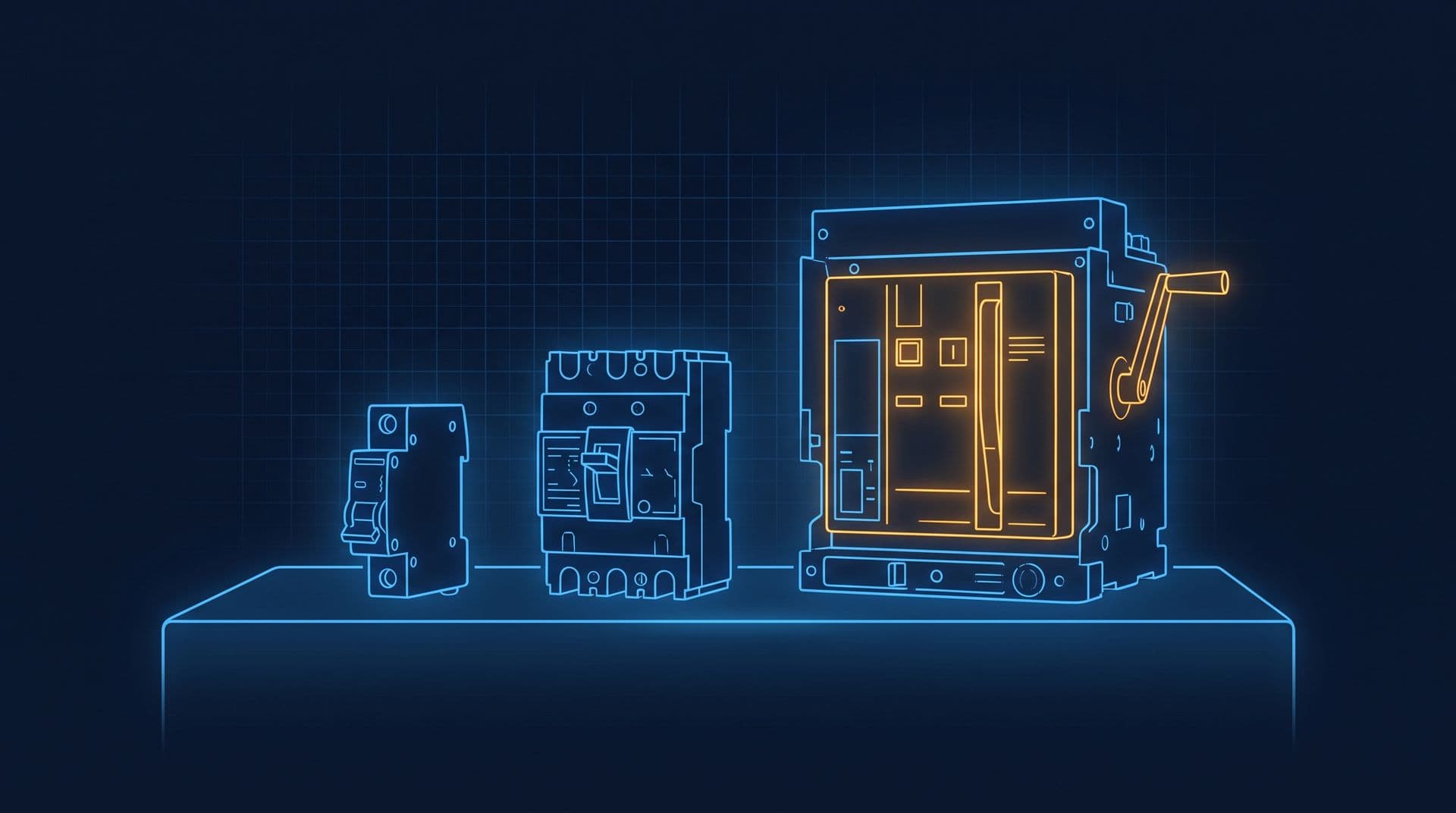
Part 4 of 11 in Cobler's Building Electrical Fundamentals course. New here? See the course page.
Part 3 left the breaker ratings off the office tower's single line diagram. This part adds them. What do the ratings beside each breaker mean, and why should a fault open only one breaker?
Start with what you can see. Behind the cover of DB-12E, the level 12 east distribution board, is a row of small switches, each with a number printed on it and a small lever. In the main switch room there is a breaker the size of a microwave oven, mounted on rails, with a handle to wind it in and out. Both do the same basic job: they cut the power when something goes wrong. Yet one fits in your palm and the other takes two people to lift. On site, a contractor lists the circuit breaker types in one breath: ACB, MCCB, MCB, RCCB, RCBO, ELCB.
Are these all the same device in different sizes? Most of them are, but not all. This part sorts them by the job each one does, then uses the office tower's single line diagram to show how they work together. It builds on What Is an Electric Circuit? and Earthing and RCDs from Cobler's Electricity Fundamentals course.
Which circuit breaker types protect the cable, and which protect the person?
Protective devices do two different jobs. Each device does one of them, or both.
Overcurrent devices protect the cable. The MCB, MCCB and ACB measure the size of the current. Too much current heats a cable, and a hot cable can damage its insulation and start a fire. These breakers trip on two kinds of overcurrent:
- an overload: a little more current than the circuit is designed for, lasting minutes or hours, for example when too much equipment is plugged into one circuit;
- a short circuit: live touching neutral or another live conductor, which makes the current jump to hundreds or thousands of amps in an instant, as What Is an Electric Circuit? explained.
Residual current devices protect people. A residual current device (RCD) does not measure how large the current is. It checks whether all the current that goes out comes back. If some of it is missing, it is leaking to earth, possibly through a person. The section on residual current devices below explains how it works.
The rest of the circuit breaker types in the contractor's list are variations on these two jobs.
Overcurrent breakers come in three sizes, one for each level of the tree
The three overcurrent breakers form a size ladder. Each size guards a larger part of the building's tree from MSB, SSB and DB (Part 1).
Breaker | Typical rated current | Where it sits | In the office tower |
|---|---|---|---|
MCB (miniature circuit breaker) | up to about 125 A | final circuits in a distribution board | 10 A lighting and 20 A socket circuits in DB-12E |
MCCB (moulded-case circuit breaker) | from tens of amps up to about 1,600 A | feeders to sub-boards and DBs, and sub-board incomers | 100 A at SSB-R2 feeding DB-12E; 630 A and 1,250 A feeders on the MSB |
ACB (air circuit breaker) | from roughly 800 A up to several thousand amps | the main incomer from the transformer | 2,500 A incomers from TR1 and TR2 |
The ACB is large for a physical reason. When it interrupts a short circuit next to the transformer, the fault current can be tens of thousands of amps. As with the vacuum breaker in Part 2, the current keeps flowing across the opening contacts as an arc, a path of very hot, conducting gas. An ACB opens in air, so it has to stretch the arc and cool it until it goes out, using chambers of metal plates that split the arc into small pieces. That needs space and mass. An MCB at the end of a final circuit never faces a fault that large, so it can stay small.
Every breaker carries two current ratings
A breaker's label gives two different currents. Mixing them up can be dangerous.
The rated current (In) is the current the breaker carries continuously without tripping, such as a 32 A MCB or a 250 A MCCB. In the office tower, the socket circuits in DB-12E have 20 A devices, and the car park feeder on the MSB has a 630 A MCCB. The designer chooses it to protect the cable the breaker feeds. Cable Size and Voltage Drop, the next part, explains how cable and breaker are matched.
The breaking capacity, given in kiloamperes (kA), is the largest fault current the breaker can safely interrupt. MCBs in buildings are commonly rated 6 kA or 10 kA. An ACB near the transformer might be rated 50 kA or more, because the fault current available there is very large.
The available fault current is highest near the transformer and falls further down the tree, because the cables along the way add resistance to the fault path. This is why the breakers with the highest kA ratings sit upstream. In the office tower, the design values are 50 kA at the MSB, 25 kA for the breaker at SSB-R2 that feeds DB-12E, and 10 kA for the devices in DB-12E.
If a breaker's breaking capacity is too low for where it is installed, it may not clear a short circuit safely. For example, if a 6 kA MCB is fitted where the available fault current is 20 kA, a real short circuit can make it fail violently instead of opening cleanly. So a breaker must only ever be replaced with one of the rating the designer specifies, by a competent person.
Discrimination: only the breaker nearest the fault should trip
Imagine the kettle cable in the level 12 pantry is damaged and live touches neutral. The fault current flows from TR2, through the MSB, SSB-R2 and DB-12E, to the fault. Four protective devices carry that same current: the 20 A RCBO on the socket circuit, the 100 A breaker at SSB-R2 that feeds DB-12E, the 1,250 A breaker on the MSB that feeds SSB-R2, and the 2,500 A incomer from TR2. All four could trip.
The system is designed so that only the device nearest the fault trips, and everything upstream stays closed. This is called discrimination, or selectivity. It is the idea Part 1 introduced when it explained why a building uses a tree of boards.
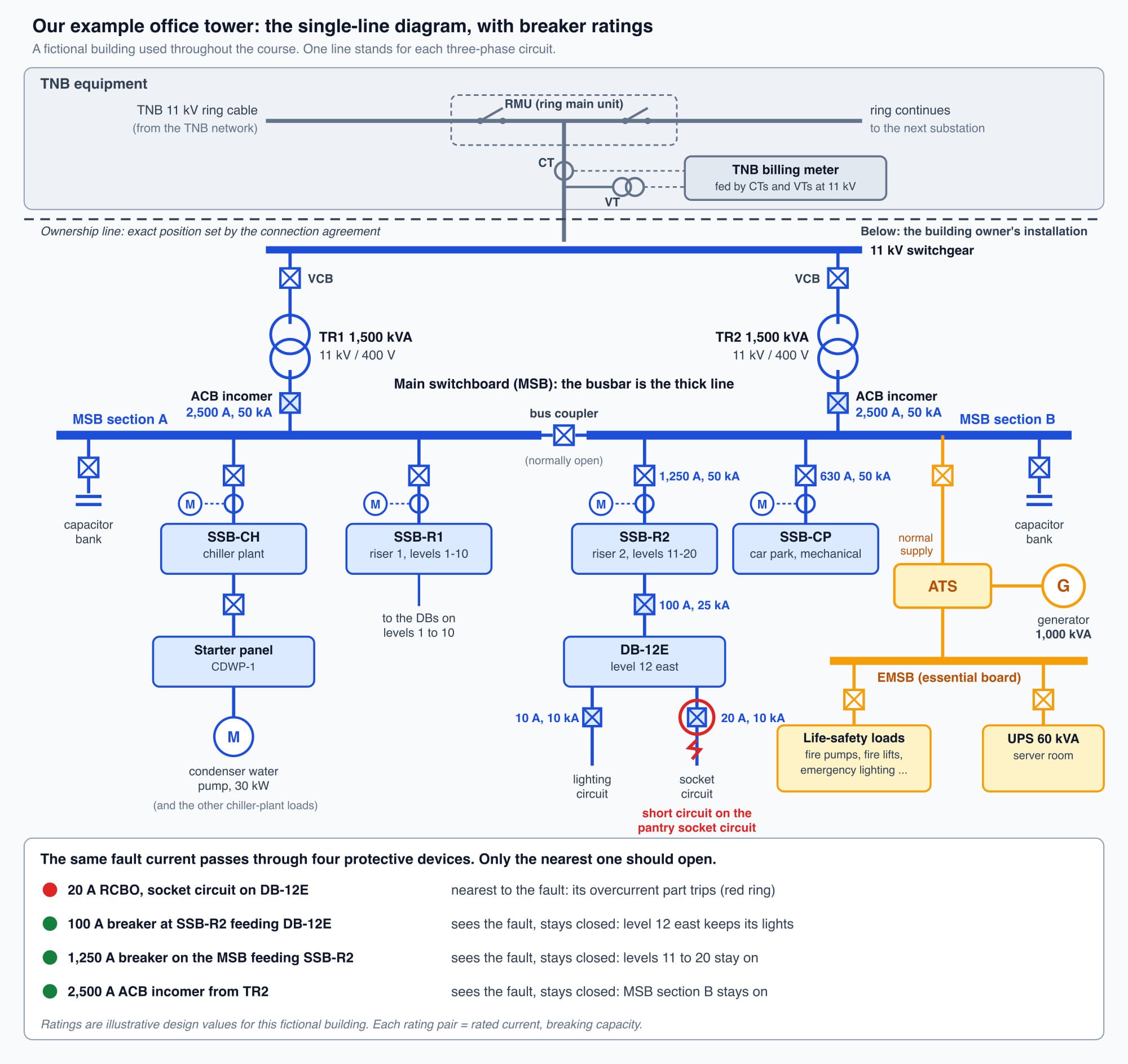
The fault current passes through four devices on its way to the pantry socket circuit; with good discrimination, only the 20 A device opens.
Designers achieve discrimination in two ways:
- Current grading. Each upstream breaker is set to trip instantly only at a much higher current than the one below it.
- Time grading. Upstream breakers, especially large MCCBs and ACBs, are set to wait a fraction of a second before tripping. That gives the downstream device time to clear the fault first.
Bigger breakers upstream do not guarantee discrimination on their own. The designer checks it using the breaker manufacturers' selectivity data and the settings of each device. When it works, the result is what you want: one socket circuit is off, the lights on level 12 east stay on, and the other floors never notice.
This also tells you something when a trip happens. If a large upstream breaker trips instead of the small one nearest the equipment, either the fault is on the feeder itself or the discrimination is not working as intended. In either case, report it to the competent person.
The letters B, C and D on an MCB
An MCB has two tripping parts. A thermal part responds slowly to overloads. A magnetic part trips instantly on the large current of a short circuit. The letter before the rating sets how large a sudden current the magnetic part allows before it trips instantly:
- Type B trips at 3 to 5 times its rated current. It is the most sensitive and is common on lighting and general socket circuits. For a 20 A Type B, that is 60 to 100 A.
- Type C trips at 5 to 10 times its rated current. It suits equipment that draws a brief surge when switched on, such as motors or a large group of LED drivers. For a 20 A Type C, that is 100 to 200 A.
- Type D trips at 10 to 20 times its rated current, for large surges from equipment such as big motors and welders, which would trip a more sensitive MCB each time they started.
The socket circuits in DB-12E use Type B devices.
Residual current devices protect people
RCD (residual current device) is the family name for devices that detect current leaking to earth. As Earthing and RCDs explained, there are two common types:
- An RCCB (residual current circuit breaker) does only the residual check. It has no overcurrent protection, so it must always be used with an MCB or fuse that protects the cable.
- An RCBO (residual current circuit breaker with overcurrent protection) does both jobs in one device, the width of one way on the board. Giving a circuit its own RCBO means a leak on that circuit switches off only that circuit, not every circuit sharing an RCCB.
Worth knowing: ELCB (earth leakage circuit breaker) is an older name, not a separate type. The old voltage-operated ELCBs are obsolete, but the name stuck. When people say "ELCB" today, they usually mean an RCCB.
On a single-phase circuit, an RCD compares the current going out on the live conductor with the current coming back on the neutral. On a three-phase circuit, it monitors all the phase conductors and the neutral, if present, together. If some current returns another way, for example through a faulty metal casing to earth or through a person, the two no longer balance. A correctly selected and working RCD trips when that imbalance meets its operating conditions. An RCD does not respond to a short circuit between live and neutral, because the current still balances; that is the job of the overcurrent protection.
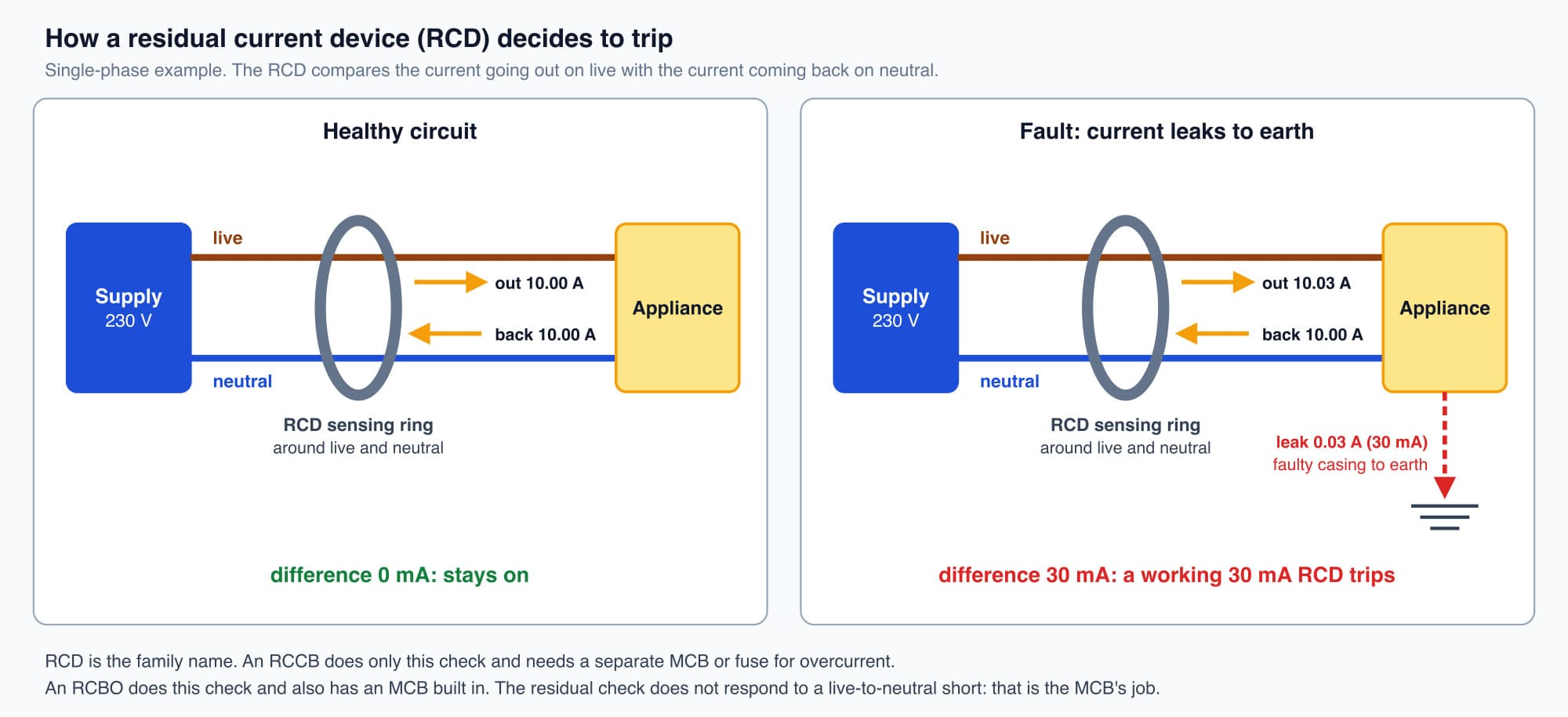
An RCD compares the current going out with the current coming back; a difference means current is leaking to earth.
What Malaysian law requires. Malaysian law sets a maximum rated residual operating current (sensitivity) for RCDs on final circuits, depending on where the circuit is used: 10 mA, 30 mA or 100 mA. The optional detail at the end of this part gives the exact categories. These are maximum ratings, not targets; the designer applies the relevant category. The shoplot shows the pattern: a 100 mA main RCD, 30 mA RCDs on the socket circuits and the kitchen, and 10 mA on the water heater circuit. In the office tower, the socket circuits in DB-12E are on 30 mA RCBOs.
Sensitivity is only part of choosing an RCD. The designer also matches its type to the equipment and coordinates it with the other protection.
The test button. An RCD has a test button marked T. Press it only at the interval set by the manufacturer and the site's maintenance procedure, after arranging for the power interruption, and only where the button is safely accessible without removing a cover. A successful trip checks the device's own test function; it does not prove the earthing is sound. If the RCD does not trip, report it at once so the circuit can be made safe and checked.
Reading a row of breakers, and what to do after a trip
You can now read the row of devices in a distribution board without touching anything inside it:
- A device with a T test button has a residual function: it is an RCCB or an RCBO.
- A letter and number such as B20 or C32 gives the MCB's curve and rated current.
- The breaking capacity is often printed in amps inside a small box, such as 6000 for 6 kA.
- The board's circuit chart, and the single line diagram for larger boards, tell you what each way feeds.
When a breaker trips, note which board and which way it is, the time, and what was running. Follow your site's rules on who may reset it. Never hold a breaker closed, reset it repeatedly or bypass an RCD. A breaker that trips again, or an RCD that keeps tripping, needs to be investigated by a competent person before it is put back into service. A Trip Is a Clue, Part 11 of this course, shows how to record and report a trip.
Optional detail: Regulation 36 of the Electricity Regulations 1994 sets the maximum rated residual operating current for final circuits: 10 mA for public-entertainment equipment serving or available to the public, 10 mA where floors are likely to be wet or walls and enclosures have low electrical resistance, 30 mA where hand-held equipment is used or likely to be used, and 100 mA for other installations, with limited exceptions.
What comes next
A breaker's rated current is chosen to protect the cable it feeds. The next part, Cable Size and Voltage Drop, follows the office tower's power along its cables to a far socket and asks: how is the cable chosen, and why do long cables need to be thicker?
Check your understanding
- The breaker at SSB-R2 that feeds DB-12E is labelled 100 A and 25 kA. What do the two numbers mean? 100 A is the rated current: the current it carries continuously without tripping. 25 kA is its breaking capacity: the largest fault current it can safely interrupt. It needs a high kA rating because the fault current available close to the MSB is much larger than at the end of a final circuit.
- The kettle's cable in the level 12 pantry shorts live to neutral. Which device should open, and why doesn't the residual part of that device respond? The overcurrent part of the 20 A RCBO on the socket circuit should open, and the 100 A, 1,250 A and 2,500 A breakers upstream should stay closed because of discrimination. The residual part does not respond because in a live-to-neutral short the current going out and the current coming back still balance.
Recap: Circuit breakers do two jobs. MCBs, MCCBs and ACBs protect cables from overload and short circuit, and they get larger toward the transformer. RCDs detect current leaking to earth to protect people; an RCCB does only that, an RCBO adds overcurrent protection, and "ELCB" is an older name. Every breaker has a rated current (what it carries) and a breaking capacity in kA (the fault it can interrupt). Discrimination means only the device nearest a fault trips. B, C and D set how large a sudden current an MCB tolerates. Regulation 36 sets maximum RCD ratings of 10, 30 and 100 mA for different situations.
Go deeper on video (optional)
This video explains the difference between overload, short circuit and earth fault. It is American, so it says "ground fault" where Malaysian drawings say "earth fault". It is optional.
"Overcurrent, Overload, Short Circuit, and Ground Fault" by Dave Gordon
This is Part 4 of 11 in Cobler's Building Electrical Fundamentals course. Previous: How to Read a Single Line Diagram. Next: Cable Size and Voltage Drop: Why Distance Matters.
Cobler builds CobiNeural, a platform that shows a facility team its building's energy, water and indoor air data as live numbers across the whole site. To see how your building performs, talk to us.
FAQ
Frequently asked questions
Ask us about this topic
Something in this article you want to dig into — or a situation in your own building it doesn't quite cover? Send us your question. We don't run public comments; the team replies to you directly by email.