Blog
MSB, SSB and DB: Your Building's Electrical Tree
MSB, EMSB, SSB, DB: the acronyms on every electrical drawing are just tiers of one tree. See why a building splits its power instead of running one giant board, and trace your kettle back to the transformer.
 Tan Kok XinBuilding Electrical Fundamentals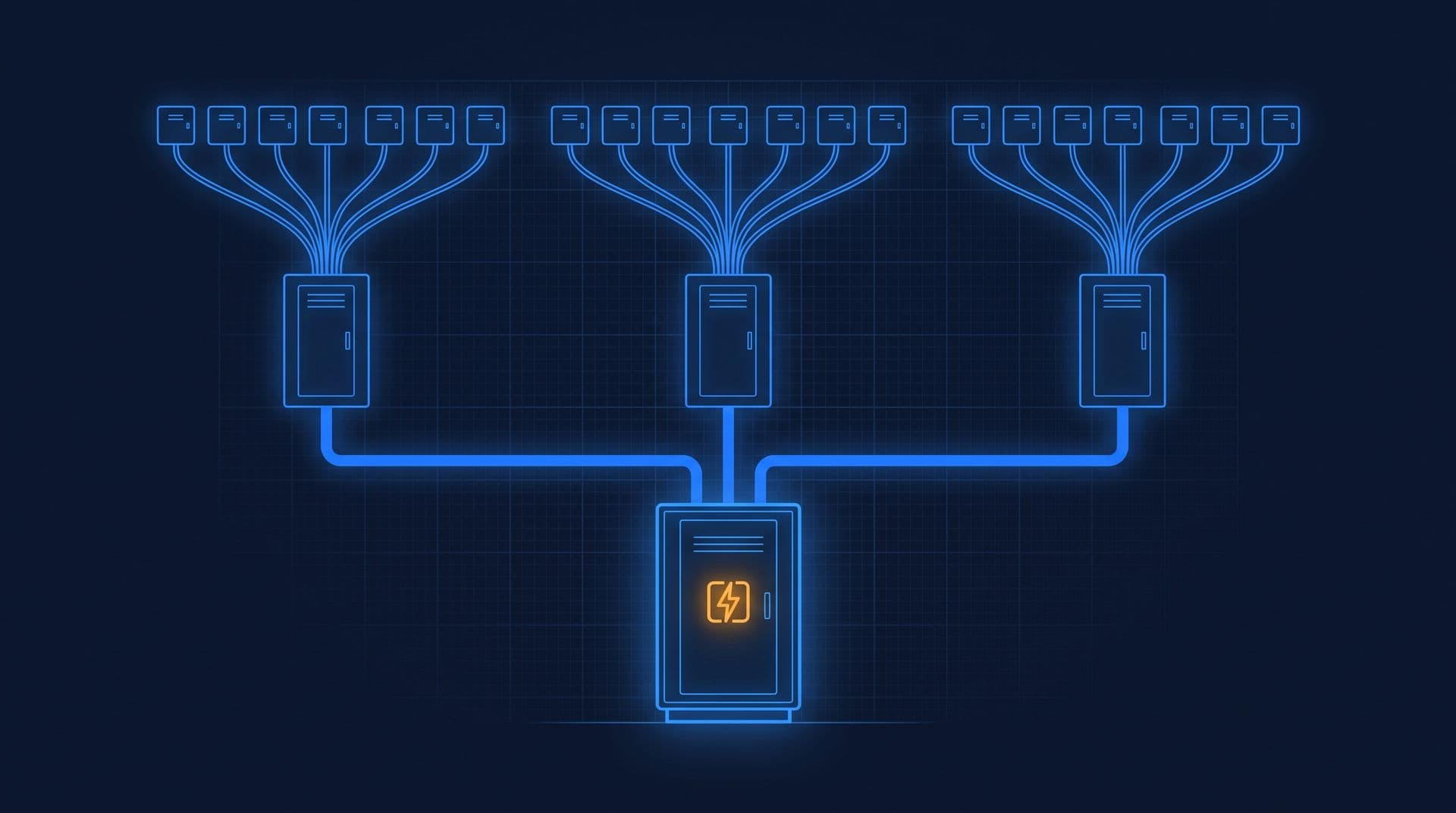
Part 1 of 11 in Cobler's Building Electrical Fundamentals course. New here? See the course page.
Before you start: what this course is, who it is for, and who may touch what. Building Electrical Fundamentals follows electricity through a building, from the point where it arrives to the socket on the wall, and ends with how to report a fault. It is written for facility, admin and operations staff with no electrical training: people who walk the plant rooms, read the drawings and report what they see, but do not do electrical work.
We use two fictional buildings throughout the course, and the numbers for both are illustrative. Our example shoplot is a three-storey building that takes a low-voltage (LV) supply at 400/230 V from a TNB (Tenaga Nasional Berhad) substation down the street. Our example office tower is a 20-storey office block that takes an 11,000-volt (11 kV) supply into its own substation, where its transformers bring the voltage down to 400/230 V for the main switchboard. After this part we call them simply the shoplot and the office tower. If your building is like the shoplot, the next part, on the substation, is optional reading.
Throughout the course, your job is to look, read labels and drawings, and report what you see. Opening a switchboard, switching the main boards and all electrical work are for authorised competent persons registered with Suruhanjaya Tenaga (ST), the Energy Commission, such as the building's chargeman or wireman.
The course assumes you have read these lessons from Cobler's Electricity Fundamentals course: What Is Electricity, Actually?, Volts and Amps, What Is an Electric Circuit?, Earthing and RCDs, Power vs Energy and Three-Phase Power Explained.
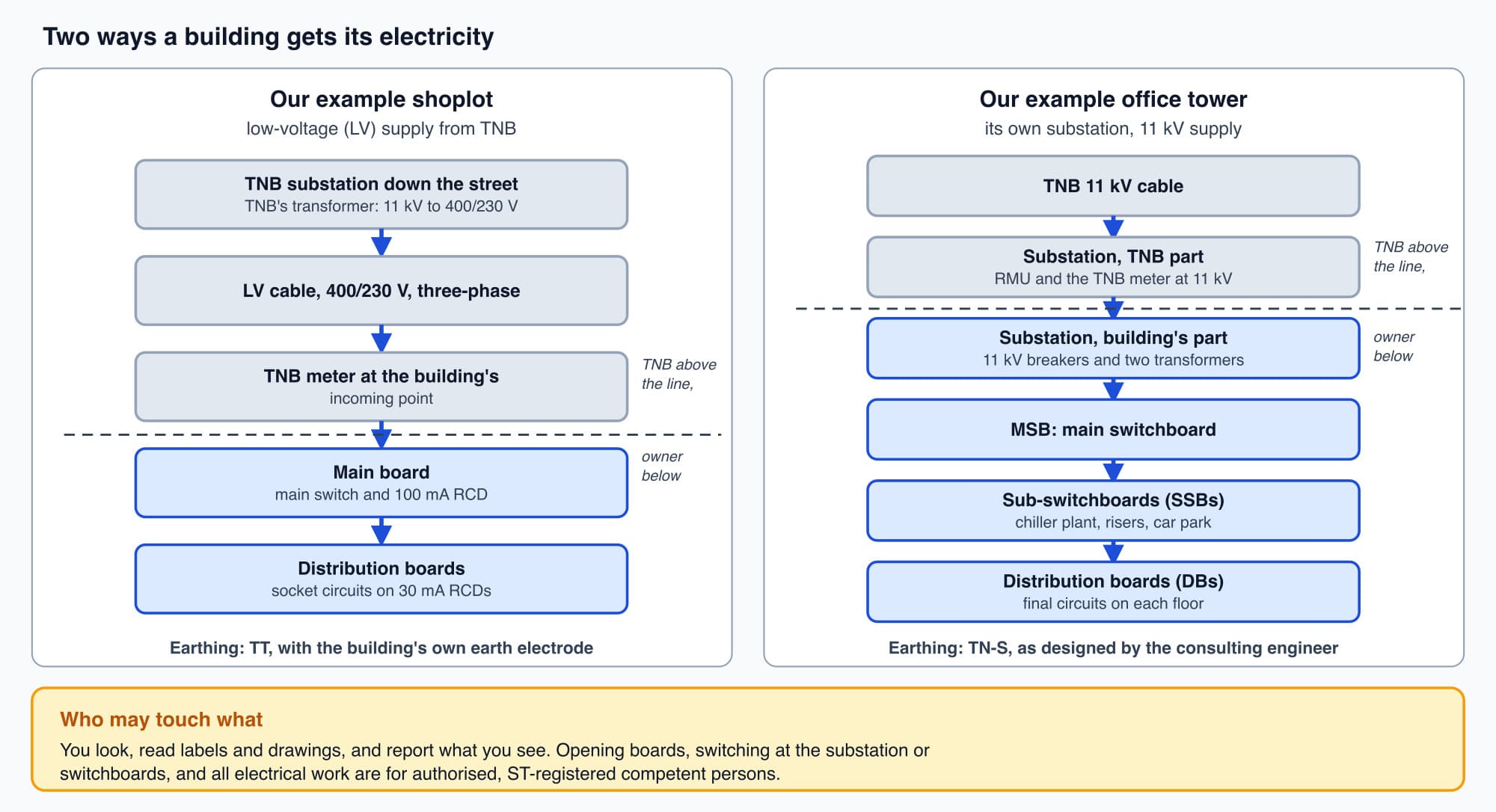
The shoplot receives 400/230 V from TNB's transformer; the office tower receives 11 kV and has its own substation.
Someone posts in the building's WhatsApp group: "Supply tripped at the MSB, levels 11 to 20 gone." Everyone replies with a thumbs up. A consultant's drawing says the riser feeds the SSBs and each floor has its own DB. These letters appear on every electrical drawing, but few people are ever told what they stand for.
So what are the MSB, the SSB and the DB, and why does a building need so many boards instead of one? This part answers both questions, one step at a time.
The supply arrives at one point and has to reach every outlet
All the electricity a building uses comes in at one place. In the shoplot it is the TNB meter at the building's incoming point. In the office tower it is the substation. From that one point, power has to reach every light, socket, pump and lift in the building.
The building shares the power out in stages. A useful comparison is a tree. The trunk is the one board where the supply lands. The branches are boards that each serve one area. The twigs are boards that feed the final circuits in each room. The comparison describes only the shape: the power divides into smaller and smaller parts at each stage. It says nothing about voltage. A twig board still works at 400/230 V; what changes is how much current each board handles.
Each tier has a name, and those names are the letters on the drawing.
The main switchboard (MSB) is the trunk
The main switchboard (MSB) is the first low-voltage board in the building. In the office tower, the supply reaches it from the transformer, the machine that brings the voltage down from 11,000 V to 400 V (Part 2 shows it in its room). The MSB is a row of large steel cabinets in the main switch room.
The MSB has two kinds of circuit breaker. As What Is an Electric Circuit? explained, a breaker opens its circuit when the current becomes too high.
- The incomer is the breaker where the supply enters the MSB.
- The outgoing breakers sit in a row beside it. Each one feeds one branch of the tree.
Now the WhatsApp message makes sense. "Tripped at the MSB, levels 11 to 20 gone" means one outgoing breaker on the MSB opened: the one that feeds levels 11 to 20. Everything below that breaker lost power. Everything fed from the other outgoing breakers stayed on, because the incomer stayed closed.
If an incomer opened instead, everything fed through it would go dark. The office tower has two transformers, and each has its own incomer, so an incomer trip would drop everything on that half of the MSB. Part 3 shows this on the building's drawing.
Sub-switchboards (SSBs) are the branches
A sub-switchboard (SSB) takes power from one outgoing breaker on the MSB and delivers it to one area. The office tower has four:
- SSB-CH for the chiller plant, which makes the chilled water for air conditioning.
- SSB-R1 for riser 1, which serves levels 1 to 10.
- SSB-R2 for riser 2, which serves levels 11 to 20.
- SSB-CP for the car park and mechanical services.
A riser is a vertical shaft that carries cables up through the floors. Without SSBs, the building would need a separate long cable from the main switch room to every area, perhaps fifty of them. With SSBs, one large cable runs to a board near the loads, and the power is divided there.
Distribution boards (DBs) are the twigs
A distribution board (DB) is the grey metal box on each floor, with rows of small breakers behind a hinged cover. It splits the supply into final circuits: one lighting circuit, one row of wall sockets, and so on. It does the same job as the board in a house, on a larger scale.
Each floor of the office tower has two DBs, one for the east half and one for the west. The board for level 12 east is labelled DB-12E. Below a DB there is no more dividing. The next thing along the wire is the appliance.
So the order is: TNB supply, transformer, MSB, SSB, DB, final circuit, appliance. The breakers get smaller at each step down, because each one carries less current than the one above it.
The shoplot's tree is shorter. Its supply goes from the TNB meter to a main board and then to a few DBs. There are no SSBs, because the building is small enough not to need them.
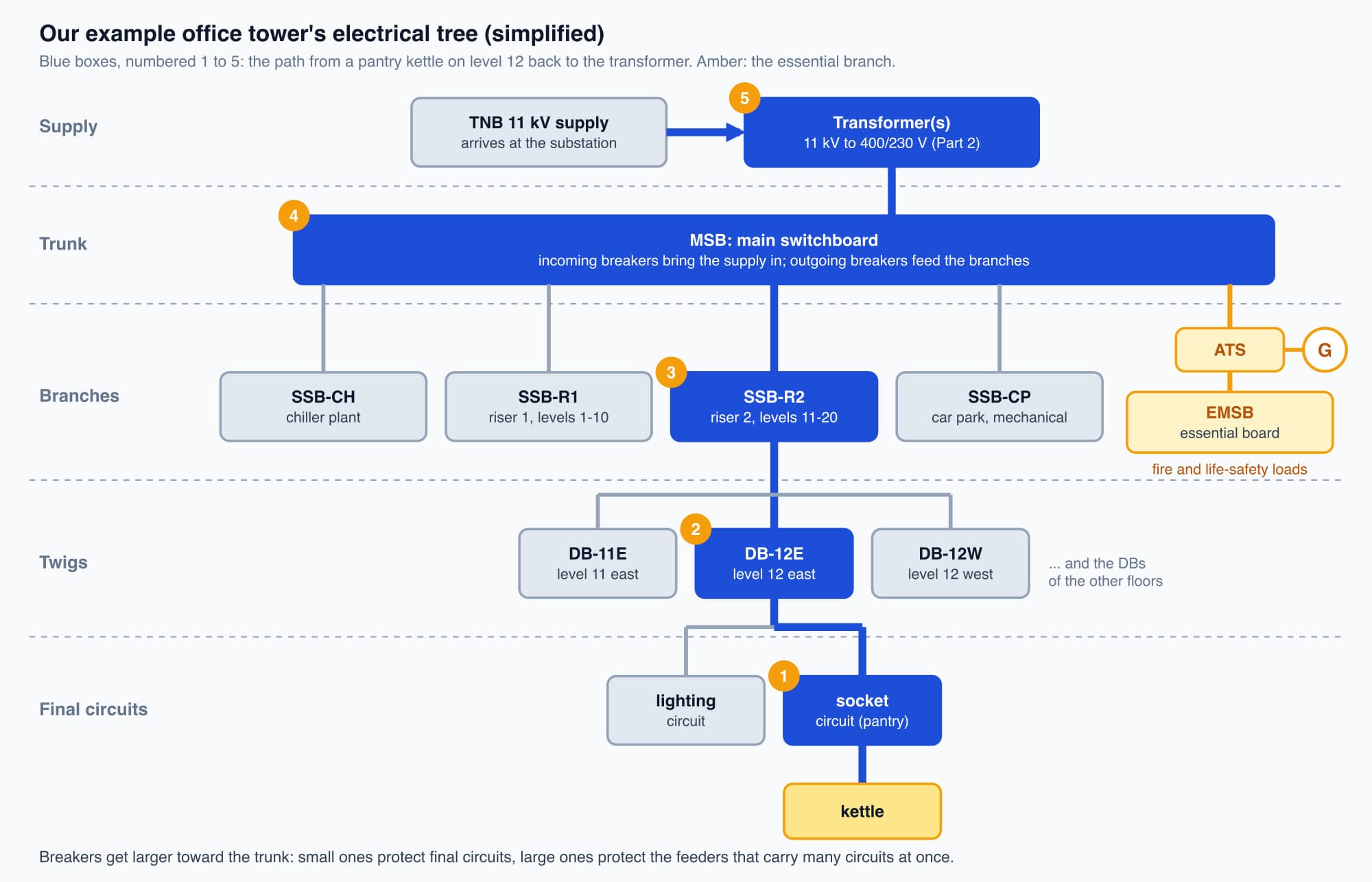
The office tower's tree: one main switchboard, four branches, a DB for each half-floor, and the numbered path from a pantry kettle back to the transformer.
Why not one giant main switchboard?
A single giant board could, in principle, feed every circuit directly. Buildings use a tree for three practical reasons.
1. A fault stays in one place. A short circuit, where live touches neutral, can make the current rise to thousands of amps, as What Is an Electric Circuit? showed. The aim is for only the breaker nearest the fault to open, while everything else stays on. A short in the pantry socket circuit on level 12 should open the small breaker for that circuit in DB-12E and nothing more. Engineers call this selectivity (also called discrimination). Circuit Breaker Types, Part 4 of this course, explains how breakers are chosen and set to achieve it.
2. One area can be switched off for work. Because the chiller plant has its own SSB, an authorised person can isolate that one branch and work on it safely while the offices and lifts keep running. With one giant board, many jobs would mean shutting down the whole building.
3. It uses far less cable. Copper is expensive and heavy. Running one large cable to a board near the loads, then short final circuits from there, uses much less copper than running every light and socket back to the main switch room.
The essential board keeps life-safety equipment supplied
Some equipment must keep working when the TNB supply fails, such as fire pumps and emergency lighting. That equipment is fed from a separate board, the essential switchboard (EMSB), also called the emergency main switchboard. In the tree diagram above it is the amber branch.
In the office tower, the EMSB feeds the fire systems, the fire lift, the stairwell pressurisation fans, emergency lighting, security and the server room. On a normal day it is fed from the MSB like any other branch, through an automatic transfer switch (ATS). When the TNB supply fails, the ATS starts the standby generator and, once it is running, moves the EMSB over to it. That takes a few seconds, so the essential loads are briefly without power.
Some loads cannot stop even for a few seconds, such as the servers in the server room. They are fed through an uninterruptible power supply (UPS), which runs them from batteries during the gap. In the office tower, a 60 kVA UPS on the EMSB feeds the server room.
A building therefore has two trunks: an ordinary one that is allowed to fail safely, and an essential one backed by the generator. When the Mains Fails: Generators, ATS and UPS, Part 8 of this course, explains what happens during a power cut, step by step.
Trace a kettle back to the transformer
Following one appliance up the tree is the quickest way to make it familiar. Take the kettle in the level 12 pantry and use the numbered boxes in the tree diagram.
- The kettle is plugged into a socket on a final circuit. That circuit has its own small breaker.
- The breaker sits in DB-12E, the level 12 east distribution board in the corridor.
- DB-12E is fed by a cable in riser 2 from SSB-R2, the sub-switchboard for levels 11 to 20.
- SSB-R2 is fed by one outgoing breaker on the main switchboard in the main switch room.
- The MSB's incomer is connected to one of the two transformers in the substation. The transformer is connected, through the substation's switchgear (its high-voltage switches and breakers), to the TNB supply arriving from the national grid.
That is five steps from a pantry kettle to the TNB supply, and each one now has a name.
The whole tree is drawn on one sheet
The tree is drawn on a sheet called a single line diagram. It shows the whole three-phase system as if each circuit were a single wire. One page shows the path from the incoming supply through the MSB to every SSB and DB, with breaker ratings and cable sizes written along the way.
In Malaysia, the law requires this drawing to be displayed near the switchboard. How to Read a Single Line Diagram, Part 3 of this course, teaches you to read one, using the drawing of the office tower.
Worth knowing: Drawings from different consultants use different names for the same tier. Some label the sub-switchboards MDB or SMDB instead of SSB; it is the same branch of the tree with a different name. The drawing's legend tells you which names it uses.
Optional detail: The Electricity Regulations 1994 require a clearly drawn diagram of the connections to be displayed near the switchboard, so that the course of each conductor can be traced (P.U.(A) 38/94, Regulation 19). The essential board exists because the Uniform Building By-Laws 1984 (By-law 253) require an emergency power system for the equipment needed for the safety of people and property.
What comes next
The tree starts where the supply enters the building. In the office tower, that is the substation: a locked room where the 11 kV supply is switched, measured and brought down to 400 V before it reaches the MSB. The next part, Inside the Consumer Substation, walks through that room. If your building is fed at 400/230 V like the shoplot, you can skim it and go on to Part 3. The substation part starts from one question: what is in that room, in what order does the power pass through it, and who is allowed to touch it?
Check your understanding
- The message says "tripped at the MSB, levels 11 to 20 gone", but the rest of the building still has power. Which breaker most likely opened? One outgoing breaker on the MSB: the one feeding SSB-R2, which serves levels 11 to 20. The incomer stayed closed, so every other branch kept its supply. If an incomer had opened, everything on that half of the MSB would have gone dark.
- During a TNB power cut, why do the fire pumps stop for a few seconds while the servers do not stop at all? The fire pumps are on the EMSB. The ATS moves the EMSB to the generator only after the generator is running, which takes a few seconds. The servers are fed through the UPS, which runs them from batteries during that gap.
Recap: A building's power is divided like a tree. The main switchboard (MSB) is the trunk, sub-switchboards (SSBs) are the branches, distribution boards (DBs) are the twigs, and final circuits feed the appliances. The tree keeps faults local, lets one area be switched off for work, and saves cable. The essential board (EMSB) is moved to the generator by the ATS after a short gap, and a UPS covers loads that cannot stop at all. The whole tree is drawn on the single line diagram.
Go deeper on video (optional)
This short video from a switchgear maker shows the inside of a switchboard. It uses UK terms, and you do not need it for the next part.
"Switchboard Basics" by Siemens Electrical Products GB&I
This is Part 1 of 11 in Cobler's Building Electrical Fundamentals course. Next: Inside the Consumer Substation: The Locked Room.
Cobler builds CobiNeural, a platform that shows a facility team its building's energy, water and indoor air data as live numbers across the whole site. To see how your building performs, talk to us.
FAQ
Frequently asked questions
Ask us about this topic
Something in this article you want to dig into — or a situation in your own building it doesn't quite cover? Send us your question. We don't run public comments; the team replies to you directly by email.