Blog
BMS Sensors and Actuators: A Building's Senses and Muscles
How BMS sensors and actuators work: the temperature, humidity, CO2 and flow sensors that see, and the valves, dampers and drives that move air and water.
 Tan Kok XinBuilding Automation & BMS Fundamentals
Part 2 of 16 in Cobler's Building Automation and BMS Fundamentals course. New here? See the course page.
In Part 1 we saw that a building management system (BMS) works in a loop: it senses a condition, decides against a target, and acts on the equipment. But a BMS is software running on small computers. It cannot feel how warm a room is, and it cannot turn a valve by itself. So how does it measure the building, and how does it move anything?
It relies on two families of hardware fixed to the equipment. Sensors do the sensing. Actuators do the acting. This part looks at BMS sensors and actuators in turn, using AHU-12A, the air handling unit (AHU) on level 12 of the office tower.
A sensor turns a condition into a signal the controller can read
A sensor is a device that turns a physical condition, such as a temperature or a pressure, into an electrical signal. The controller in a BMS only understands electrical signals. The sensor is the translator between the two.
Take the return air temperature sensor on AHU-12A from Part 1. It sits in the duct that brings air back from the level 12 offices. As the air warms or cools, the sensor's electrical signal changes, and the controller converts that signal back into a number: 25 °C, for example.
The sensors a BMS relies on
Each sensor in a BMS exists so the controller has something to compare with a target. The target is called the setpoint, as in Part 1. If the room air reads 26 °C and the setpoint is 24 °C, the controller knows the room is not cool enough. Without the sensor, the setpoint is only a wish.
These are the sensors a typical BMS relies on:
- Temperature. The most common sensor in any building. It measures the temperature of air in a room, air in a duct, or water in a pipe. A typical cooling setpoint in a Malaysian office is about 24 °C. The chilled water temperature sensors in the plant room matter even more, as the next section shows.
- Relative humidity. In Malaysia's climate, humidity matters as much as temperature for comfort. A humidity sensor reports how much moisture the air holds, as a percentage of the most it could hold at that temperature (relative humidity, RH). Malaysia's Industry Code of Practice on Indoor Air Quality 2010 (ICOP IAQ 2010, from the Department of Occupational Safety and Health) gives 40 to 70% RH as the acceptable indoor range, alongside 23 to 26 °C. Many designers aim for 50 to 60% within that range. At the humid end, a room feels clammy even when the thermometer says it is cool.
- Pressure. Air ducts and water pipes both have pressure sensors. A duct pressure sensor tells the system how hard the fan is pushing the air, which lets the BMS run the fan only as fast as it needs to. A water pressure sensor does the same for the pumps on a chilled water system. A related sensor measures the filter differential pressure, the pressure difference across a filter: as the filter collects dust, the air finds it harder to pass through, and the difference rises.
- Carbon dioxide (CO2). People breathe out CO2, so the CO2 level in a room shows roughly how many people are in it. A CO2 sensor lets a BMS bring in as much fresh outdoor air as the people need, and no more. Too little fresh air and the room feels stuffy. Too much and the building spends energy cooling and drying hot, humid outdoor air for no reason.
- Water flow. A flow sensor, or flow meter, measures how much water moves through a pipe, usually in litres per second. On a chilled water system this is one of the most useful measurements in the building, because flow together with temperature tells you how much cooling is being delivered.
- Electrical power and energy. A power meter measures the kilowatts (kW) a piece of equipment draws at this moment and the kilowatt-hours (kWh) it has used over time. This is how a BMS knows what its decisions cost. If the difference between the two is unclear, the Electricity course explains it in Power vs Energy: kW and kWh Explained.
AHU-12A has four of these measurements. Sensors read the return air temperature, the supply air temperature (the air leaving the AHU towards the offices) and the filter differential pressure. A fourth signal, the fan status, confirms whether the supply fan is actually running. Part 6 explains which device should provide that signal.
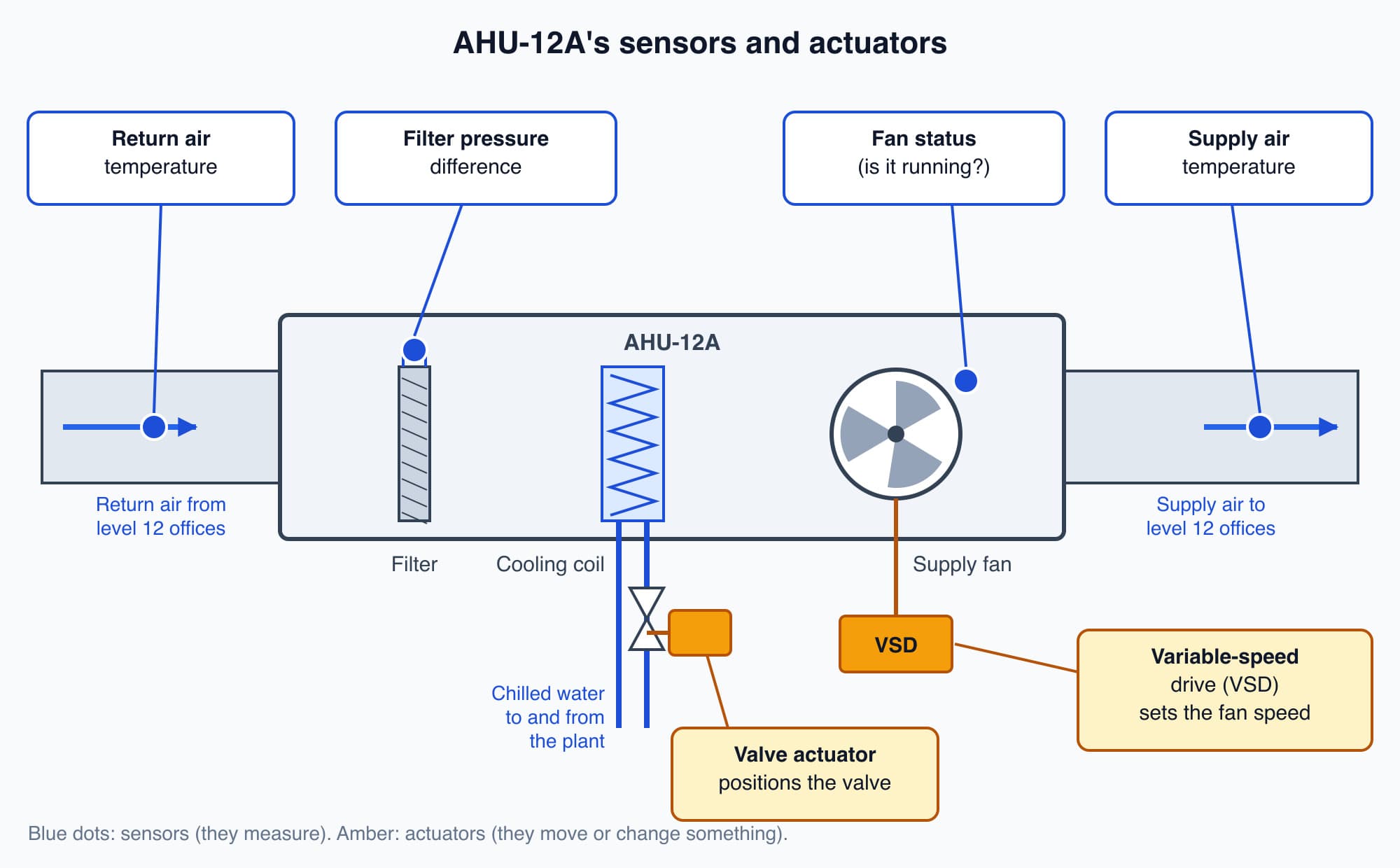
AHU-12A's sensors (blue) measure the air and the filter; its actuators (amber) move the chilled water valve and set the fan speed.
A sensor can be wrong without looking wrong
A reading is only useful if it is accurate, and sensors do not stay accurate forever. Their readings slowly drift over time. Calibration means checking a sensor against a known reference and correcting it. It has to be repeated at intervals.
A drifted sensor usually shows a number that looks reasonable, so nobody notices. Consider the chilled water plant. It judges how much cooling it delivers from the difference between the temperature of the chilled water going out to the building (supply) and the water coming back (return). That difference is called delta-T. In the office tower, the design supply is 6 °C and the return is 12 °C, so the delta-T is 6 °C.
Now suppose the return water sensor has drifted and reads 1 °C lower than the truth: 11 °C instead of 12 °C. The plant now calculates a delta-T of 5 °C instead of 6 °C. Its estimate of the cooling delivered is about one-sixth too low, and it may run pumps and chillers harder or softer than it should. That wastes energy or leaves parts of the building short of cooling. Part 12 shows how the chiller plant uses delta-T.
Actuators turn a decision into movement
If sensors let the BMS measure the building, actuators let it act. An actuator turns a controller's command into physical movement. The controller says "open a bit more", and the actuator pushes something open.
Most actuators in a building do one of three jobs: turn a water tap, turn an air tap, or change a speed.
The water tap: control valves
A control valve controls how much water flows through a pipe. On AHU-12A, a control valve on the chilled water pipe sets how much chilled water flows through the cooling coil, and so how much heat the coil takes out of the air passing over it. Open the valve further and more chilled water flows, so the air leaving the coil gets colder.
This is not a simple on/off tap. A modulating control valve can sit at any position between closed and fully open, so the controller can ask for exactly 37% of full flow if that is what the offices need.
The part that moves the valve is the valve actuator: a small motorised device clamped to the top of the valve. It is usually powered at 24 V AC and takes a small control signal from the controller. Its one job is to move the valve to the position it was told and hold it there.
The air tap: dampers
A damper controls how much air flows along a duct. It is a set of blades inside the duct that pivot open and closed, like a Venetian blind. Dampers decide how much fresh outdoor air enters, how much stale air is exhausted, and how air is shared between areas. Like a valve, a modulating damper can sit at any position.
A damper is moved by a damper actuator. This is also a small, low-voltage device that positions the blades.
The speed dial: variable-speed drives
The third kind of actuator changes speed.
A fan or pump is turned by an electric motor. The simplest way to run a motor is on or off: full speed or nothing. A variable speed drive (VSD), also called a variable frequency drive (VFD) or an inverter, sits between the electricity supply and the motor. It lets the controller run the motor at any speed from slow to full.
This matters for energy. A fan running at half speed uses far less than half the power, so easing a fan off saves much more than its speed reduction suggests. Part 13 explains where those savings come from and what limits them. AHU-12A's supply fan has a VSD, so the BMS can set its speed. To see how a drive works inside, the Electricity course explains it in Power Electronics: Rectifiers and Inverters Explained.
The actuator is not the motor
This distinction is easy to get wrong, and it comes up throughout the course, so we set it out once here.
A valve actuator or damper actuator is a small, low-voltage positioning device. It takes the controller's command and moves a valve or a damper to the right position. That is all it does.
The pump, fan or compressor is a different machine. In a commercial building it is usually a three-phase motor on the 400 V supply, and it does the heavy work of moving air and water around the building. AHU-12A's supply fan motor, for example, draws about 6 kW. The BMS does not power that motor. It sends a command to the motor's variable speed drive, or to a starter (a switch that turns a fixed-speed motor on and off). The drive or starter takes its power from the building's switchboard and runs the motor.
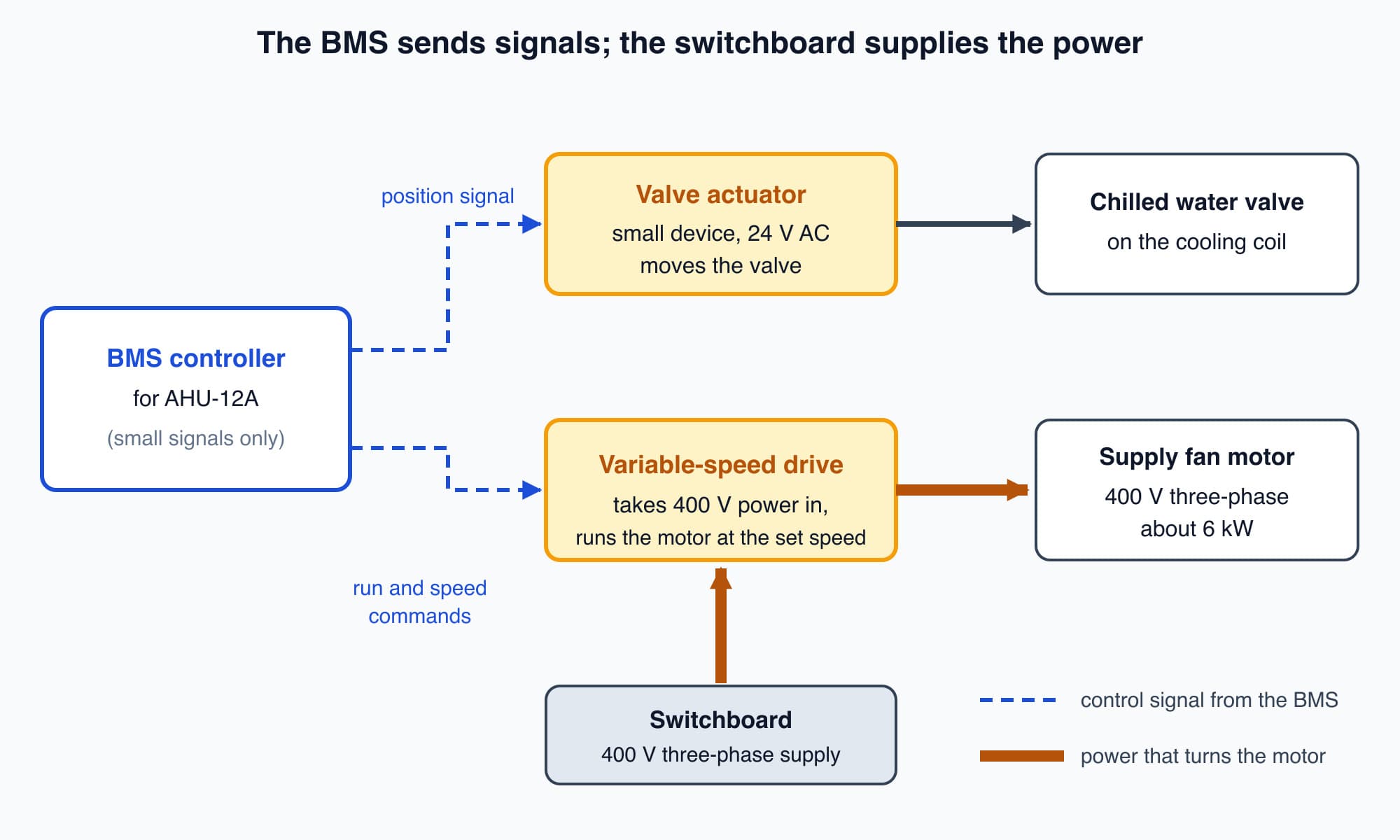
The controller sends small signals; the power that turns the fan motor comes from the switchboard, through the drive.
So keep two things apart:
- The valve or damper actuator is a small 24 V device that positions a tap.
- The pump, fan or compressor motor is a three-phase 400 V load that does the heavy work, run through a drive or starter.
Mixing up the small actuator and the large motor leads to wrong drawings and wrong decisions, such as expecting a BMS output to power a motor directly. This course keeps the two apart from here on.
Two kinds of signal: analogue and digital
Every signal in the sections above is one of two kinds.
- An analogue signal is a value that can vary smoothly across a range. A temperature of 18.4 °C, a humidity of 55% and a valve at 63% open are analogue values. Most sensor readings and most modulating commands are analogue.
- A digital signal, also called binary, has only two states: on or off, running or stopped, alarm or no alarm. A fan is either commanded to run or not, and a pump either reports that it is running or it does not.
AHU-12A uses both at the same time. Its controller reads analogue air temperatures and an analogue filter differential pressure. It sends an analogue position command to the chilled water valve and an analogue speed command to the fan's drive. It also sends a digital run command to the fan and reads a digital signal confirming that the fan is actually running.
The difference matters because it decides how each device is wired to the controller and counted. Part 3 shows that a controller's size is described by how many of each kind of signal it can handle.
Worth knowing: A BMS cannot be smarter than its worst sensor. A drifted sensor usually shows a number that looks reasonable, so nobody notices, and every decision that uses it goes wrong in the same direction. That is why sensors are calibrated at intervals, not only when they are installed.
Optional detail: A three-phase motor is a 400 V load, measured between the supply lines. Electrical equipment is often marked "400/230 V". The 230 V is the voltage between one line and neutral, used by single-phase equipment such as lights and sockets, not by the motor. Very large centrifugal chillers may be fed at medium voltage instead of 400 V. If three-phase supply is new to you, see Three-Phase Power Explained; the motors themselves are covered in How Electric Motors Work. You do not need either for the rest of this course.
What comes next: the controller in the middle
We now have the sensors that measure AHU-12A and the actuators that move it. The next part, Controllers, DDC and I/O Points, explains the controller and how every sensor and actuator connects to it. It opens with the question this part leaves: what sits between the sensors and the actuators and makes the decisions, and how is each device connected to it?
Check your understanding
- AHU-12A's chilled water valve actuator and its supply fan motor both "move" something. Why are they treated so differently? The valve actuator is a small 24 V device that positions the valve on the controller's command. The fan motor is a three-phase 400 V machine, about 6 kW here, that does the heavy work of moving air. The BMS sends the motor's drive a command; the power comes from the switchboard through the drive, not from the BMS.
- A chilled water return sensor reads 1 °C low. Why does this matter when the number on the screen looks normal? The plant judges the cooling it delivers from the supply-to-return difference (delta-T). With a 6 °C design delta-T, a 1 °C error makes the calculated delta-T 5 °C, so the cooling estimate is about one-sixth too low. The plant may then run pumps and chillers wrongly, wasting energy or short-changing the building.
Recap: Sensors turn physical conditions (temperature, humidity, pressure, CO2, water flow, electrical power) into signals the controller can read, so it can compare them with setpoints. Sensors drift and need calibration, and one wrong sensor can mislead every decision that uses it. Actuators turn commands into movement: modulating valves control water, dampers control air, and variable-speed drives set fan and pump speeds. A valve or damper actuator is a small 24 V device; the pump, fan or compressor motor is a separate three-phase 400 V machine run through a drive or starter. Signals are either analogue (a varying value) or digital (on or off).
Go deeper on video (optional)
This video shows the sensors, valves and dampers on a real air handling unit, the same kinds of devices we placed on AHU-12A. It is optional: you do not need it for the next part.
The MEP HVAC channel walks through how a building management system reads its air-handling-unit sensors and drives the valves and dampers that actually move the air and water.
This is Part 2 of 16 in Cobler's Building Automation and BMS Fundamentals course. Previous: What Is a Building Management System (BMS)? A Plain-Language Start. Next: Controllers, DDC and I/O Points: The Brain Behind the BMS.
Cobler builds CobiNeural, a platform that shows a facility team its building's energy, water and indoor air data as live numbers across the whole site. To see how your building performs, talk to us.
FAQ
Frequently asked questions
Ask us about this topic
Something in this article you want to dig into — or a situation in your own building it doesn't quite cover? Send us your question. We don't run public comments; the team replies to you directly by email.